Archive for the ‘Cavendish Laboratory’ Category

The Cambridge Science Tour

The Cambridge Science Tour
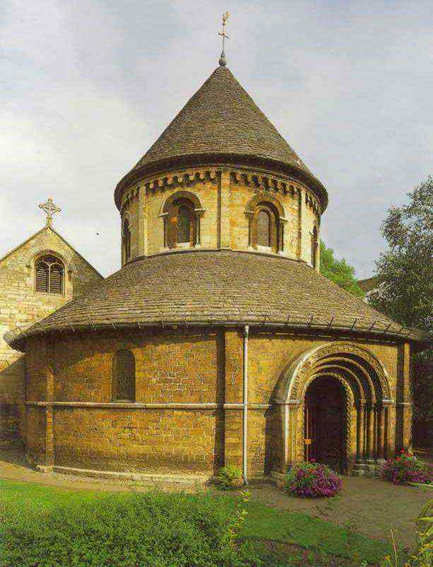
The Round Church Cambridge Photo credit: Noles1984, CC BY-SA 3.0, https://commons.wikimedia.org/w/index.php?curid=4404128

Just under two years ago in 2024, my brother, cousin and brother-in-law and I were given the Cambridge Spies tour by Sophie Smiley. It was the third time I had taken that tour with different guides and I really enjoyed Sophie’s version.

Cambridge Spies Tour Revisited | Fenlandphil’s Blog

Sophie mentioned at the time that she also did other tours and that the Science Tour might interest us. It did interest us, and eventually we got our heads together and booked the tour. The A bus from St Ives Park and Ride dropped us off at the Round Church a little after 11 am, which gave us an hour before our arranged rendezvous with Sophie outside the church at noon.

As we had a bit of time on our hands, a cuppa could be squeezed in before meeting up with Sophie at noon; the café was next to Portugal Place- well, that’s what the sign said. It was a narrow pathway between another, not-round church, St. Clement’s and Bridges Café, where we were enjoying a cuppa. I had seen Portugal Place on the telly in an episode of Professor T and persuaded my companions to join me for a walk through it, so we could see the house where the professor’s aunt lived. We had a very difficult time finding toilets in the area, but a portaloo answered the call eventually, and it was then time to meet up with Sophie.
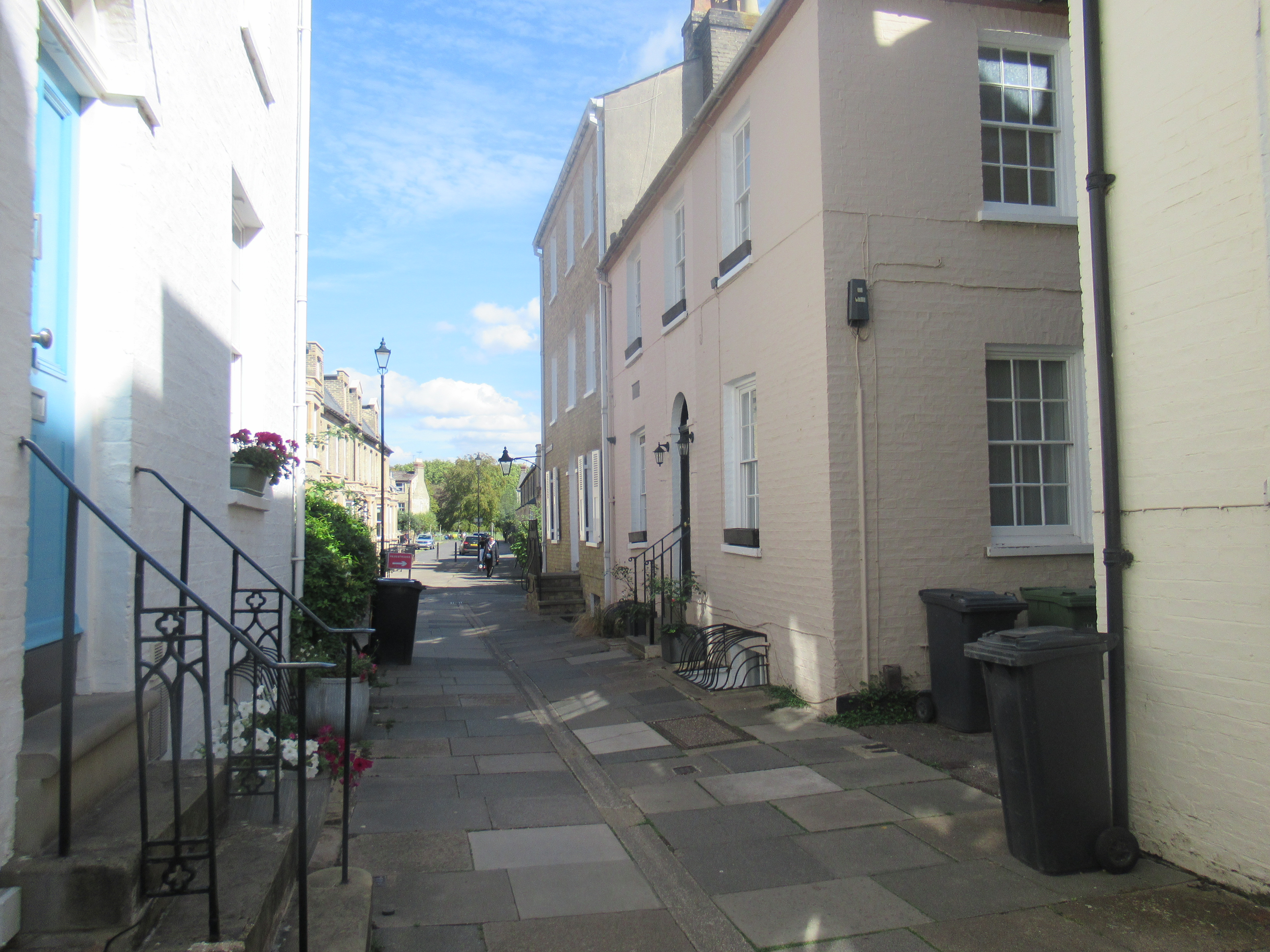
Portugal Place

We had a brief chat with Sophie outside the church, and she showed us an early map of how the city had looked in the early thirteenth century. This was when a group of students escaped to Cambridge from Oxford in 1209 to avoid capture by its townspeople after a dispute. The number of churches crowded into such a small area was, and still is, quite remarkable. Many of these churches provided the bases for the colleges some of which bear their names and are integral parts of Cambridge University.

Sophie led us down Round Church Street until we turned into, I think, Park Street before re-entering Portugal Place, then walking along until we stopped outside Francis Crick’s house with its double helix sculpture above the door.
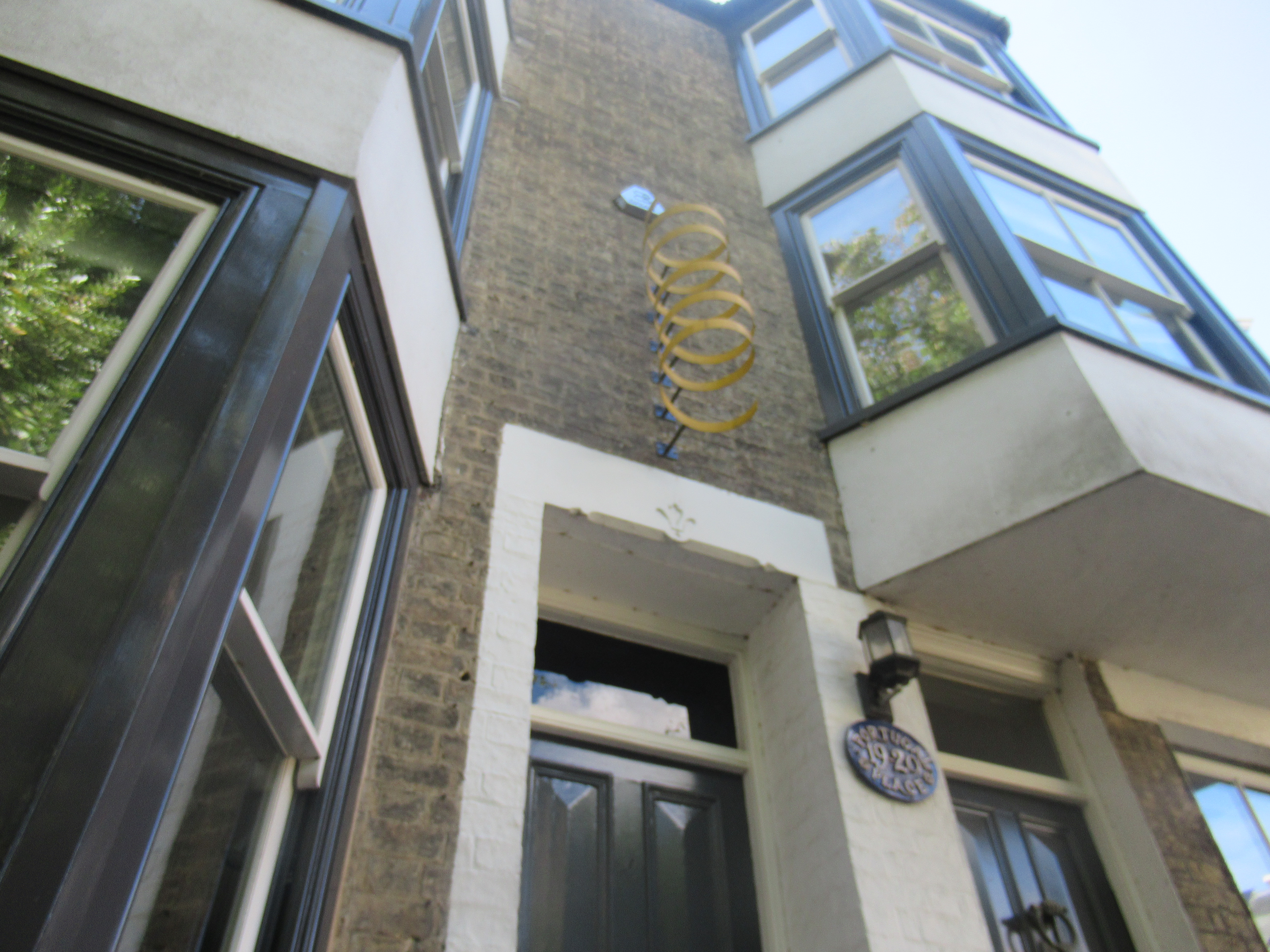
Francis Crick’s House in Portugal Place

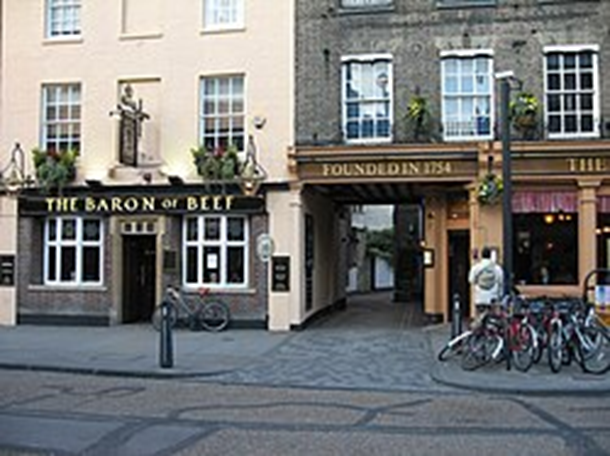
Emerging from Portugal Place, having passed St. Clement’s church, it was back onto Bridge Street and a walk past the Baron of Beef pub and its next-door neighbour, the Mitre. Sophie told us about the fight there between Clive Sinclair and Chris Curry, when Curry told Sinclair he was leaving to join Acorn Computers.
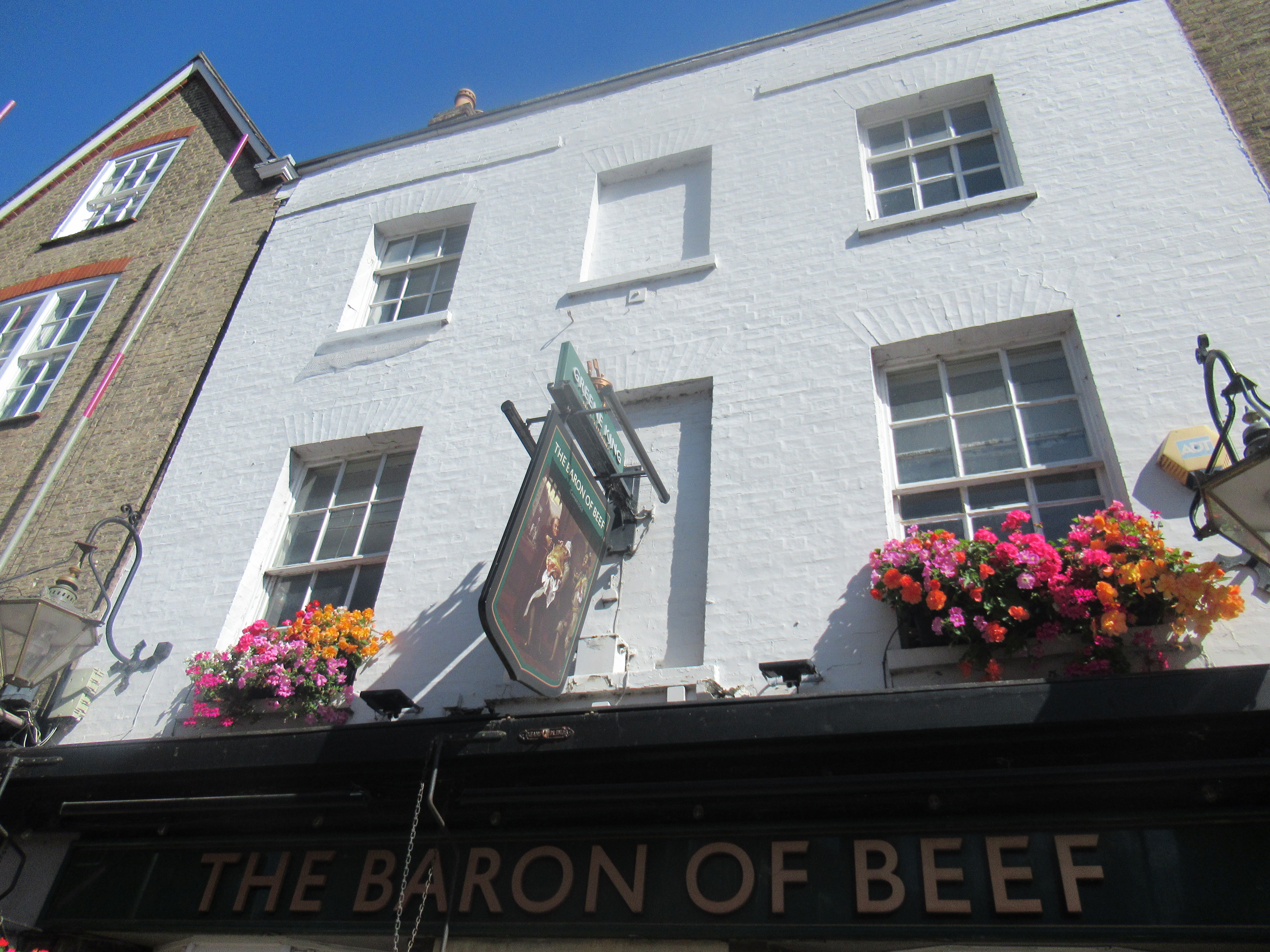
The Baron of Beef

This is a better picture, one showing both pubs. (Picture credit Hans Wolff, Public domain, via Wikimedia Commons)

Having passed the two pubs, we crossed Bridge Street and walked into St John’s Street. I had seen these objects embedded in the pavement before, but helpfully, Sophie was able to tell me what they were.
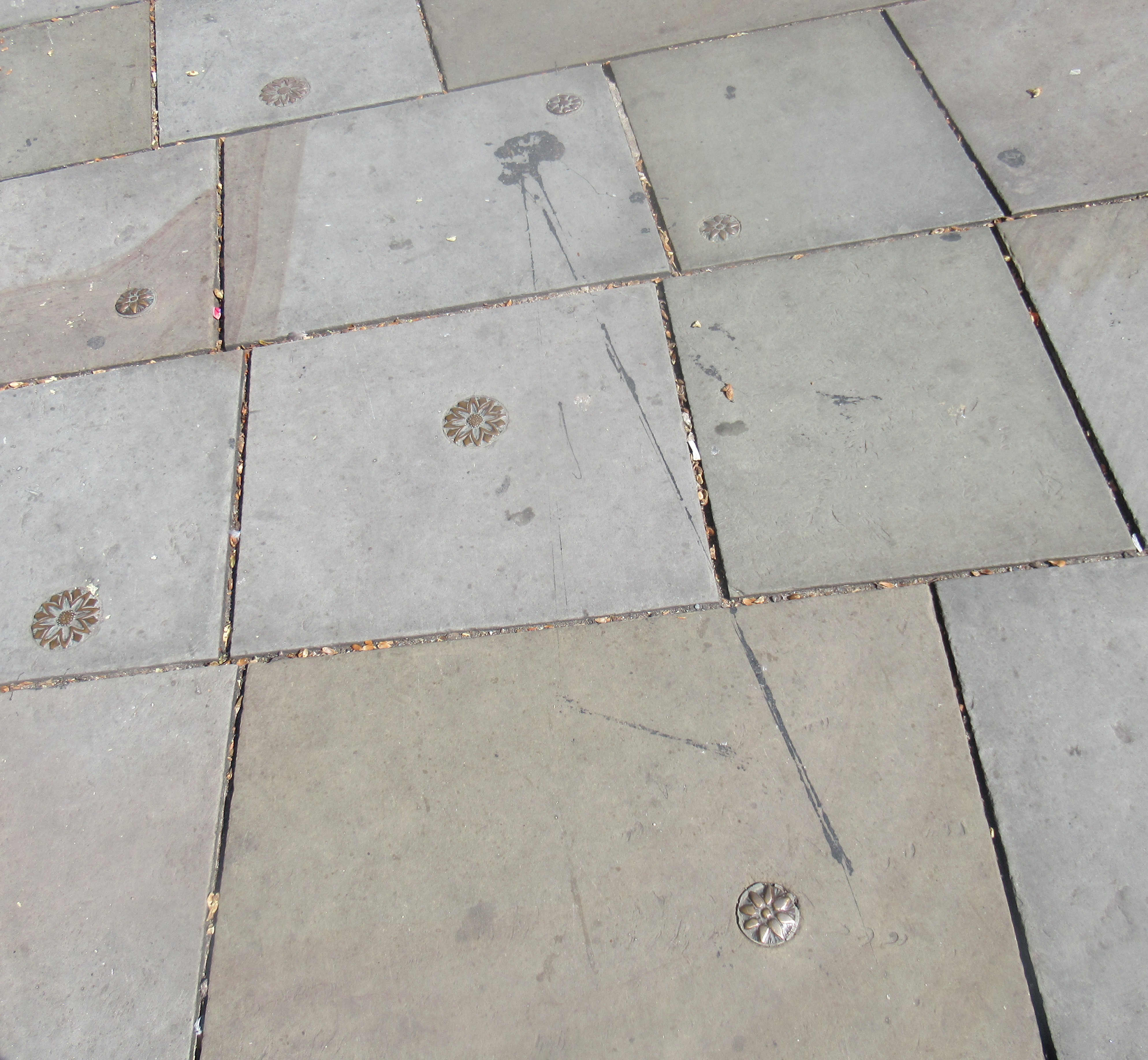
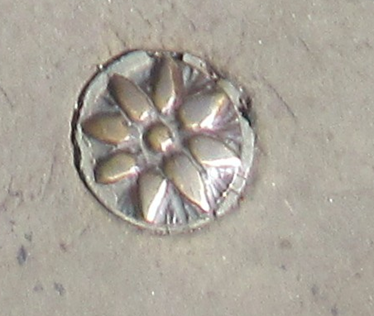
The objects in the pavement
Close up of one of the medallions

The Flower Trail leads to the gates of St John’s College. I did a bit more research, and there are 600 flowers on the pavements. Not just on St John’s Street but on others around the city. The flower designs are used in decorations on the gates of St John’s and other buildings.  The artist who designed them is Michael Fairfax. The college was founded by Countess Margaret Beaufort.
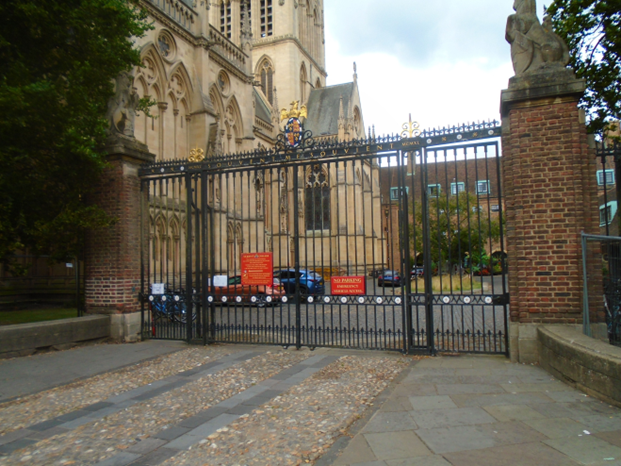
Gates of St John’s College incorporating the medallion designs.
Photo credit: Jo Edkins, 2025

Douglas Adams, author of The Hitchhiker’s Guide to the Galaxy, attended St John’s College. He also based one of his shorter stories, in The Salmon of Doubt, on St John’s College, renamed St Cedd’s. It was also the college of Maurice Wilkins (DNA), Roger Penrose (Black Holes), Frederick Sanger (Biochemist), Max Born and Paul Dirac (Quantum Theory). Also much earlier, the college of the polymath John Herschel.
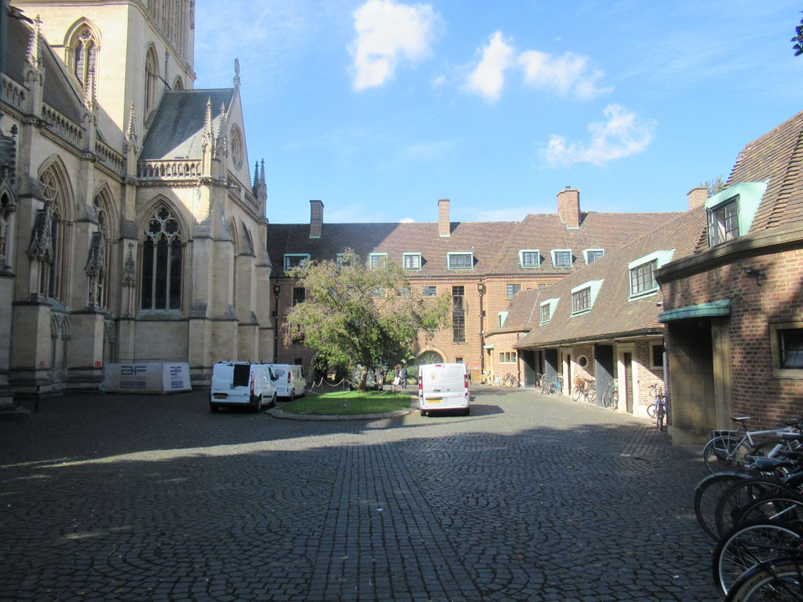
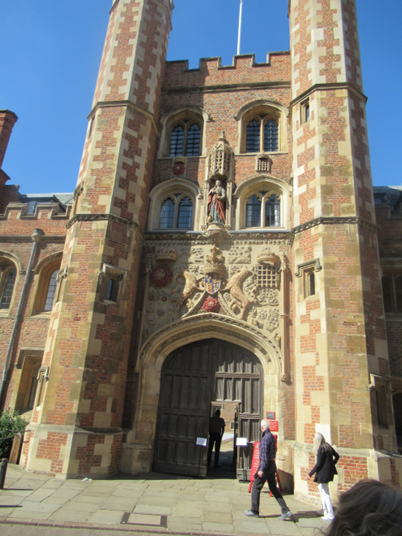
The other side of the gates at St John’s College
The main gate to St John’s College. The statue is that of the Saint John the Baptist.
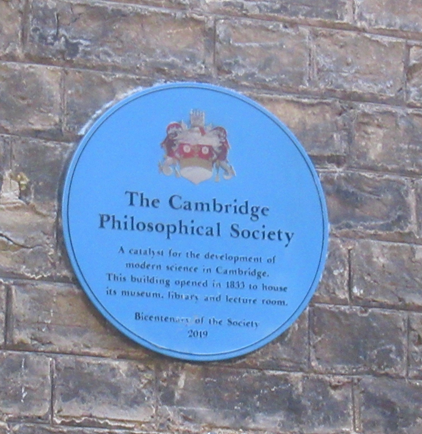
The blue Plaque in All Saints Passage

Having lingered at St John’s College and the pavement inspection, it was time to move further on along St John’s Street, then into All Saints’ Passage. The blue plaque marked the site of the Cambridge Philosophical Society’s early meeting place, library and museum.

As we were leaving All Saints’ Passage, we spotted one of Cambridge’s Dinky doors.
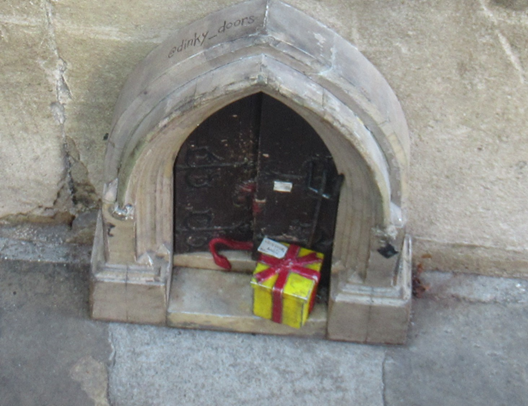
The Dinky Door in All Saints Passage

At the end of All Saints’ Passage, we crossed St John’s Street to Trinity College, stopping briefly to look at Newton’s apple tree-well, one grafted from one at Woolthorpe Manor.
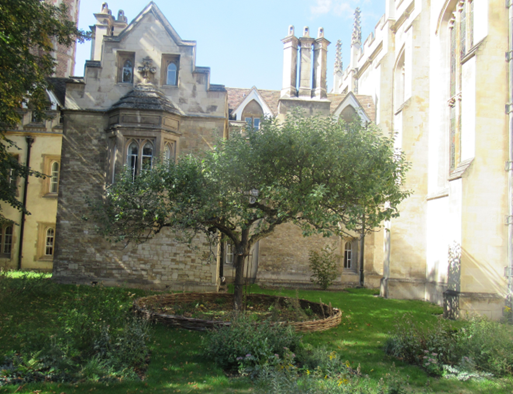
Newton’s Apple Tree.

Trinity College’s great Gate stood in front of us, with Henry the Eighth’s statue as its founder standing centrally within its brickwork. Enterprising students regularly swap his sceptre for other objects, most notably a chair leg. Trinity’s most famous member was Sir Isaac Newton; other notable scientific alumni include Ernest Rutherford (physicist), James Clerk Maxwell (physicist), Niels Bohr (physicist), Charles Babbage (polymath) and Srinivasa Ramanujan Iyengar (mathematician).
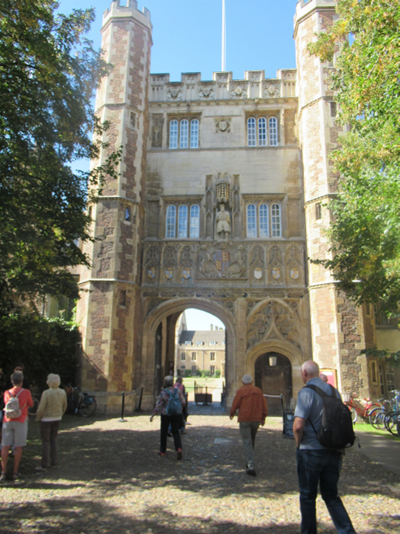
Trinity College’s Great Gate

Our next point of call was Gonville and Caius College, where Francis Crick had studied and had, amongst its other alumni, physicists: Thomas Allibone, Sam Edwards and Basil Schonland. Mathematicians: Eugenia Cheng, John Venn and George Green, together with Ed Anderson, (chemist), George Thomas Bettany (biologist) and Robert Percival Cook (biochemist).
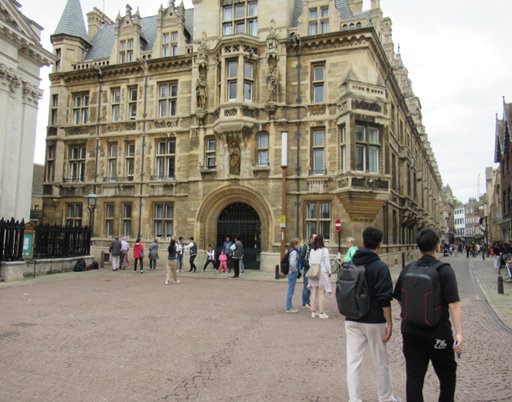
Gonville and Caius College

We carried on along King’s Parade, stopping briefly outside King’s College to learn that mathematician Alan Turing had studied here, as had chemist Frederick Sanger and physicist Patrick Blackett. 

The next stop was the Eagle in Benet Street to look at the blue plaque celebrating the discovery of DNA.
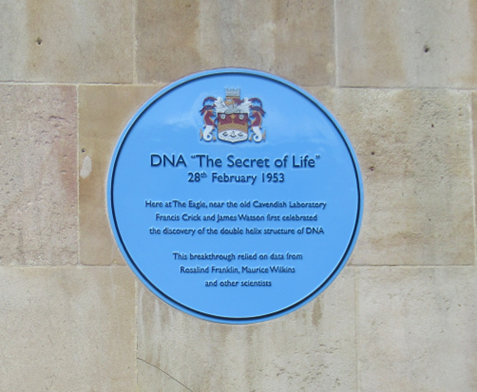
The Blue Plaque on the Eagle public house.

Our last stop was at the site of the original Cavendish Laboratory in Free School Lane, just across the road from the Eagle. As Sophie reminded us, this was where the secret of life was discovered with the discovery of DNA and the means to end it with splitting the atom. Cathy’s father had worked here as a laboratory technician, describing himself as Rutherford’s tea boy.
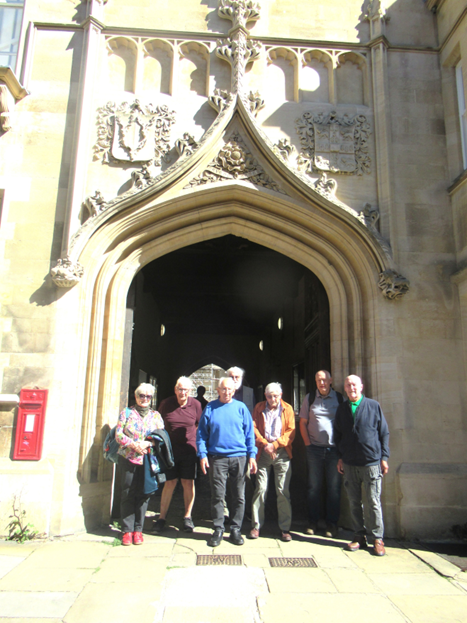
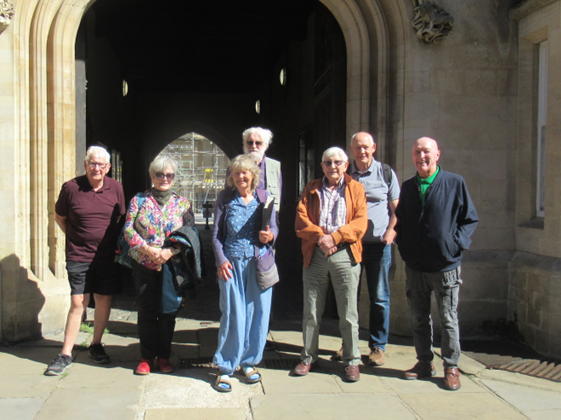
Outside the entrance to the original Cavendish Laboratory
And with our guide Sophie smiley in the centre.

We concluded our day with a late lunch in the Bath House on Benet Street before heading for Drummer Street and the guided bus back to St Ives.

It was a great day out with excellent company and an excellent tour guide. I wish I could have remembered more of the information Sophie gave us.

Thanks to Jo Edkins for the use of her photo; it saved me a trip back to Cambridge.

Exploring the Mullard Radio Astronomy Observatory (MRAO): A Fascinating Tour

Visit to the Mullard Radio Telescope

The Cambridge Astronomical Association had organised the tour of the Mullard Radio Telescope. Jeff and I were there before 9.30, waiting for the gate to open at half past nine.

When I had an ironwork business, I had driven past the telescope on occasion when travelling between Cambridge and Sandy. The huge structures visible from the road with what appeared to be radar dishes on top, sitting beside the A603, fascinated me. I can’t remember if I knew it was a radio telescope at the time, but Mullard was definitely a familiar name. Mullard had made and possibly still does radio valves, the forerunners of transistors. It was not just the large structures that interested me but that some were mounted on a trolley, albeit a substantial one, with flanged wheels running on very widely spaced iron rails.

Once the gate had been opened and the visitors allowed in, it was closed and locked, and we gathered outside the former Lord’s Bridge Station building to be greeted by our host, Peter. Peter gave us a brief history of the site as we stood outside the former station building on what had been, before its closure, the Cambridge-to-Oxford railway line, the one now being rebuilt at enormous public expense.

The former Lords Bridge Railway Station Building

Before and during the Second World War, the site had been used to store munitions and explosives, notably many containing mustard gas. This extensive 30-hectare site, occupied by the radio telescope, is owned by Cambridge University.

Following the brief introduction, at the former station building standing outside on what would have been its platform, we were shown into the station building itself. In there, we were given more details about the site’s history and that of the telescope by Peter. The telescope isn’t one single instrument but a variety of configurations of apparatus and structures, each measuring different wavelengths of signals emitted by the various planets, stars, galaxies and other bodies that make up the cosmos.

The telescope was opened in 1957, it is part of the Cavendish Laboratory and was initially funded by Mullard Limited. It was originally under the direction of Professor Sir Martin Ryle, who, together with Professor Antony Hewish, went on to receive the 1974 Nobel Prize for Physics for their work there on radio astronomy.

Radio telescopes can observe parts of the cosmos not visible in the optical spectrum and can look back at the very early universe, as it was billions of years ago. A lot of the work at the Radio Telescope is on the Cosmic Microwave Background (CMB), which is observed using some of the Ryle Telescope and other instruments on site.

Part of the Ryle Telescope.

We moved from the station building to look around the site itself. The first stop was the Ryle telescope, which consists of large dishes with some mounted-on rails, also known as the Large Array. Using these clusters of dishes, they can achieve the same results as one large dish, the diameter of the distance between the smaller dishes in the array. So, the one-mile-long array produces results equivalent to a single dish one mile in diameter.

The site is so large that we drove from one part of the site to another, although even so, there was a fair bit of walking involved. Back in the cars, as we moved on to our next stop, we passed the Merlin 32m dish, part of a Jodrell Bank project involving a number of these dishes in different parts of the country.

Merlin 32m dish.

After passing various wartime bunkers or their remains, the next stop revealed some very interesting receivers, which seemed to be structures in the shape of large diameter bowls constructed of wooden frames covered in wire mesh. These turned out, I found out later, were Part of the prototype HERA, the Hydrogen Epoch Ionisation Array developed on site at Lord’s Bridge. HERA looks back at the very early universe just after the Big Bang. The shape of the antenna above the centre of one of these dishes is the result of extensive research.

HERA, the Hydrogen Epoch Ionisation Array

The next stop was to look at the memorial plaque to the telescope and, below it, one celebrating the work of Grote Reber. Reber built the first radio telescope in his backyard in Wheaton, Illinois, USA, in 1937. This followed the discovery of radio signals from the Milky Way by Karl Guthe Jansky in 1933.

The Memorial Plaques.

The Small Array was next on the list. Consisting of ten smaller dishes used together with two of the Ryle telescope’s receivers it forms the Arcminute Microkelvin Imager (AMI). This project primarily measures temperature fluctuations in the Cosmic Microwave Background (CMB).

The Small Array part of the AMI

We had a short biscuit break before looking around some other telescopes, none of which looked like what you would imagine a telescope to look like. Probably the closest to an optical telescope was the Cambridge Optical Aperture Synthesis Telescope (COAST), which combines the signals from several telescopes. The telescopes track the same object and combine the images to produce one that overcomes atmospheric effects, yielding images equivalent in resolution to those from a 70m-diameter telescope.

The Cambridge Optical Aperture Synthesis Telescope (COAST) in the background, Peter, our guide, in front. To the right of the telescopes is the bunker where the data gathered from the instruments is analysed.

Inside the COAST bunker.
Photo credit: By Cmglee – Own work, CC BY-SA 3.0, https://commons.wikimedia.org/w/index.php?curid=33433698

Although much of the site is active, there was also a historical connection. The mile-long telescope is no longer in use but the structures, the dishes and rails are still in place as is the data collection centre, kept locked but opened for our visit. This building is a time capsule housing what was, in its day, cutting-edge technology, now largely obsolete, including eight-inch floppy discs, punched-tape machines and some very old electrical instruments.

The Mile Long Telescope with the 2C Array to the right.
Inside the control room for the Mile Long Telescope. Note the 8″ floppy disc.
In its day, this was cutting-edge technology. Note the punched paper tape
Note the wide paper strip information from the instruments was recorded on this and checked visually. Jocelyn Bell Burnell was said to have examined hundreds of feet of this paper to find the pulsars she is credited with finding

To one side of the mile-long track is the 4C telescope, a series of masts with oddly shaped arms sticking outwards at right angles to the line of masts, which appear to be connected with cables at the top and struts lower down. This telescope was constructed in 1957 and was one of the first to be built there. 

The 2C Array built in 1954.
Photo credit the Cavendish Laboratory Cambridge.

Further along, we crossed the tracks and were shown down a narrow pathway to view a much simpler, low-tech design. The Interplanetary Scintillation Array, built in 1967, covered four acres. It was enlarged in 1978 to nine acres and refurbished in 1989. It was designed by Antony Hewish, who was awarded a Nobel prize for the discovery of pulsars, although the credit should arguably have gone to Jocelyn Bell Burnell. Jocelyn Bell Burnell not only analysed the results from the data gathered by the array, but she also helped build it. Originally, it had consisted of over a thousand wooden poles connected with cabling to measure another part of the wavelength of signals received from space. Time has taken its toll on this telescope and what remains of it is in poor condition.

The Interplanetary Scintillation Array. as it is now
The Interplanetary Scintillation Array as it was originally in 1967, with Jocelyn Bell Burnell.
Photo credit: Science Museum Group. Parts from the Cambridge Interplanetary Scintillation Array. 2009-43 Science Museum Group Collection Online. Accessed 9 July 2026. https://collection.sciencemuseumgroup.org.uk/objects/co8105496/parts-from-the-cambridge-interplanetary-scintillation-array.

This completed our tour. After returning to the former Lord’s Bridge Station building, the gate was unlocked and we headed home. It was a fascinating visit. I was amazed by the depth and quantity of knowledge that our guide, Peter, not only the knowledge he had acquired and retained but also how much he shared with us.

plasticdollheads

Dr Gemma Ahearne

BRYN DONOVAN

TELL YOUR STORIES, LOVE YOUR LIFE

Kyle Brennan

The Truth for Kyle

Gabrielle Ray

'Gabrielle Ray said, 'I am always dancing; I love it! When I don't dance, I sing. What else is there to do?'

JR Harland Poetry

This is a collection of some poems I've written.

Whittlesey Street Pride

Creating pride in Whittlesey

Kim's Musings

Authors Supporting Authors

Story Empire

Exploring the World of Writing

Gloria McBreen

May you be at the gates of heaven an hour before the devil knows you are dead.

Love13Reading

FOR READERS AND ASPIRING WRITERS

Jill's Book Cafe

Bookish news, views and 'Five on Friday'

Victoria Weisfeld

Stories about the perils of life and the mysteries of travel

Brooke Nelson

Author of New Adult Fantasy and Thriller novels

Huntingdonshire History Festival

Discovering Huntingdonshire's Local History

Grumpy old fart!!!

"If you talk to God you're religious. If God talks to you, you're psychotic."

Later life

Enjoying Twilight Years

Kent Wayne

Epic fantasy & military sci-fi author.

Seclusion 101 with AnneMarie

Life After Retirement

CabbieBlog

Taxi Talk Without Tipping

Gabriele Romano

Less Noise. More Meaning

My Life With GraciePress

A Backyard Garden Is A Perfect Place For Chickens

Words and Fictions

Jessica Norrie on writing, books and language - in her own words.

Damyanti Biswas

For lovers of reading, crime writing, crime fiction

Tessa’s poems

Poetry from a Septuagenarian

Linda's Book Bag

Loving books and reading

John Ager's Home on the Web!

reflecting my eclectic (and sometimes erratic) life

Stuart Orme

Historian, Folklorist, Writer, Re-enactor, Museum Professional. Follow me on Twitter: @stuartorme

thedrabble.wordpress.com/

Shortness of Breadth

Best Dog Training Tips & Tricks

Dog Training Guidance

Fenlandphil's Blog

A blog from the low country

So You think you've got problems?

The advice columns of two eccentric agony aunts who guide the bewildered of Britain through their personal problems,

Marigolds and Gin

Because even in chaos, there’s always gin and a good story …

Seriousgardener's Blog

Just another WordPress.com weblog

The Incomplete Verse

Here I share words and illustrations I discover on the journey within the crevices of my mind and the outside world. 💚

Dread Poets Sobriety

Irreverence's Glittering New Low!

MovieBabble

Ramblings of the Cinema

Mistakes Writers Make ...

... and how to put them right! Advice and opportunities for new, aspiring and upcoming journalists and writers of non-fiction