Humble Boy (photo Credit Nick Farka (Red and Round).
The terrific set for Humble Boy
This was my third visit to Tolethorpe Hall, had the Covid crisis not intervened it would certainly have been more. All three visits have one thing in common, the performances were outstanding.
Humble Boy written by Charlotte Jones was exceptionally good, I thoroughly enjoyed it as did all of our party of eight.
The weather was unkind with sporadic heavy showers, luckily most of the heaviest rain fell during the interval.
The play was new to me, it is well written and extremely funny. The acting was excellent the characters were believable, the timing, brilliant.
The set also deserves a mention, as with all the sets for the plays I have seen at Tolethorpe it was beautifully designed, well made and the build quality appeared outstanding.
It was a very professional production.
A truly magical evening, thank you Stamford Shakespeare Company.
I am looking forward to next year’s season of plays.
I find it is always a balancing act when writing reviews, trying not to spoil the plot for would-be readers but giving some sense of what lies between the book’s covers.
Cambridge Black is the seventh in Alison Bruce’s DC Gary Goodhew series. I am sure most readers will like myself have read some, possibly all of the preceding books and have a familiarity with the characters.
The story centres around three quest’s, Amy’s for the truth concerning her father’s conviction for murder, Sue Gully’s search for her father and Gary Goodhew’s hunt for those responsible for his grandfather’s murder.
The story is well-plotted and paced.
Cambridge is as all the Goodhew novels the setting for Cambridge Black. Alison Bruce has a great affection for the city which shows in the writing. I enjoy the familiarity of many places in the story, probably something I share with other fans.
I thoroughly enjoyed the twisting turning story as DC Goodhew and the team pursue the perpetrators of a current and simultaneously two other historic unsolved cases. The writing as always is exceptionally fine, the descriptions and scene-setting excellent. I was racing through the pages towards the end as the story reached its nail-biting climax.
This was retiring DI Marx’s last case; I hope it won’t be the last case for DC Gary Goodhew too.
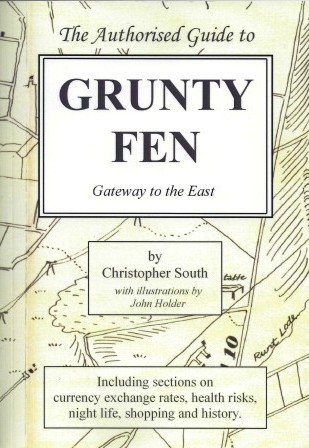
The Authorised Guide to Grunty Fen by Christopher South
I was at Niche Comics Bookshop in Huntingdon a few weeks ago delivering copies of my books, when my gaze fell on The Authorised Guide to Grunty Fen by Christopher South.
Dennis of Grunty Fen was a celebrated resident of this unusual place and appeared weekly in conversation with Christopher South on BBC Radio Cambridgeshire. When I managed to listen to them I was usually reduced to uncontrollable laughter, accounts of Hereward the Wake and his racing punt, the undiscovered vaults beneath Ely Cathedral are just two of the incidents discussed by Dennis and Christopher. There is many, many, many, more each one a gem.
This book gives an account of the area its architecture and inhabitants, it is a long time since I laughed so much that the tears rolled down my face. The Grunty Fen in this book has only mild exaggerations of some of the buildings in the fens. Rusting corrugated iron, railway sleepers together with leaning buildings of all shapes and sizes are not uncommon. The book contains many excellent drawings by John Holder enhancing visually the pictures so eloquently painted in words by the author.
Day to day life in this remote area of the fens is described in detail. For example, the importance of rhubarb both as a staple part of the diet and a means of communication is carefully described as are local competitive sports, Drain Rodding as a sport is unique to the area.
Sadly Dennis, Pete Sayers, is no longer with us but his spirit lives on I am grateful for the pleasure he and Mr South gave me. Even now there are pilgrims asking directions to Grunty Fen from the surrounding villages in search if not of Dennis but Potts Garage, Mrs Edwards at the Post Office, The Wolseley Hen Coop Car and of course Dennis’s home the LNER carriage. Visitors are advised to be wary of Feral Nuns on Vespas.
This book is a wonderful reminder of Sunday mornings on Radio Cambridgeshire, the world is a poorer place without Dennis and the community of Grunty Fen.
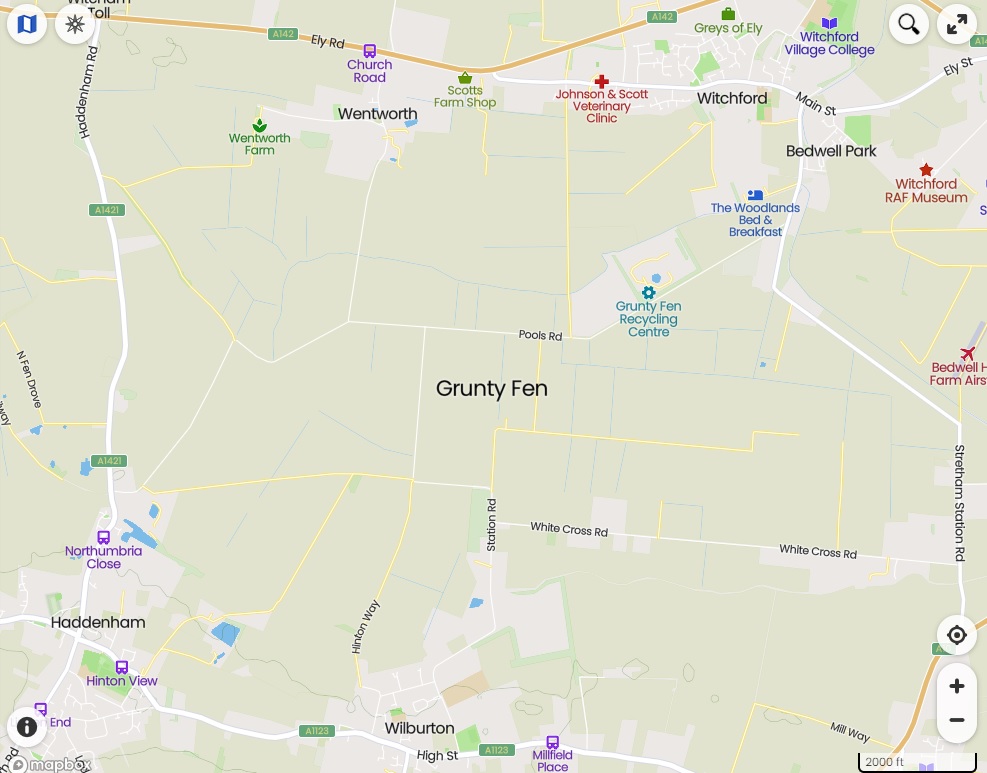
There is actually a place called Grunty Fen
This was Grunty Fen in 1648 before much of the fens was drained
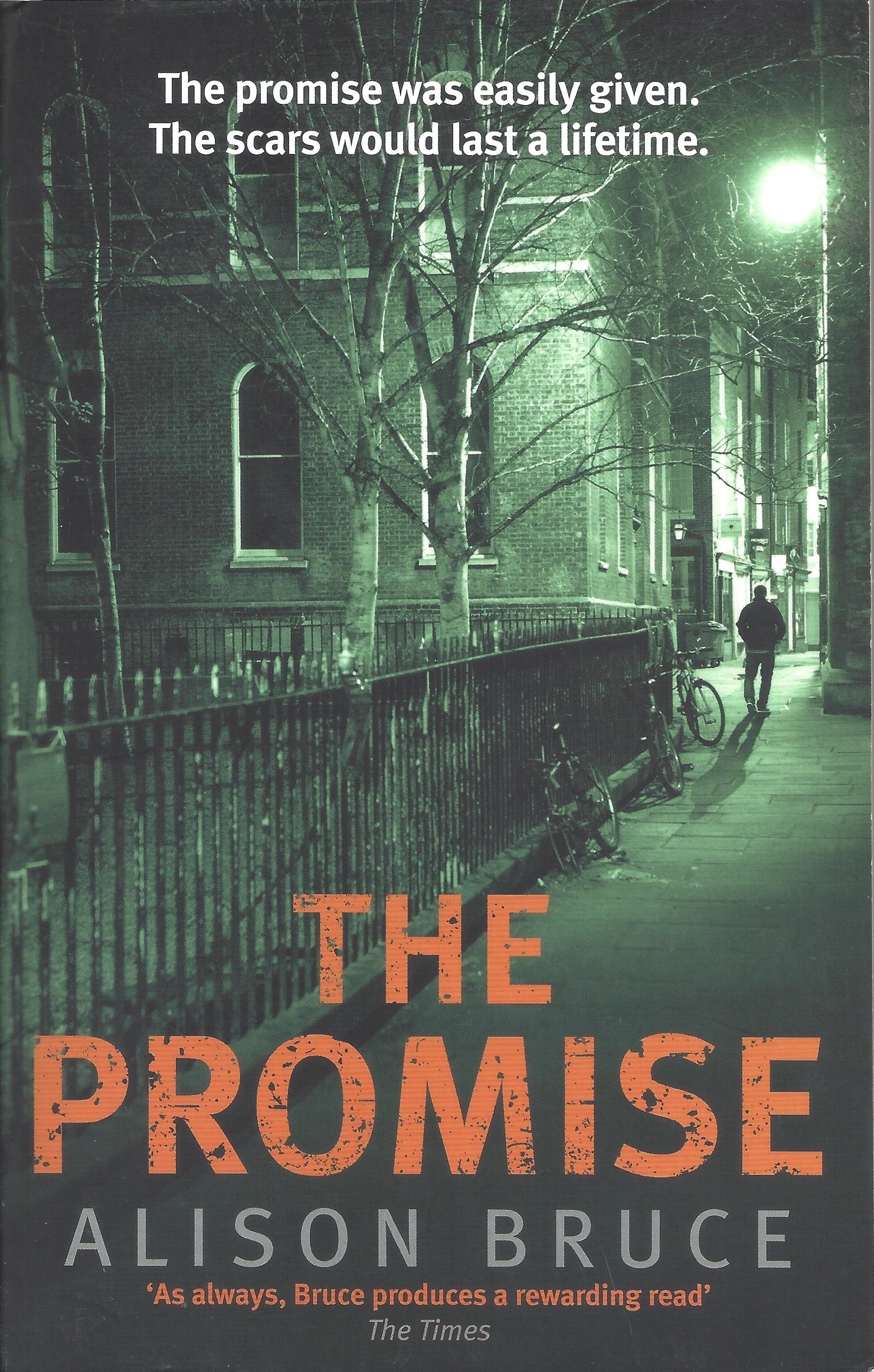
I am gradually reading all of Mrs Bruce’s Gary Goodhew books, The Promise is number six of seven.
Each succeeding book is better than the one preceding it; a difficult accomplishment when the first one, Cambridge Blue is so good.
The brutal murder of a homeless man, known to DC Gary Goodhew, prompts his early return to work while still recovering from injuries received during his last case. Cambridge is the setting for this and the books before it, is captured perfectly; the plot is intricate and convoluted, the characters are well drawn, the ending unexpected.
It is a really difficult book to put down until you have finished reading it I have ordered Cambridge Black and I am looking forward to reading it. It has The Promise of being an excellent read.
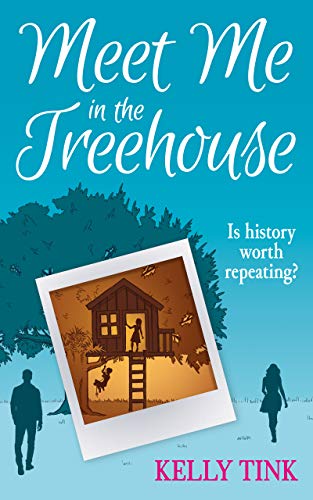
I confess Romantic Fiction is not a genre I would normally read, “Meet me in the tree house” is the first ever book of romantic fiction I have tried.
Kelly’s book is a well written, well crafted novel, exploring Emma’s grief and her accommodation with loss. The grief is for a dead friend. The loss is that of her marriage, itself another form of grieving. Grieving for the hopes, plans and dreams of a future now gone. Emma hesitates to form new relationships or revisit old ones; she is wary; worried that the history of her failed marriage may repeat itself.
We follow Emma as she tries to reconstruct her life and move on from a troubled past, it is an interesting journey and for me an informative one.
Kelly has I understand started on a second book, I can’t wait to read it.
I wrote this piece in 2014 I think but don’t recall posting it:
I came across a post on Linkedin recently promoting a piece of software that would automatically write articles on any chosen subject with material gathered by it from Google and other online sources.
Ultimately its’ main purpose seems to be to make websites more visible to Google, in order to improve search engine optimisation. For example I could start a search to produce an article on rose arches, I could specify its’ length and enrich its’ content to be full of the keywords suitable for my purposes. The sentences would be properly parsed and the result could be altered sufficiently to be largely original, references to sources can be included and identified. Whether at the end of the day anyone would find it as useful as something I had written (however badly) myself is another matter.
This undoubtably is a very clever piece of software and could save a lot of time. Whilst it is clever and possibly a masterpiece in software design it is ultimately to my way of thinking, in many ways totally devoid of real value or to be precise its’ output may well be devoid of value. If our purpose in life is to serve the interests, increase the status and the well being of Google and similar organisations then it is indeed potentially a tool of imense value. If on the other hand the real purpose of writing articles is to disseminate original thinking, communicate new ideas or engage in debate then its’ value is far less certain.
It could, it is fair to say, be used as a research tool, gathering together information easily and quickly but I think it more likely that it will become in the hands of the many, a means to produce items of very questionable value, except that is to the Google machine.
The question for me is whether or not we are losing the plot, this device seems to be the ultimate recycling tool, negating the need for research and scholarship. Taken to its’ furthest extreme it will end up recycling the recycled. Somewhere lurking in my memory is a paragraph or two from the Foundation Trilogy by Isaac Assimov which alluded to something like this. Isaac Assimov was prophetic in many ways I hope in this instance he was wrong.
I searched for automated writing software today and there is a lot available. The thought that crosses my mind is that some of the prolific blog writers are perhaps not sharing their own thoughts with us but that of an automaton.
Alison has become one of my favourite authors and I am gradually reading her Gary Goodhew series. I say gradually with good reason. I enjoy her writing and read the books one at a time with an interval in between each one, so I enjoy each one as a fresh read.
“The Backs” is number five in the series and number six “The Promise” is sitting on the shelf ready for my next special occasion.
The Backs, as is all of Alison’s books, the ones I have read so far, set in and around Cambridge. I am familiar with the city and the surrounding area. For me, this familiarity is a bonus.
Following a violent scene-setting prologue the action moves what was for the story the present day, the Gog Magog hills at night, a burning car and the discovery of a gruesome murder.
Jane Osborne’s return to Cambridge sets the story off in another direction and the plot weaves around several different strands. DC Gary Goodhew and the team he belongs to gradually, start to untangle the events leading up to the murder and hitherto undiscovered crimes of the past. In the process darker, secrets emerge from their hiding places.
As with all Alison’s novels (the ones I have read so far), the characters are well-drawn and the plot multilayered, as each layer is lifted more is revealed underneath. Each time the reader thinks they may have an inkling of who the villain may be or the possible outcome the ground shifts underneath.
I have a back pack, my writing bag, that accompanies me on research trips, it was a Christmas present from my wife and it is very practical. The bag contains maps, notebooks, pens and something to eat. Sometimes I take a small tablet computer with me which fits inside nicely, a flask of drink and occasionally an umbrella clipped to the outside.
Often I will find somewhere to write while I am out, a library, a cafe, pub or even on a nice day a bench outside, in a park, a garden or other public space. My favourite writing places are probably libraries, there are additional means of research available using the library’s computers and internet.
My writing bag hasn’t been out at all this last year, unsurprising really with the lock down, I am beginning to assemble two new books in my mind and have written a few opening chapters for both. But I need to get out to visit the places I m writing about to find those extra details that Google cannot provide. At some point in the future I will need to return to Cambridge to help D I Arnold Lane with his enquiries. Hopefully soon it will be safe enough for a few day trips and excursions. My writing bag and me.
This is the second of Tony J Forder’s books featuring D I Bliss and his partner Detective Sergeant Penny Chandler.
Newly returned to Peterborough after twelve years away policing organised crime, DI Bliss joins the Major Crimes Team and immediately is thrown into a brutal murder enquiry. The murder appears to be the latest in a series. Bliss very quickly spots a possible link between a series of rapes and murders.
Penny Chandler now promoted to Detective Sergeant joins the enquiry as the rapes she has been investigating seem linked to the murders.
The search for the serial killer and rapist then becomes a desperate race against time to apprehend the culprit before he can add to his growing list of rape and murder victims.
The enquiry involves a trawl through old cases and incidents. When a pattern emerges a trip to the U.S.A. becomes a necessity to follow old leads. Bliss and Chandler know they are up against a deadline but don’t know what it is. Speed and accuracy are needed, the plot twists and turns as the desperate search accelerates to a cliff-hanging conclusion.
A satisfying, engaging, read, the characters are well-drawn and apart from the U.S.A., the settings are familiar to me.
Excellent, thank you, Mr Forder.
Degrees of Darkness is the next in the series and I shall be obtaining it before very long.
The Scent of Guilt is available on Amazon and from bookshops.
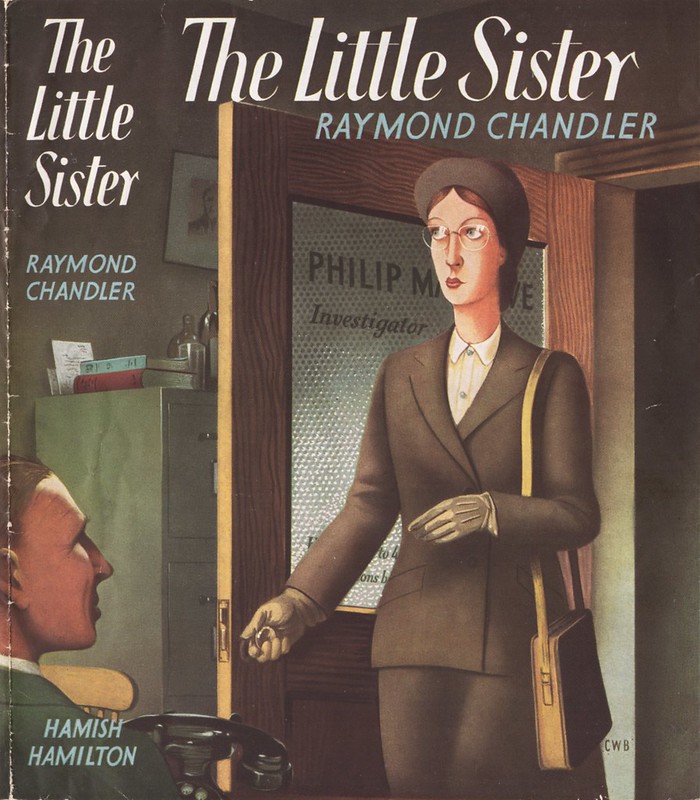
Dust-wrapper design by C W Bacon for The Little Sister by Raymond Chandler (1949).
Members of the Creative Writing Group, Whittlesey Wordsmiths, know of my affection for the author Raymond Chandler. He wrote during the thirties, forties and fifties. Starting to write after losing his job in the thirties a result of the great depression. Chandler was a depressive, alcoholic and womaniser but I believe wrote some of the greatest one-liners and similes.
Chandler’s hero was a Private Eye, Philip Marlowe, (I can’t fault his choice of forename.) Marlowe is a complex character and Chandler’s novels explore this complexity and depth.
I wrote this piece a few months ago but I thought I would share it with you now.
I am reading Playback sporadically at the moment while trying to finish (with considerable help) beating my own first novel Killing Time in Cambridge, into shape. Playback was Chandler’s last novel and the only one so far not to have been made into a film. It was while reading it that I rediscovered the piece that inspired this article:
“On the dance floor, half a dozen couples were throwing themselves around with the reckless abandon of a night watchman with arthritis.”
For me, it paints a picture with an economy of words.
I have dug out a few more of Chandler’s gems to share with you to enjoy.
“She gave me a smile I could feel in my hip pocket.” ~ Raymond Chandler Farewell, My Lovely ch. 18 (1940)
“It was a blonde. A blonde to make a bishop kick a hole in a stained-glass window.” ~ Raymond Chandler Farewell, My Lovely ch. 13 (1940)
“He looked about as inconspicuous as a tarantula on a slice of angel food.” ~ Raymond Chandler 1940 Of Moose Malloy. Farewell, My Lovely, ch.1.
“Tall, aren’t you?” she said. “I didn’t mean to be.” Her eyes rounded. She was puzzled. She was thinking. I could see, even on that short acquaintance, that thinking was always going to be a bother to her.” ~ Raymond Chandler The Big Sleep: A Novel”, p.5,
“She had eyes like strange sins.” ~ Raymond ChandlerThe High Window: A Novel”, p.161,
“Alcohol is like love. The first kiss is magic, the second is intimate, the third is routine. After that you take the girl’s clothes off.” ~ Raymond Chandler The Long Goodbye ch. 4 (1953)
“You’re broke, eh?” I’ve been shaking two nickels together for a month, trying to get them to mate.” ~ Raymond Chandler“The Big Sleep: A Novel”, p.90,
“From 30 feet away she looked like a lot of class. From 10 feet away she looked like something made up to be seen from 30 feet away.” ~ Raymond Chandler “The High Window”. Book by Raymond Chandler, 1942.
“Dead men are heavier than broken hearts.” ~ Raymond Chandler“The Big Sleep: A Novel”, p.42,
These books are of their time as were Conan Doyles Sherlock Holmes stories in a few sentences you are transported back to the time and place. Billy Wilder insisted on Chandler to write the screen play for Double Indemnity, he said, “No one writes dialogue better than Chandler.”






 Fenlandphil's Blog