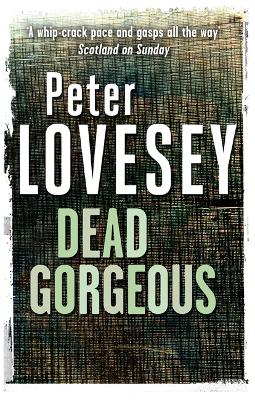
I have watched the film Dead Gorgeous at least twice and discovered that it was based on one of Peter Lovesey’s books, On the Edge; it was retitled Dead Gorgeous after the film was released.
Antonia and Rose meet up again by chance in London during 1946; they had served together as WAAFs. The two of them had worked as plotters at the same aerodrome during the recently ended Second World War. Both are in unhappy and unsatisfactory marriages: Antonia to Hector, a wealthy businessman, Rose to an ex-RAF fighter pilot, Wing Commander Barry Bell, who is now a civil servant. Antonia and Rose conclude their only solution to future happiness is an end to their marriages.
Antonia has a plan to rid themselves of their husbands. She also has her sights set on a move to America with a man who is not her husband. Rose is not comfortable with Antonia’s plan but becomes embroiled in it with no chance of escape. Dead Gorgeous is a story with any number of surprises well told and an authenticity that draws on the author’s lived experience of that immediate post-war period.
Although I thoroughly enjoyed the book, I felt the film was a better version of the story.
Laurel’s first day in her new home, wasn’t exactly ideal. The sudden death of a yet to be acquainted with neighbour can be unsettling, even for someone with Laurel’s experience. Her career had been in end of life care. As the story moves on Laurel begins to question her choice of Elderwick for her new home. However, despite the machinations of a property developer and a pocketed councillor, intent on contentiously bringing new homes and a leisure facility to the village, there are the redeeming features of an excellent village bakery, The Plump Tart, The Pleasant Pheasant Cafe and the Snooty Fox, the village pub.
It isn’t long before murders blight the ideal appearance of the village, whose history has also been darkened by that of the area’s leading family, the Hartfields, owners of Elderwick Hall, the site of the new development. Marcus Hartfield the present occupant of Elderwick Hall is the development’s prime mover.
The story is inhabited by a variety of interesting, colourful, characters both human and animal. A Little Bird Told Me, realistically details the conflicts and friendships within a small village community. However, at its core this is a crime story albeit a cosy one. The revelation at the book’s end is surprising which is as it should be.
For me it was a quick but absorbing read, well done, Ms Gray.
I am not normally tempted by historical novels; those more historical than the 1930s, that is but it was the promise of a murder mystery that swung the balance. The story is set in the early eighteenth century West Country and mainly in Bristol.
Miss Coronation Amesbury leaves her village in Wiltshire to seek her fortune in Bristol. The coach journey alone in atrocious weather is an adventure in its self. Her arrival in this bustling port city following a difficult overnight stay in Bath is not an easy one for her and a great shock after village life.
The recent horrendous murder of several young boys haunts Bristol. We follow Coronation as she looks for work in what she hopes will be her new home and her search for the perpetrator of these horrendous crimes.
The time, place and the events are beautifully painted we can see it all in our minds eye, a warts and all view of a bustling Bristol with its busy port during the era of slave trading. The story is well told and I found myself neglecting important tasks to finish the book, I struggled to put it down until I read those two final words, “The End”.
On the face of it, travelling to Cambridge on a rainy day would seem an unusual choice. Apart from visiting the street where one of my Great Grandfather’s lived at the time of the 1921 census (thanks to the help of a lady in the local u3a Genealogy group) I wanted to see how the city appeared in the rain, for purposes of research. Arnold Lane keeps nudging me hoping for a return and in response I have written a couple of tentative chapters.
How was Cambridge in the rain? Wet is the answer. I got off the bus at New Square rather than Drummer Street, thinking that Greggs would give me a bit of shelter. Hopefully, the rain would die down a little over a coffee and roll. Foolishly, I had left the umbrella in the car at St Ives; I remembered it once I was on the bus.
The rain was having none of it and carried on relentlessly after I left Greggs I crossed over to Wilkos and bought a cheap brolly. Even the threat of an umbrella didn’t stop the rain. Such is the nature of research, I had once driven from Cambridge to Heacham in the rain, recording it all on my dash cam for research, my wife thought I was mad, she still does.
I found the house in Norwich Street where Great Granddad had lived, took a look at the outside and set off back to the top of the road. There was a most unusual delivery van parked up further along the road, it had four wheels was pedal powered with an electric motor to assist. I had a chat with the driver; he said it was okay in windy weather particularly if it had a full load, which surprised me, it looked very lightweight and likely to catch the wind.
Pedal-powered deliveries in Cambridge
The bus around the corner in Hills Road, delivered me to Emmanuel Street; I had a short walk to the Grand Arcade and my next destination, the Central Library. There was an exhibition of life size animated dinosaur models in the arcade, I stopped and photographed them before spending an hour writing in the library.
Pterodactyl
More Dinosaurs
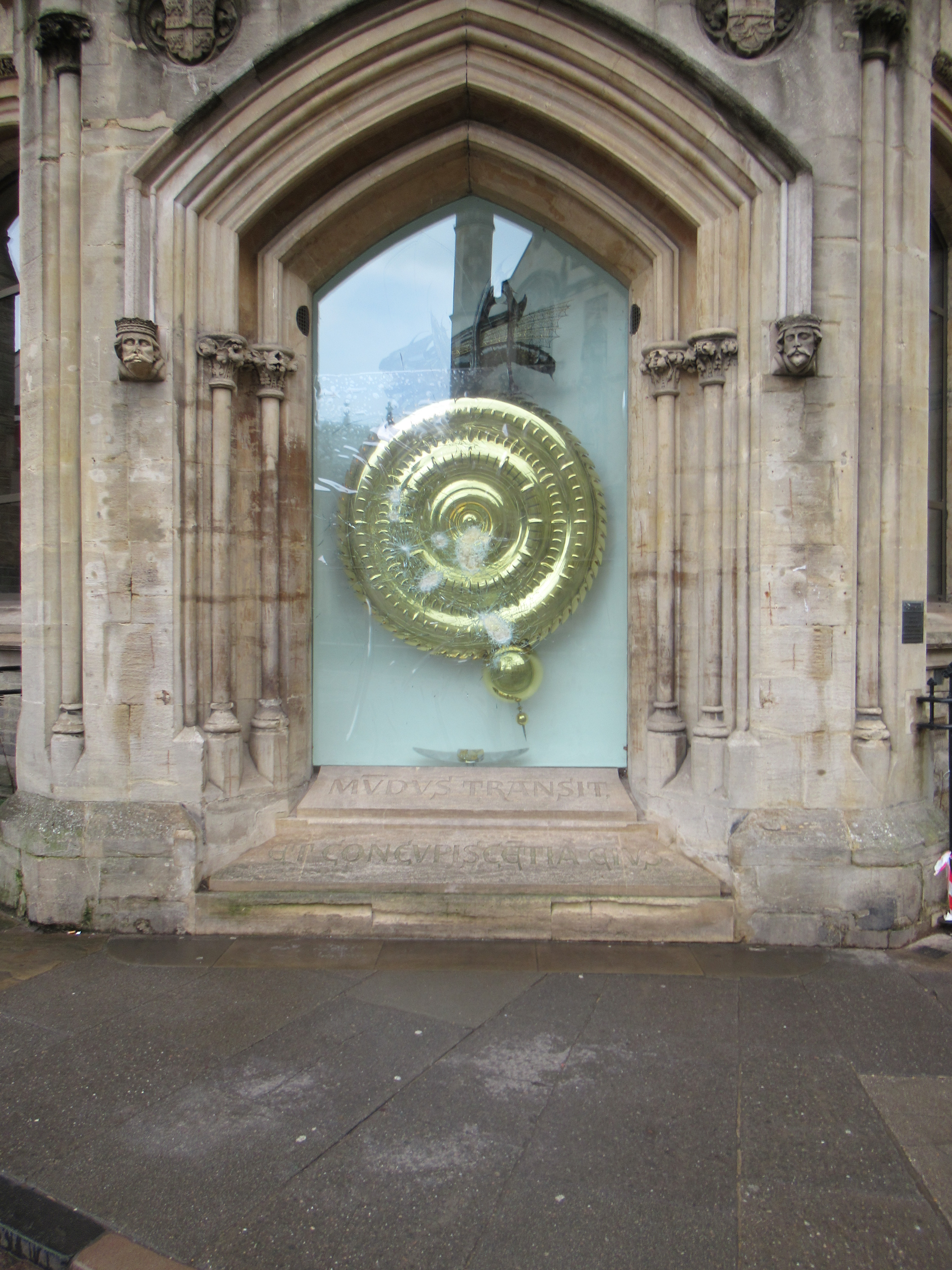
Benet Street, was next on the list to visit, I wanted a look at the damaged Grasshopper Chronophage at Corpus Christi College. It is a sad sight, to see this beautiful clock stilled and the grasshopper unable to munch through the minutes.
The damaged clock
Close up of the Grasshopper clock in happier times
It was time to return home so it was back to Drummer Street and to catch the bus back to St Ives. I was saddened by the damage to the clock whose picture occupies the cover of my novel, Killing Time in Cambridge. Hopefully, it can be repaired and the grasshopper put back to work, I know Arnold hopes so too.
Jill who is estranged from her husband, has moved to a seaside town to run a mobile, beachside, vegetarian, snack bar.
She is caring for her young grandson, Jack but grieving for her son, Davey, Jack’s father. As Christmas nears; the anniversary of her son’s death, Jill struggles to cope with her conflicting emotions, trying to give Jack the best possible Christmas she can while dealing with the still rawness of her grief.
I am certain this story will stay with me for a very long time. It moved me in a way that surprised me. It is beautifully written, the characters are believable and well-drawn. The end is satisfying, living up to the title
The only other book that has affected me in the same way as A Gift Called Hope; is “The Catcher in the Rye” by J D Salinger.
That I remember so much of The Catcher in the Rye after reading it just once, fifty years ago, speaks volumes.
Like Catcher in the Rye, this story is about loss and the grief that accompanies the loss of a loved one.
Reaching an accommodation with loss is a bumpy road; this book describes that journey with tenderness and humanity.
I can’t think of a single occasion when I have visited a book event at Huntingdon’s Commemoration Hall and left empty handed.
The Book Bank and similar book related events are hosted by Niche Comics and Books of Huntingdon, it was at a recent event that I came away with “Missing, Presumed”, written by Susie Steiner.
Angela Mackey, of said Niche Comics told me that the book was set in Huntingdon.
I bore my purchase home and have now finally got around to reading it.
I think knowing the area identifying the streets and places adds a little more to the story, it does for me and I have had similar comments from those readers familiar with Cambridge about my book.
Susie Steiner’s story is of a young woman, whose disappearance, is discovered by her boyfriend. An open door a trail of blood, her clothing and mobile phone left behind in their house, prompts fears for her safety. DS Mannon Bradshaw, DI Harriet Harper and their team struggle to make headway in the search for famous surgeon Sir. Ian Hinds’, daughter Edith.
This is a fascinating story, the plot moves in different directions as new threads are woven into its fabric.
All the time the team are coping with their own problems, within their relationships and families.
A tale of secrets, fragile lives, deception and families under stress, the end is unexpected and satisfying.
Susie Steiner
I learned from Angela that Susie Steiner was no longer with us having died of brain cancer in July 2022 at the tragically young age of 51.
I am grateful to Niche Comics and Book Shop of Huntingdon, in particular to Angela Makey of the said establishment. Angela regularly organises events in Huntingdon bringing many well-known authors into the town’s Commemoration Hall to discuss their writing and books. The only problem it gives me is trying to sneak the books into our house which I buy at these events without my wife noticing, she thinks that we have far too many books already.
A while back I was at an event where two authors, Alison Bruce and Sophie Hannah; were in discussion with a gentleman whose name escapes me (I’m sorry I should have been taking notes.)
I am familiar with Alison’s work and a great fan, Sophie Hannah was a name I recognised but hadn’t read anything of hers. I enjoyed the evening and came away with a copy of Sophie Hannah’s Monogram Murders; I have copies of all Alison’s novels.
It is a long while since I have read any of Agatha Christie’s books and I must admit I am not a huge fan of hers, so I hesitated and prevaricated about starting to read Ms Hannah’s take on Agatha Christie’s famous Belgium detective.
The story starts when Poirot’s supper is disturbed by a distraught young woman entering the café where he is dining. She is convinced that she is soon be murdered.
Three murders take place at the Bloxham Hotel in London on that very same night. The victim’s bodies are found in separate rooms on different floors. Hercule Poirot assists Catchpool a Scotland Yard detective, who lives at the same lodgings as Poirot; investigate the murders. Before very long Poirot is in charge of the case with Catchpool, the narrator trying to keep up with Poirot’s thought processes.
The plot is engaging; constantly twisting and turning, to wrong-foot the reader.
I prefer Sophie Hannah’s version of a Poirot mystery to any I have read penned by Agatha Christie; I shall read more of Sophie’s books.
Raymond Chandler’s shoes are very difficult to fill. Philip Marlowe, Chandler’s hero is someone who has inhabited the imagination of all those who have read Chandler’s novels. My Marlowe will be different to everyone else’s Marlowe but our own original has its own presence.
‘Poodle Springs’, Chandler’s unfinished novel was completed by Robert B Parker and worked well for me; I have since discovered that Parker wrote another Marlowe novel, ‘Perchance to Dream.’ This is one I will seek out and read.
Marlowe is engaged by The Pacific Mutual Insurance company to investigate the death by drowning of Donald Zinn; before the million dollar payout is made to his widow.
Donald Zinn is an all too easily recognisable pastiche of a contemporary character, one who it appears has followed a similar career path to Zinn’s.
It was a good idea to base the action in Mexico; the location of Zinn’s demise.
Only to sleep didn’t work well for me, perhaps it was taking Marlowe out of his time and place; California’s, the thirties, forties and fifties or maybe at 73 Marlowe just hadn’t aged well. I didn’t recognise him even as an older version of himself
Other Chandler and Marlowe fans may enjoy this book; it just wasn’t a good read for me.
Generally, I only watch a few hours of television a day if at all. Mostly it is crime dramas that attract my attention and they occupy most of my viewing time; my daily ration of dodging the adverts while trying to follow the plot.
I often watch Vera, a series featuring DCI Vera Stanhope as its main character, gradually becoming aware of the name of the Vera books author, Ann Cleeves. Ann is the creator of the programme’s characters. After a recent stint of writing at the local library, (I work better there) I sought out her books happening on her very first; A Bird in the Hand.
It is a very good read, excellent in fact, tightly plotted and populated with well-drawn, interesting characters. The thread that binds both the story and its characters together is bird watching, particularly the community known as “Twitchers”.
When the murdered body of a young twitcher is discovered in the Norfolk coastal marshes; George Palmer-Jones, a retired Home Office investigator is asked to help solve the crime. George is an elderly bird watcher respected by the bird watching community and knowledgeable about the people and their habits. Assisted by his wife Molly, George embarks on discovering the truth behind the brutal killing, we accompany the pair as they tour the country chasing sightings of rare birds while hunting the killer.
It is a brilliant first novel, as it was then. I now know there are many, many more books by Ann Cleeves, for me to read.
I have found a new sweet jar and I will dip into it whenever I can.
This month I’m chatting to local author Philip Cumberland. As one of the founding members of a local writing group, Phil reached out to me several years ago to ask if I’d be interested in reviewing a book the group had put together called Where the Wild Winds Blow: an eclectic mix of fact and fiction, featuring short stories, poems, and memoirs, contributed by the various members of the Whittlesey Wordsmiths. Honoured, I said I’d love to. Since then, Philip has released his own debut novel, Killing Time in Cambridge, which was also my choice for this month’s book review.
Welcome Phil, thanks for being my guest. Can you tell everyone a bit about yourself?
Thank you for inviting me, Eva.
I grew up in Huntingdon and have lived in Cambridgeshire all my life, the last thirty-five years in Whittlesey.