Blackheath, during the approach to Christmas, is blighted by the murder of Caspar Campbell, a friend of the Morrigan household.
The Morrigan family home, Greenway, is due to host its first family Christmas for many years. The celebrations include the return to the family home of May Corrigan’s identical twin sister, Cass, on the insistence of Minty. Minty is May and Cass’s somewhat unconventional ninety-six-year-old mother.
Fletcher, May’s friend, is the other member of the household, apart from May’s mini Dachshunds, Bess and George. Fletcher is writing, directing and producing the village pantomime, Peter Pan.
The star of the show, a fading, predatory actor, Clarke Woolf, is playing Widow Twankey and causing Fletcher problems trying to manage Woolf’s attempted philandering.
The run-up to Christmas brings the sharing of family secrets, while May is trying to navigate her way through an acrimonious divorce.
This is a great book. I read it very quickly, putting aside things I shouldn’t have put aside to find out how the story ends. It certainly turns out to be a most curious Christmas.
I had been meaning to read some of Gina Kirkham’s work for some time, so when the opportunity presented itself to me, I grabbed it eagerly. This was to be my first acquaintance with the ladies of the Winterbottom Women’s Institute. The opportunity to become extras in an upcoming film was an opportunity too good to miss for these women. The chance to meet an attractive male actor, Flynn Phoenix and his co-star, Dana Simon, cast in the leading roles, was another attraction.
The filming is to take place in Black Abbey Towers, a building with a dark history, currently owned by the church and occupied by the Archdeacon Clement Gregory of Fallow Falls and his wife, Fiona. The Archdeacon’s wife is none too keen on the intrusion of the film-makers and their entourage. However, her husband is keen to obtain the money the film-makers will bring into the church’s coffers.
Four of the ladies of Winterbottom W.I., Ethel, Hilda, Kittie and Millie are taken on as extras. The ladies, ‘The four Wrinkled Dears’, are joined by another lady, Olive, recruited from the cast of extras, and they are soon sleuthing. At first, trying to locate a missing Housekeeper and then a murderer. With Prunella Barnes, the Winterbottom WI’s president, in the late stages of pregnancy. It was down to Bree Richards, the W.I.’s vice president, to rein in the sleuthing ladies.
The story is overshadowed by Black Abbey Towers’ dark history, and the house itself is a labyrinth of secret passages, holding even darker secrets of its own. The film crew’s very mature female stunt coordinator, Dorothy May (Dottie) Barker, plays a significant part in the action, a lady with remarkable talents.
I enjoyed this book; it was a great read and I will seek out more of Gina’s work.
It is a little while since I have read one of Tom Sharpe’s books, several years in fact, Porterhouse Blue had been serialised in the television some years ago, after watching it, I had always intended to read the book.
Porterhouse is a fictional college within Cambridge University. The city of Cambridge is largely unchanged from the late 1960s when the book was written and set within. Many of the streets that Sharpe’s characters inhabited are much as they are described in the book; I suppose this gives Porterhouse Blue a degree of familiarity to those of us who visit the city on a regular basis.
Porterhouse is a poor relation compared to its wealthier fellow colleges; Skullion its head porter manages various dubious schemes to help the finances and maintain the college in the traditional way its fellows and he regard as essential. However, it is the arrival of a new master, Sir Godber Evans, an ex government cabinet minister and former Porterhouse student, which starts a battle of wills. His intention of reforming the college and bringing it into the twentieth century, provokes a battle between the two opposing camps. The fellows and Skullion are strongly united against Godber’s planned reforms which included: female students, more concentration on academic achievement and less attention to sporting prowess. However, it is the master’s proposed installation of a contraceptive machine in the student toilets that proves the catalyst for even greater conflict.
I really enjoyed Porterhouse Blue and was laughing out loud at times, a really good read.
I’ve had an interesting week and a half. On the 27th of August, a Wednesday, I was admitted to Hinchingbrooke Hospital for a scheduled hernia repair. It was keyhole surgery, and I was discharged the same day. I spent a reasonable night at home, a little uncomfortable but nothing too worrying. The next morning, I was up early and getting one or two administrative chores out of the way and feeling quite good. However, by the evening, I wasn’t too well and brought up what appeared to be dark blood. My wife and I concluded that, as a tube had been put down my throat to help with breathing during the operation, perhaps it had caused some bleeding.
By Saturday evening, things had become worse, so I contacted the hospital, “No, it isn’t normal, dial 999.” The ambulance could only deliver me to Peterborough. Aware of the possibility of miscommunication between the two hospitals, my brother took me to Hinchingbrooke and delivered me into the welcoming arms of A&E during the early hours of Sunday morning; they were expecting me.
After a while I was wheeled into the same ward I had been admitted to the previous Wednesday. It is always difficult to get answers it seems, I was connected up to drips and given blood transfusions but apart from a doctor telling me it wasn’t a surgical problem and that I would be moved to a medical ward that was about it. The hernia repair gave me no trouble and seems to be a well executed piece of surgery. Eventually I was given an endoscopy and a diagnosis of a Hiatus Hernia. When I was able to talk to a consultant I asked him if what they had found could have accounted for such a large loss of blood, (about one and a half pints or to use the Tony Hancock scale one and a half armfuls). He assured me this was the likely cause.
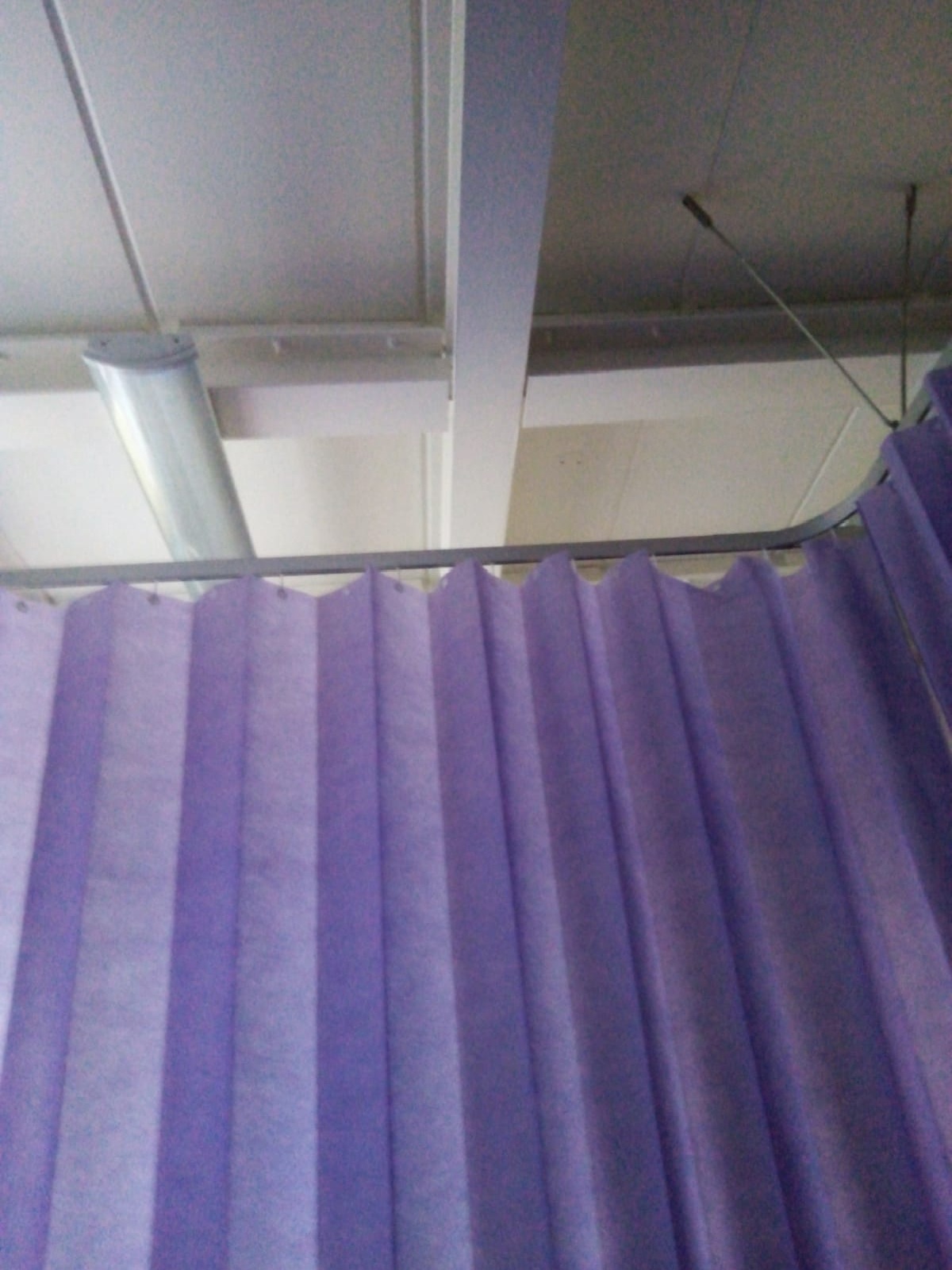
While lying in bed on my back, I started to examine the ceiling of the ward I was in. Hinchingbrooke Hospital is suffering from the problems of RAAC (dodgy concrete), and they are desperately trying to rebuild it while keeping it open. The ward’s ceiling and presumably the roof above it are now supported by a grid of 203 x 203mm Universal Columns; the minimum weight of this size of column is 47kg per metre (close to a hundred weight per yard). Nearly forty years ago, when I started my metalworking business, the supply price of manufactured structural steelwork was £1000 a tonne; prices haven’t gone down in that time. It wouldn’t surprise me if the cost of the steelwork alone, supporting the roof in that ward, exceeded £20,000, not including all the installation costs. Meanwhile, within half a mile as the crow flies is the original Huntingdon County Hospital building is still there intact and over one hundred years old.
Some of the steelwork.
The ward staff were brilliant, compassionate, patient and caring. When I was asked if I would mind vacating my bed early while waiting to be collected I had no hesitation in agreeing. The chap they wheeled in looked very poorly. It was heartening to see the love of mainly, wives, daughters and granddaughters for their, husbands, dads and granddads.
Above all else the experience has given me a renewed hope for us all.
I think I have read most if not all Mr Lovesey’s, Peter Diamond books. This one is a little different to any of the others in that it features a Private Eye, Johnny Getz, (no relation to Stan Getz the jazz saxophonist). Diamond meets Johnny Getz while he is trying to enjoy a quiet drink at the end of a working week in his local. Getz is working for a new client, the daughter of an antiques’ dealer trying to trace her missing father.
Diamond reluctantly gets involved in Getz’s inquiry when with his client they investigate the break in at the shop that had prompted the hunt for the antique shop’s owner. The story is a convoluted one, entwining the world of art, high class consumerism, journalism and of course murder.
Johnny Getz the Eye in question, models himself on the fictional thirties and forties private eyes created by among others, Raymond Chandler and Dashiell Hammett. However, the mean streets Getz pounds, are not those of forties California but the somewhat grander ones of present day Bath.
Diamond doesn’t welcome the intrusion of this reincarnation of Philip Marlowe or Sam Spade, as Getz acknowledges in his own account of events. However, eventually an uneasy alliance is formed to solve the case.
I enjoyed the story, although I found the point of view of Mr Getz a little difficult to cope with to start with. It will be interesting to see if Mr Getz turns up in future books.
A quick, absorbing and enjoyable read; well done Mr Lovesey.
My thanks goes to Philip for being part of my blog tour. I’m excited to have my first children’s book, The Secret Dragon, out this year. The book has been written for 5-7 year olds and it’s the first in the Saffy’s Secret Quest series. Publication date is 28th July but it’s available for pre-order now. Here’s a little bit about it:
The blurb
When Saffy discovers a dragon statue at the bottom of her garden, her boring summer holiday becomes full of excitement.
The statue is a real dragon called Lily. She’s from the magical world of Mandoreum, a place that’s in danger and in need of Saffy’s help.
There are clues to solve, a wicked witch to battle and secrets to be kept at all costs. Will Saffy be able to save Mandoreum before it’s too late?
Extract:
Saffy looked up at the statue – at its huge, cotton wool feet, up to its mighty scales dangling down and up into its face and row of red gums, which were looming closer and closer as the dragon bent towards her.
Suddenly, the dragon looked very fierce indeed.
Saffy put her hands over her eyes and peeked through her fingers. The dragon was still there.
Pop! Now the dragon had gone.
She looked all around. There was no sign of it. Had there really been a huge, menacing dragon leaning over her?
Author bio:
Esther
Esther has been a freelance writer for over twenty years, regularly writing articles and short stories for magazines and newspapers such as Writers’ Forum, Writing Magazine,The Guardian, Best of British, The Cat, This England, Yours and The People’s Friend.
Winner of several competitions, including those run by Writing Magazine and The Global Short Story Contest, she has also had the privilege of judging writing competitions and relished being given the role of head judge of the Writers’ Forum monthly short story competition.
Esther loves writing, but she also enjoys helping others, which she achieves in her role as a tutor for The Writers Bureau. She also runs their monthly writing club, Let’s Write.
She has had two how-to books on writing published as well as two collections of short stories. Her first children’s book is coming out in July, where she writes under the name of Esther Moonstomp.
Acts of Convenience had sat on my TBR pile for a long time. I finally lifted it off the heap last week and started reading it. The Assisted Dying Bill passing through Parliament has given the story a timeliness that perhaps an earlier read wouldn’t have.
Cassie is a nurse, used to early deaths and personal tragedy. The book charts an uneasy glimpse into an ever-increasing dystopian future where the acts of convenience are only convenient for the few wealthy enough to avoid their consequences. The story is of love, coping with adversity and a resolute determination by Cassie, not only to care for and protect her family and friends but to expose wrongdoing. The story’s Voluntary Euthanasia Bill is the first step on an ever-steeper descent on the slippery slope to a troubling future. If we hadn’t seen the decimation of the NHS and the increasing influence of the private sector, most of this story would seem complete fantasy. I sincerely hope it isn’t what it seems, a vision of the future.
If you only read one book this year make sure that this is the one, it is brilliant.
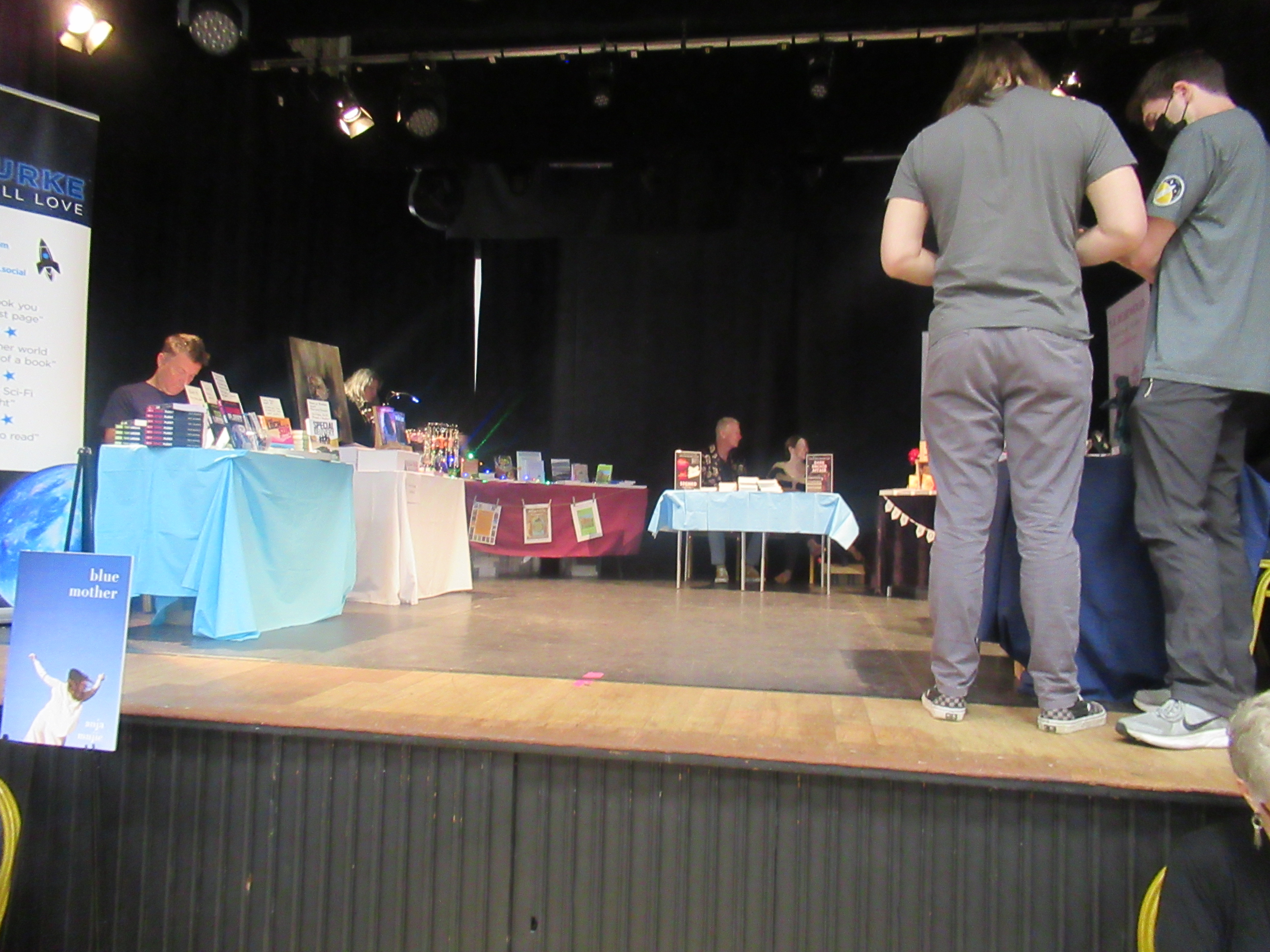
Although I visited the Indie Author Book fair, in Huntingdon, last year, it is always a different experience for a visitor than as an exhibitor. The back corner of the stage, which was the spot I was allocated, wouldn’t have been my first choice as an ideal stand position. Advised by a friend earlier who had exhibited at another show in the Commemoration Hall, I asked three weeks earlier if the extra stairs the hall possesses could be installed for the show, but I didn’t receive a reply to my email.
Henry’s critical eye.
My colleague and I arrived early, too early as it turned out to start setting up, so we unloaded the contents of our borrowed supermarket trolley back into the car and returned at the appointed hour, 9.00 am. I asked the organiser about the extra stairs but was told we couldn’t have them because they blocked a fire exit. As it transpired the organisers had been let down by their table suppliers, so it wasn’t that good a start for them either. At 9.00, we returned and moved our stuff in. Then found a larger table than had been allocated to us giving the original one to our neighbour to increase their display space. Strangely enough for a theatre setting, it was very dark on the stage, particularly so in our very remote corner. Luckily, we had some lighting with us but not enough.
Our dark corner far left before the extra stairs appeared.
In addition to my own books, Killing Time in Cambridge and the short story book Strange Times and Other Stories, I had with me books written by fellow u3a, Whittlesey Wordsmiths and those of other members: Henry Curry, my assistant, Cathy Cade, Val Fish, Wendy Fletcher and Stephen Oliver.
The warning notice on the stairs telling people that they used the stage at their own risk wasn’t conducive to encouraging much foot traffic either. At a little after midday, the second set of stairs was produced and installed in the centre of the hall, giving two points of access to the stage. Traffic then increased considerably, although that wasn’t saying a lot.
Down below the footlights
Dow below the footlights 2.
It was an interesting day, to say the least. We met some nice people, other exhibitors, and those interested in our books. Perhaps, it shouldn’t have been a surprise that there was only one exhibitor I remembered from last year’s show. We packed up and left at 4 pm; luckily, the supermarket trolley was still available. Although some books were sold, it was not a commercially worthwhile experience. Sometimes you have to buy your experience.
It isn’t unusual for human bones to be discovered during archaeological excavations, in this case, on the site of a proposed new farm shop, at Elderwick Hall, in whose grounds the discovery was made. The hall has had a long and troubled history, so finding an unknown burial wasn’t a huge surprise. However, once all of the remains had been uncovered, the questions followed, whose remains were they, how long had they been there and what was the cause of death?
Although being there when the discovery was made, Laurel tried to avoid being drawn into the inquiry. She had decided to steer clear of detective work but eventually, reluctantly, to help her friends, she succumbed to the inevitable and started with the help of Maggie and Albert, to investigate the murder.
Laurel’s fractious relationship with D.I. Coral; doesn’t help the situation, particularly, as Laurel was at the site when the remains were discovered. The story is multilayered with a glorious cast of characters, including Albert’s stroppy cockerel, Aroon, it is set in the delightfully painted East Yorkshire village of Elderwick. Who wouldn’t want to buy cakes from the Plump Tart, enjoy tea and cakes at the Pleasant Pheasant or sink a pint at the Snooty Fox?
I thoroughly enjoyed, A Storm in a Teacup, which is the third in the Elderwick Mysteries series. I read it quickly; wanting to find out how it ended, more please, Rachael.
Carol was a guest speaker at our local u3a meeting; she had been part of the team making a popular local radio program about a character living in the fens, Dennis of Grunty Fen. Carol was not only the sound recorder for the programme but she edits and illustrates books written about Dennis’s Grunty Fen. We met at an Indie Author Book Fair in Huntingdon where I bought another of the Grunty Fen books, written by Christopher South, the third in the series. Carol illustrates and edits, these books.
But enough about Huntingdon, when Carol gave her brilliant talk at our U3a meeting about Dennis of Grunty Fen, she brought books with her. In addition to the Grunty Fen books was a book of her own; Gingerbread Children. I bought my copy there and then.
. Gingerbread Children, is apart from the architecture nothing like that of Hansel and Gretel, (What about the children?), well children are involved a boy and a girl. There are witches too, not just one but lots of them and cats, together with other ‘Familiars’ but mostly cats. The story starts with the failing health of the Matriarch of The University of Nature, (The Union), with her failing health comes the question of who will succeed her. The question of succession, the building of an edible house, a gymnasium for dogs which is managed by a cat, are among just some of the remarkable events within this fantastic book. And of course, there is magic, gingerbread and lots of cake.
Gingerbread Children is one of the most unusual books, I have read but it is without doubt one of the best. Thank you Carol
Gingerbread Children is available to buy from bookshops or on Amazon.