My thanks goes to Philip for being part of my blog tour. I’m excited to have my first children’s book, The Secret Dragon, out this year. The book has been written for 5-7 year olds and it’s the first in the Saffy’s Secret Quest series. Publication date is 28th July but it’s available for pre-order now. Here’s a little bit about it:
The blurb
When Saffy discovers a dragon statue at the bottom of her garden, her boring summer holiday becomes full of excitement.
The statue is a real dragon called Lily. She’s from the magical world of Mandoreum, a place that’s in danger and in need of Saffy’s help.
There are clues to solve, a wicked witch to battle and secrets to be kept at all costs. Will Saffy be able to save Mandoreum before it’s too late?
Extract:
Saffy looked up at the statue – at its huge, cotton wool feet, up to its mighty scales dangling down and up into its face and row of red gums, which were looming closer and closer as the dragon bent towards her.
Suddenly, the dragon looked very fierce indeed.
Saffy put her hands over her eyes and peeked through her fingers. The dragon was still there.
Pop! Now the dragon had gone.
She looked all around. There was no sign of it. Had there really been a huge, menacing dragon leaning over her?
Author bio:
Esther
Esther has been a freelance writer for over twenty years, regularly writing articles and short stories for magazines and newspapers such as Writers’ Forum, Writing Magazine,The Guardian, Best of British, The Cat, This England, Yours and The People’s Friend.
Winner of several competitions, including those run by Writing Magazine and The Global Short Story Contest, she has also had the privilege of judging writing competitions and relished being given the role of head judge of the Writers’ Forum monthly short story competition.
Esther loves writing, but she also enjoys helping others, which she achieves in her role as a tutor for The Writers Bureau. She also runs their monthly writing club, Let’s Write.
She has had two how-to books on writing published as well as two collections of short stories. Her first children’s book is coming out in July, where she writes under the name of Esther Moonstomp.
A version of this article was published in Best of British Magazine in their Past Remembered section. A first for me, being paid for something written by myself.
The wholesalers were in the far right-hand corner of the outbuildings, painted white. The house at the front belonged to the owner of the garage.
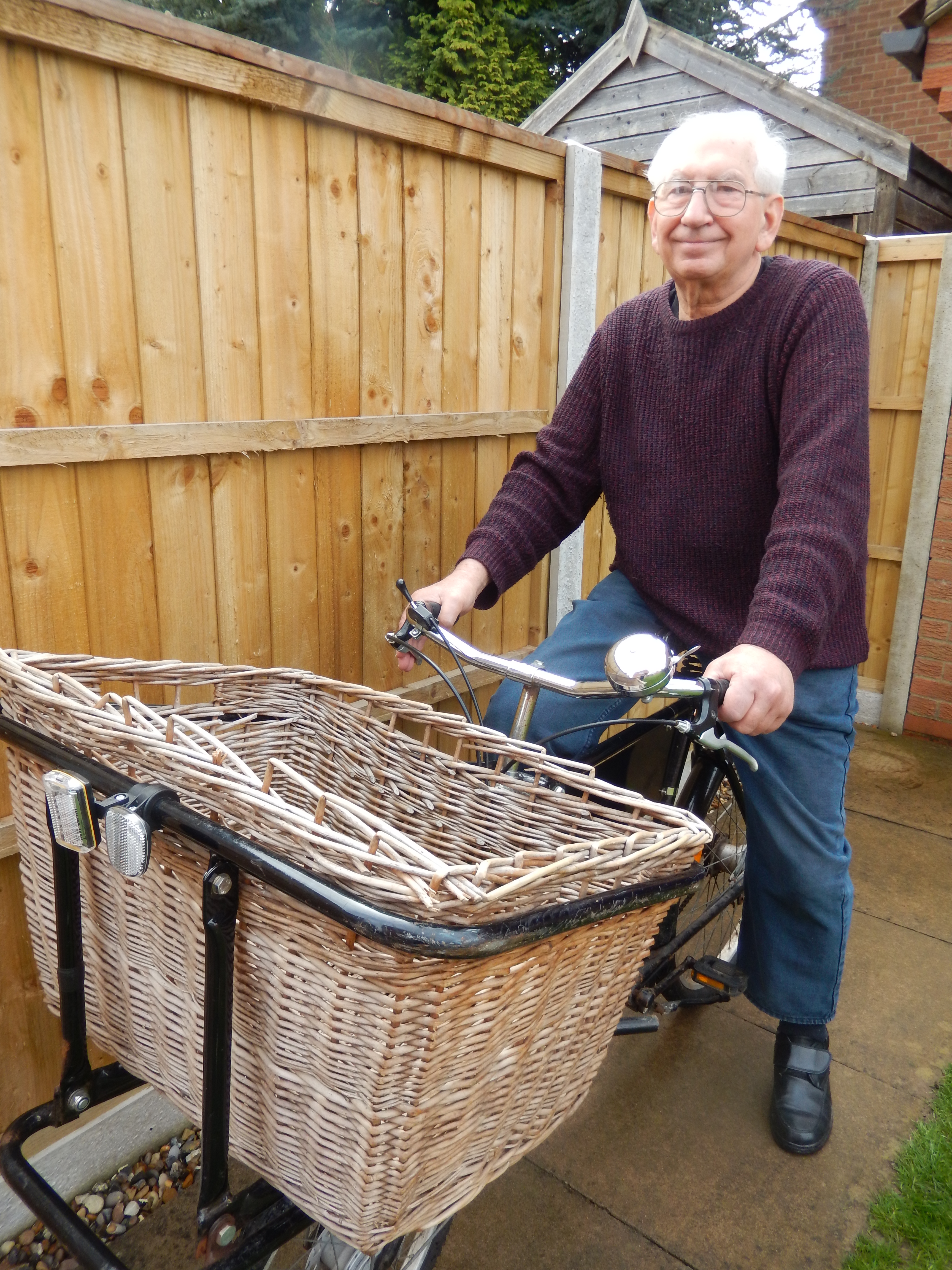
I was about or just under thirteen years old when starting my first newspaper round in Huntingdon – a morning round, using a Pashley small front-wheel large-basket trades bike. A Sunday round was added next, in a different part of town. At that time there was competition for paper rounds, even waiting lists. My evening round was the most interesting. The morning and Sunday rounds I delivered for a newsagent but the evening round was my first taste of self-employment.
An older lad leaving school gave me the round. The papers were bought direct from a wholesaler and sold to the public. In 1964 the gross profit per paper was one penny – the old penny: large and 240 to the pound.
The wholesaler used an office at a garage and taxi company’s in Ferrar’s Road. It was situated in the back corner of a rectangular cobbled yard, the house at the front was the garage owners’. There were workshops down one side of the yard, a high wall along the opposite side. The back of the yard, away from the house, had more buildings and an arch with a driveway underneath leading to lock up single garages rented to the public.
The office contained a desk, a typewriter and chair, two largish tables, two more chairs, a telephone, tea-making facilities, also a large machine for printing Stop Press onto the papers. The evening papers sold by my wholesaler were London papers – The Evening News and The Standard. He was also the local wholesaler for a few magazines, one of which was Private Eye, a good read even then.
After finishing school, dropping my things at home, and collecting the trades bike, it was off to the wholesalers. There I collected about a dozen papers before cycling to the railway station. In the station I sold papers to waiting passengers – at first on the platform nearest the ticket office then, crossing the footbridge to the northbound platform, to commuters waiting there. When the express train from London arrived – I can’t remember whether, at that point, they were still steam or early diesels – the papers were collected from the guard’s carriage. The two bundles were carried back over the bridge – Evening News on my right shoulder, Evening Standards in my left hand – heaved into the basket of my bike, and I would be off.
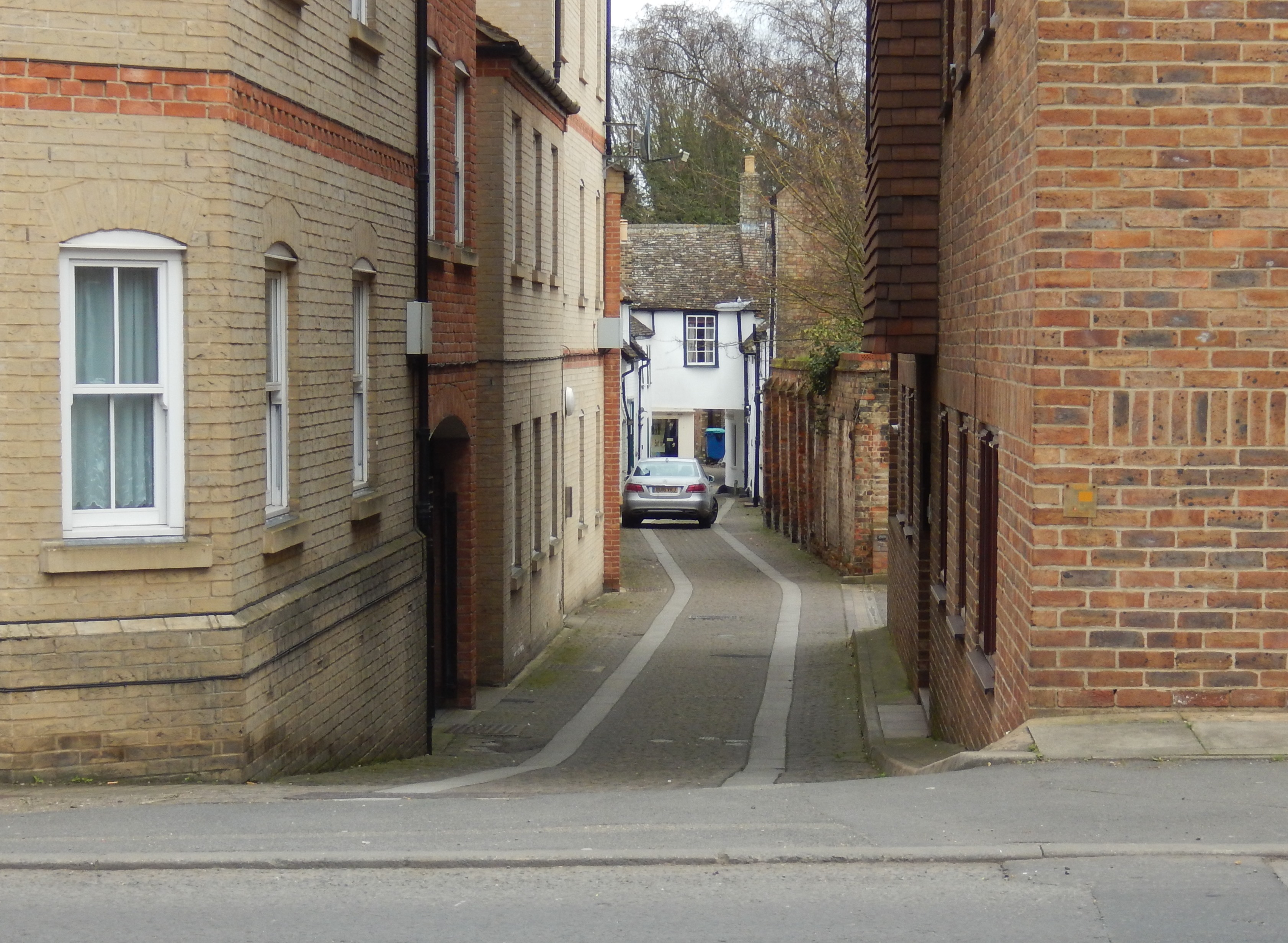
There was a steepish hill out of the station to George Street but after that it was downhill leaving George Street, to use a short cut down cobbled Royal Oak Passage to the High Street. The passage had a central gutter then with an iron drain about halfway along. One day the bike’s front wheel caught in the drain, catapulting me over the handlebars. The bike stood on its end, the heavy papers pinning the basket to the ground.
Royal Oak Passage as it is now the central gutter and drain have both gone
Once through the passageway, my journey would continue up the High Street to the wholesaler’s delivering the papers to the office.
The Stop Press news would be received by telephone and transcribed in shorthand by the wholesaler’s secretary, the garage owner’s wife. The news was typed up onto a Roneo stencil, a narrow strip that looked like carbon paper perforated at one end. The stencil was loaded onto a drum at one end of the Stop Press machine, the papers placed onto a shelf at the other end then fed onto a conveyer by hand. The conveyer passed papers under the rotating drum, which printed the news updates onto each paper in turn.
As soon as a dozen papers were printed. I would take them to a nearby factory – The Silent Channel – this company made rubber mouldings and also the guide channels for vehicle windows, cycling around the factory to sell as many as papers as possible before returning to the wholesalers to collect the rest of my papers. The other distributor at the wholesalers had driven off by then in his Austin A30, delivering papers to local newsagents.
Pashley Trade’s Bike
The basket would be reloaded then I would head for the home of my assistant Stephen. His was the original round acquired from my predecessor. When he had his papers it was off again, next stop French’s offices and hostel. French’s were building London overspill estates, enlarging Huntingdon. After selling papers around their premises I delivered my own round, looking out for new prospective customers at the same time. A small John Bull printing set enabled me to produce advertising cards for evening paper delivery services, posted through the letter boxes of new arrivals, followed up with a call, which often gained new customers. The business was given to Stephen when I left school aged fifteen keeping a Sunday round on for a few years afterwards. I have a Sunday paper round now, have had for fifteen years or so, but in a different town. I am probably now the oldest paper boy in the Fens