Winter is seldom welcome however autumn with its beautiful paint box colouring the leaves of trees in red, golds and browns is another matter entirely. Autumn never starts on a particular day we try to box it with dates but it comes and goes to suit itself. The corn harvest in the country seems to occur with the last of summer, whilst the blackberry and apple crops seem to coincide with the first hints of autumn, for me autumn starts with the browning of leaves. I was walking my son’s dog in our Lattersey Nature Reserve and found an early first fall of brown leaves starting to cover the ground. Autumn can stay for a while but it needn’t hurry away to let winter in, not on my account anyway.
I wrote this piece as an entry for a flash fiction competition. A member of our writing group asked me if it was autobiographical, apart from the reference to Jimmy Mack all of it is the product of my imagination.
Do girls still dance around their handbags? Wondering, seeing again, remembering fondly the long-legged girls of my teens… Joyce would dance around her handbag with girlfriends in a circle, or sometimes in a line, to Jimmy Mack or Heatwave. All I could manage was a slow cuddle around the dance floor with her as When a Man Loves a Woman played. My efforts to dance more energetically or remotely in time with the music, were a lost cause.
Joyce was petite, pretty, bubbly, kind, and altogether lovely; I couldn’t believe my luck when she agreed to go out with me. We were together for a few months after leaving school – both fifteen. Joyce worked in a grocer’s shop; I was an apprentice car mechanic.
Joyce was adopted. The relationship with her adoptive parents wasn’t good; boyfriends weren’t allowed to visit her home.
One dark Friday night Joyce disappeared. There was no trace of her after that.
It left me heartbroken. The only information I had was that she had been seen at the station boarding a London train alone, with just a suitcase. A letter from her arrived a month later, apologising for the sudden departure and saying she would be in touch when things had sorted themselves out. There was no return address.
I heard nothing more, and a year later Rose entered my life. We fell in love and married – and were happy until Rose died suddenly last year.
I turned Joyce’s new letter over in my hands, wondering what to do next. Fifty years is a long wait to get in touch. Now it is my turn to pack a suitcase and catch a train to London. Perhaps in a few days we will return together, there is a lot to talk about.
Before I retired and before our dog died from old age, the weekends, most weekends would see Sophie and I at the nearby Whittlesey’s Lattersey Nature reserve. Sophie was a lovely old girl with a lot of black collie in her heritage, a rescue dog, she was clever, loving and funny.
During the working week my wife would give Sophie her daily walk but at the weekends it was my turn. This man and his dog would wander round the two parts of the reserve, Sophie running around not normally venturing too far away from my side, except sometimes to unsuccessfully chase the odd rabbit. Now and again she would have a swim in one of the ponds but it wasn’t a regular event. Sophie’s death put an end to my weekend treats, her ill health had limited and ended them a while before. Having no reason to visit the nature reserve, I seldom ventured into its confines. Sophie’s absence was not only something we felt in our home but something more profound than that.
Sophie our old dog
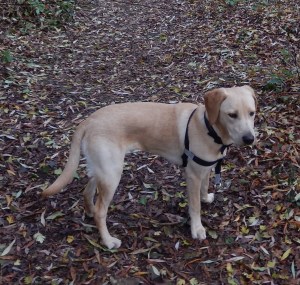
Just over a year ago my son and his girlfriend adopted a golden Labrador pup, Hugo. We participate in a dog share during the working week. Monday to Thursday, my wife and I look after Hugo. He is a character, about sixteen months old, still full of puppyish naughtiness and bounding with energy. Most days we go to the nature reserve for one of his twice daily walks.
A young Hugo
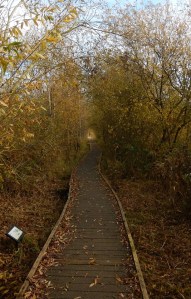
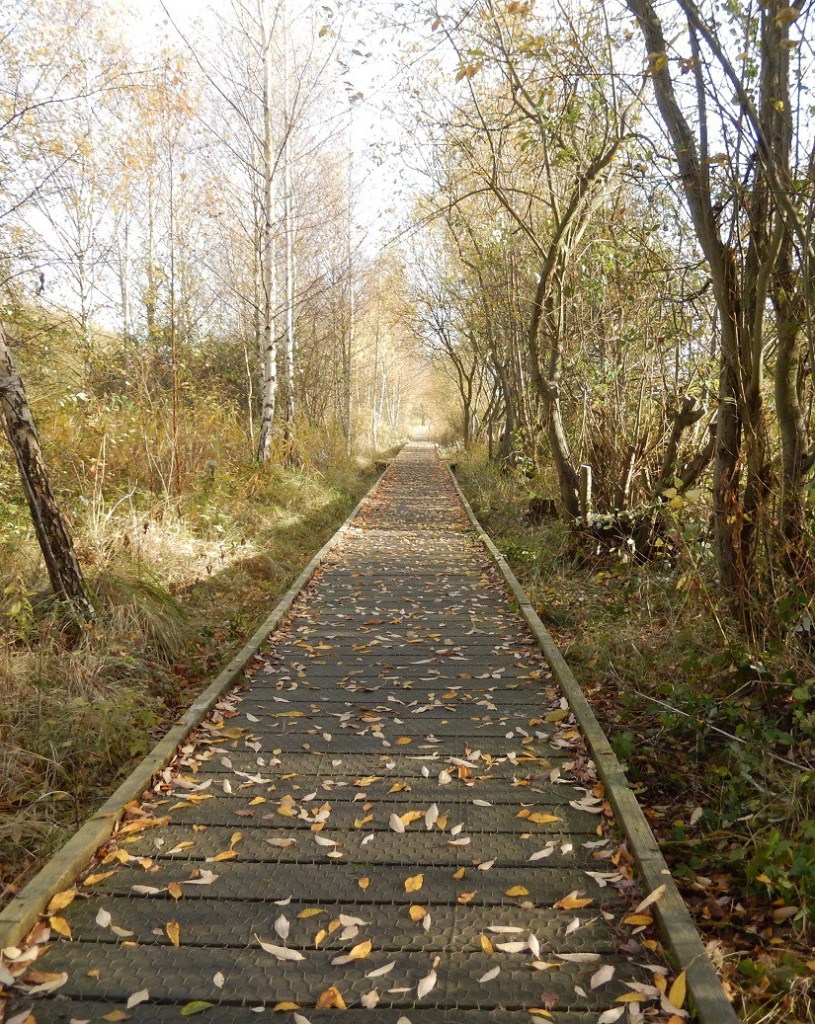
We usually start on the right hand side of the reserve entering through the galvanised metal kissing gate into the reserve. Before us a large field fenced on the right hand side to accommodate grazing cattle. We walk along a mud track worn into the grass, to the left rough grass edged by trees, falling away into a dip. Moving down the track, Hugo enthusiastically exploring new smells, pulling on his lead his tail wagging constantly.. The grass, mainly uncut is often still damp from the night the air full of wet leaved earthy smells. The field path ends at, the reserve’s boundary, marked by a hedge of Birch trees, Elder and Hawthorn bushes. The reserve is higher at this point, originally brick workings, then a refuse tip. Turning left, the track descends a slope then joins a raised board walk, about a foot from the ground which is prone to winter flooding. The ground is dry in the summer months the reeds and rushes flourishing. Alongside the slope are brambles their uneaten fruits available in the late summer and early autumn, an avenue of silver birch flank the board walk. The walkway follows the line of an old railway siding which had served the brickworks, broken willows decay amongst the birches, many perforated by burrowing Goat moth caterpillars. There is little audible bird song most is drowned out by the noise of vehicles at a gravel works and from the railway nearby.
The Boardwalk in spring
The Boardwalk in autumn
The walkway planking is topped with wire mesh to prevent slipping, to our left is a pool of open black water, much of it filled with reed and rushes, these die back brown for the winter. A few red dragonflies skim about as we walk, one foolhardily lands on the decking in front of us, Hugo fortunately doesn’t notice it, he eats them. During the autumn around the boardwalk the leaves of the trees and bushes, are a riot of brown and gold. Later in the autumn any greenery left is mainly from grass. brown leaves, predominantly hawthorn and birch form thick carpets in places. We leave the boardwalk ascending rough steps in the slope that are edged with old railway sleepers. Following another track through more brambles before ascending another set of steeper narrower steps back to near our starting point, then through the gate crossing to the left hand part of the nature reserve.
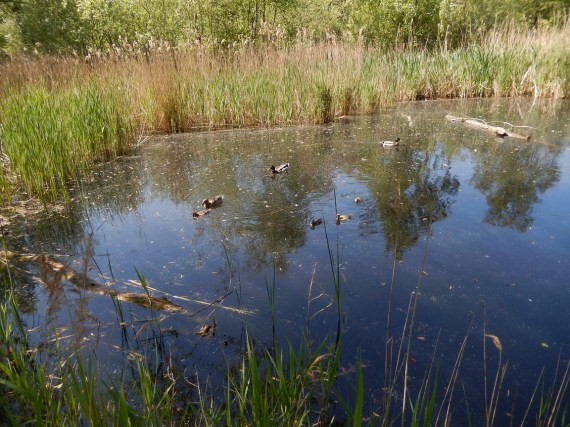
Ducks and Coots on the big pond
We enter by a kissing gate and descend wide steps cut into the slope edged by old railway sleepers. This part of the reserve has a larger cleaner pond, another former clay pit, home to ducks coots and the occasional visiting Canada Goose. At times we have witnessed fights by both ducks and coots in the water. If there are no young coots or ducklings around, Hugo likes a swim retrieving the sticks I throw for him. When either he or I have tired of the activity we resume our walk round the reserve. There is no boardwalk network this side of the reserve just one across an area that becomes waterlogged in the winter months. The paths are of rough earth worn into the ground through constant use. Leaving the pond area the reserve splits into woodland on the left and grass and scrub and bushes to the right. If the sun is particularly hot we stick to the shade of the woodland. retracing our steps when we reach the end before returning home. On cooler days we leave by a gate at the top and walk the long way home along the roads.
This nickname was given to The Huntingdonshire Cyclist Battalions, (The Hunt’s Cyclists) a military unit raised within the county of Huntingdonshire.
As part of the Huntingdonshire History Festival Mr Martyn Smith, webmaster of http://huntscycles.co.uk/ gave a talk at the George Hotel in Huntingdon on the 26 of July.
His talk about the Hunts Cyclist Battalion was interesting and informative. Several of the audience had ancestors or other relatives who had served in our local unit. Many men then moved on to regiments of the line to fight in France or overseas. The Hunts Cyclist battalion was only allowed to deploy in the British Isles under the army regulations of the time.
A photograph of A Company Hunts Cyclists at Filey in 1914
Most of us didn’t know but guessed at the high casualty rate; of those who joined, 25% were killed and 50% wounded in action. Many more carried hidden wounds until the day they died. Reliving unrelenting memories of horrors they had witnessed or grief for the loss of close, even boyhood friends. Post Traumatic Stress wasn’t identified as a problem then and no treatment was available.
This local battalion, a cavalry unit was started in 1908, the Earl of Sandwich its honorary colonel. Because Huntingdonshire was a small rural county, there seemed little likelihood that the 1000 men needed to form an infantry regiment would be available. A cavalry battalion only needed 500 men. However instead of horses, their steeds were to be bicycles, the soldiers were described as wheelmen. As some of the bicycles were allegedly made from surplus gas pipes, they became known as the Gaspipe Cavalry.
The Hunts Cyclists spent their active service in Yorkshire and North Lincolnshire protecting the coast from a possible German invasion. As Martyn pointed out their single shot rifles were no deterrent to the German Battleships which shelled some East coast towns. Their failure to deter the German navy led to ill feeling from the affected town’s residents who were disappointed in their failure.
The talk showed in great detail how the local Hunts community got behind their own men whether it was knitting warm clothing for them or converting vehicles to carry machine guns.
He detailed the development of the Gaspipe Cavalry’s mounts (originally the cyclists were expected to supply their own steeds). How rifle mounts were developed, the need for brakes, (very important in the hilly areas where they were stationed not so in the fens). There were many casualties caused by the cycles themselves until their design was improved
Another interesting feature was the billeting arrangements, bell tents for the unfortunate men, a hotel for the officers. He mentioned Charles Laughton, not from Huntingdon but a family member of the hotel owners in Scarborough where the HC. officers stayed. He was evidently recruited there. Charles Laughton became a famous actor in the twenties and thirties. Starring on both the stage and in films He went onto become a renowned film director and producer, dying in 1962 at Hollywood.
Mr and Mrs Richard Cumberland. My grandad and grandma.
My grandfather Richard Cumberland served in the army during the First World War. Joining the Hunt’s Cyclist Battalion in August 1914 before seeing active service as a member of Royal Warwickshire Regiment. He was discharged wounded in February 1918.
His first posting was as a member of A Company to Filey, I am not sure whether during the time he was there my grandmother joined him or not. I have a recollection of a story that Granddad helped out at the fish docks unloading the catches, whether this was at Filey or somewhere else in that area. This may have been as part of his duties or a bit of spare time private enterprise. When you are young you seldom ask the questions you should have done. Thinking that people will live forever you put off finding out information that will become so precious in later years.
War badge record showing Grandad’s discharge record
Martyn’s love of his subject, the tremendous respect and desire to make sure these men who sacrificed so much are not forgotten is something that will stay with all of us who were privileged to hear him speak, for a long time. He has made it his mission to track down every member of the Hunts Cyclists and commemorate each one, holding memorial services as he finds another grave or resting place. Honouring the men we owe our existence to
The Falcon Inn Huntingdon Headquarters of the Parliamentary forces’
Last Monday evening I joined a group of like-minded people for a guided walk to explore what was left of the Huntingdon Oliver Cromwell would have known. The tour had been organised by Huntingdonshire History Festival, our guide was Alan Butler, a long-serving volunteer at the Cromwell Museum.
Our group set off from the Town Hall heading for the North end of the High Street. It was here that Royalist troops entered the town following their thrashing at Naseby, to start what became known as the Battle of Huntingdon. The Royalists overcame local resistance and occupied the town for two days before withdrawing.
Moving South the next point of interest was Cromwell House, the site of Oliver Cromwell’s birth and home of his parents. Outside the house set in the pavement is a commemorative plaque one of several around the town. The original building in Cromwell’s time was a Priory. The house is now a care home.
St John’s churchyard is a little further along on the opposite side of the road to Cromwell House, Oliver was baptised here, the church was in a state of disrepair even then and didn’t survive the civil war pulled down near its end in 1651.
Moving along the High Street, Alan our splendid guide directed to cast our eyes to the roofs of the buildings on the George Hotel side. To the surprise of most of our group, we learned that most of these buildings dated from the seventeenth century. The twisted chimneys an important clue. My great-grandfather, then my granddad (his son in law) had a corn shop in one of these buildings no 63. I knew it was old but hadn’t realised it was that old. Now an estate agent the beams in the ceilings and in the party walls have been exposed and clearly visible, through the front windows. The George Hotel (outside). was the next stopping point, Alan said that Charles the First had his headquarters here for the two days the Royalists occupied the town.
On our left, as we moved southwards to what is now the Cromwell Museum. The rebuilt Old Grammar School where Oliver Cromwell and been a pupil and later one Samuel Pepys.
The Cromwell Museum Huntingdon from all Saint’s churchyard.
All Saint’s church was next, opposite the museum occupying one side of Market Hill, there is another commemorative plaque set in the pavement just outside the church gates. Oliver Cromwell’s father Robert is buried here in the family tomb. An old former Huntingdon neighbour claimed to have shaken hands with Oliver Cromwell’s father when work was being carried out on the tomb.
The Falcon Inn to the left of All Saints also in Market Hill was used as the Parliamentarian’s headquarters during part of the Civil War, it was also reputedly the recruiting station for the New Model Army. Remaining original features of the Inn include the heavy oak doors and the first-floor bow window.
The Falcon Inn Huntingdon Headquarters of the Parliamentary forces’
The present Town Hall directly opposite All Saints Church is built on the site of an earlier town hall. We walked behind the town hall passing the Market Inn, though old it isn’t thought to date from that period.
Moving south along the High Street we paused at Saint Benedict’s Court site of the church of that name. The church was said to have been destroyed by Royalist cannon fire during the Civil War. Stone reclaimed from the ruins of the church was used to build the Barley Mow public house in nearby Hartford.
Continuing along, Alan told us that lurking behind many of the present day shop and building frontages, older building remain. Again he directed our attention skyward to the evidence of twisted seventeenth-century chimneys. An open door from the High Street to one of the remaining passages gave us a glimpse of half-timbered walls on either side.
The present-day Hartford Road is shown on John Speeds map of the time, on the corner of which stands the Three Tuns Public House. My great-grandfather is recorded in the 1911 census as landlord (William Dixon). His daughter, my grandmother Lily, is shown in the record as working there, not Cromwell related but a bit of local history.
The Three Tuns Huntingdon
Saint Mary’s Church was our next port of call, this was old in Cromwell’s time, Robert Cromwell, his father had been one of its bailiffs. After passing more seventeenth century buildings, including the wonderfully restored 147 High Street, next to the former studio of photographer Earnest Whitney, we crossed the ring road to arrive at the stone bridge between Huntingdon and Godmanchester. During the Civil war, the central section was removed and a wooden drawbridge substituted as part of the town’s defences.
Entrance to Saint Mary’s Church Huntingdon
After visiting the Bridge we made our way back beside the ring road to Castle Hills, during the Civil War the earthworks were used as defensive positions. The hill top commands a good view with firing positions for cannons over the river and the bridge. The site would have been larger in Cromwell’s time the encroachment of first the railway then the A14 has taken a sizable portion of the site.
We completed the tour near the Bus Station, at the town sign, lamenting collectively about the lack of a statue to Oliver Cromwell, in this his birthplace. He is described by Antonia Fraser as our “Chief of Men” and by Christopher Hill as “God’s Englishman”.
Thanks Alan for a most interesting tour.
If you fancy seeing what’s on offer at the Huntigdonshire History Festival try this site:
I was asked to start what will hopefully become a discussion on the Whittlesey Wordsmiths blog about writing. As a member of this group I have been helped by their support and privileged to meet a group of very talented individuals. Hopefully some of this talent will rub off on to me, they can spare a bit.
Any way the piece is on the blog please take a look and add your two pennyworth or more.
A version of this article was published in Best of British Magazine in their Past Remembered section. A first for me, being paid for something written by myself.
I was about or just under thirteen years old when starting my first newspaper round in Huntingdon – a morning round, using a Pashley small front-wheel large-basket trades bike. A Sunday round was added next, in a different part of town. At that time there was competition for paper rounds, even waiting lists. My evening round was the most interesting. The morning and Sunday rounds I delivered for a newsagent but the evening round was my first taste of self-employment.
An older lad leaving school gave me the round. The papers were bought direct from a wholesaler and sold to the public. In 1964 the gross profit per paper was one penny – the old penny: large and 240 to the pound.
The wholesaler used an office at a garage and taxi company’s in Ferrar’s Road. It was situated in the back corner of a rectangular cobbled yard, the house at the front was the garage owners’. There were workshops down one side of the yard, a high wall along the opposite side. The back of the yard, away from the house, had more buildings and an arch with a driveway underneath leading to lock up single garages rented to the public.
The office contained a desk, a typewriter and chair, two largish tables, two more chairs, a telephone, tea-making facilities, also a large machine for printing Stop Press onto the papers. The evening papers sold by my wholesaler were London papers – The Evening News and The Standard. He was also the local wholesaler for a few magazines, one of which was Private Eye, a good read even then.
After finishing school, dropping my things at home, and collecting the trades bike, it was off to the wholesalers. There I collected about a dozen papers before cycling to the railway station. In the station I sold papers to waiting passengers – at first on the platform nearest the ticket office then, crossing the footbridge to the northbound platform, to commuters waiting there. When the express train from London arrived – I can’t remember whether, at that point, they were still steam or early diesels – the papers were collected from the guard’s carriage. The two bundles were carried back over the bridge – Evening News on my right shoulder, Evening Standards in my left hand – heaved into the basket of my bike, and I would be off.
There was a steepish hill out of the station to George Street but after that it was downhill leaving George Street, to use a short cut down cobbled Royal Oak Passage to the High Street. The passage had a central gutter then with an iron drain about halfway along. One day the bike’s front wheel caught in the drain, catapulting me over the handlebars. The bike stood on its end, the heavy papers pinning the basket to the ground.
Royal Oak Passage as it is now the central gutter and drain have both gone
Once through the passageway, my journey would continue up the High Street to the wholesaler’s delivering the papers to the office.
P Cumberland DN The wholesalers were in the far right-hand corner of the outbuildings painted white. The house at the front belonged to the owner of the garage.
The Stop Press news would be received by telephone and transcribed in shorthand by the wholesaler’s secretary, the garage owner’s wife. The news was typed up onto a Roneo stencil, a narrow strip that looked like carbon paper perforated at one end. The stencil was loaded onto a drum at one end of the Stop Press machine, the papers placed onto a shelf at the other end then fed onto a conveyer by hand. The conveyer passed papers under the rotating drum, which printed the news updates onto each paper in turn.
As soon as a dozen papers were printed. I would take them to a nearby factory – The Silent Channel – this company made rubber mouldings and also the guide channels for vehicle windows, cycling around the factory to sell as many as papers as possible before returning to the wholesalers to collect the rest of my papers. The other distributor at the wholesalers had driven off by then in his Austin A30, delivering papers to local newsagents.
Pashley Trade’s Bike
The basket would be reloaded then I would head for the home of my assistant Stephen. His was the original round acquired from my predecessor. When he had his papers it was off again, next stop French’s offices and hostel. French’s were building London overspill estates, enlarging Huntingdon. After selling papers around their premises I delivered my own round, looking out for new prospective customers at the same time. A small John Bull printing set enabled me to produce advertising cards for evening paper delivery services, posted through the letter boxes of new arrivals, followed up with a call, which often gained new customers. The business was given to Stephen when I left school aged fifteen keeping a Sunday round on for a few years afterwards. I have a Sunday paper round now, have had for fifteen years or so, but in a different town. I am probably now the oldest paper boy in the Fens
For many years I have loved the song Moon River, vaguely aware that it was connected with the film Breakfast at Tiffany’s. I was browsing the DVDs at a local charity shop looking for Funeral in Berlin when I found a copy of Breakfast at Tiffanys. I bought it and watched it tonight for the first time. Those of us who grew up during the sixties, well me at least, always associate that time, that decade with hope and a feeling that things were improving, would continue to improve.
Breakfast at Tiffanys has that feeling about it. A journey leading the two main characters, played by Audrey Hepburn and George Peppard, away from dependency on those who sought to buy their souls to a hopeful better future. A film like all good films for me, with a happy ending. Most of us if not all us want happy endings, not always for ourselves but more importantly for those we love and care for. A journey with our own Moon River perhaps.
The walkway at Lattersey Nature reserve the beauty of this scene constantly changes with the seasons
Whittlesey Wordsmiths are fortunate to have within their ranks, two published authors, winners of fiction writing prizes, a very able editor/ proof-reader and a talented biographer.
Set up under the Whittlesey U3A umbrella this local group meets monthly at the Scaldgate Centre in Whittlesey. Meetings are held every first Thursday of the month from 11am, anyone is able to attend a free taster session but will need to join the U3A to become a member of the group, the fee is £3 per meeting to cover venue costs.
At recent meetings we have been fortunate to have had presentations by two local authors on the intricacies of publishing a book, both in print and online. The talks were informal, informative and very instructive. Thank you Stephen Oliver and Stuart Roberts. Like many commonplace objects that successfully manage their function, we ignore the container, giving it little or no regard but delight only in its contents. In the same way that we ignore the jar the jam arrives in, caring little for its design, construction and functionality, so it is with a book. We care little for the printing unless the quality is so bad it makes reading difficult, little for the binding (unlike Samuel Pepys) but only on the written words within.
Publication, its details, fonts, layout, sizes, printing, copyright and a myriad other things, though only covered briefly, were for most of us a completely new field.
A current project is to produce a collection of work by the Wordsmiths in time for Christmas, these talks were a help in focussing attention on the job ahead. The content is being assembled with ease from the increasing pool of talent, that is the group. The hard work will probably be assembling it into a finished product, not the filling but the container.
I had the privilege of reading the first novel by a locally based author and a request for my thoughts.
It is always difficult to invite criticism of your work, knowing that from personal experience. Whilst my work involved selling products I had designed and made, writing a book is equally as difficult. No one should underestimate the mental and emotional effort required together with dogged determination to turn an idea into a finished written work.
Stuart’s first book, a supernatural thriller, is a damn good read, in fact, it is a really very damn good read, I consumed it in less than a day finding it difficult to put down. Most of my reading is either detective fiction or espionage thrillers so was unsure whether something that wasn’t within those genres would work for me. The story centres around two men from different backgrounds thrown together by circumstances into, for them the alien environment of a mental health ward. The edgy story twists and turns before reaching a nail-biting conclusion.
I look forward to seeing more work from this very talented man and hope a second novel is underway.
I have had an email asking me to put a link in my post from someone who would like to get a copy, so for them and anyone else interested.







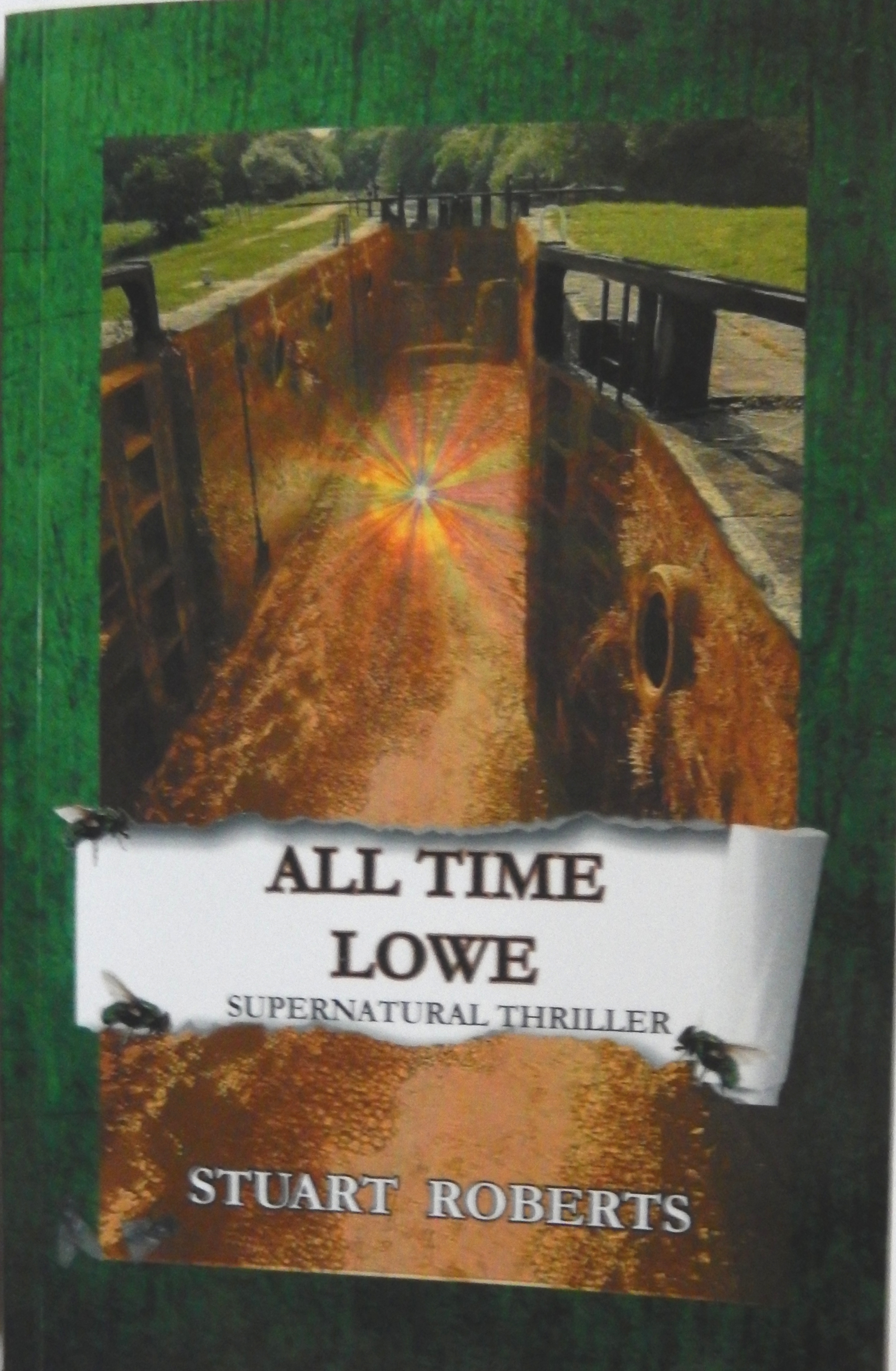 All Time Lowe. Written by Stuart Roberts
 Fenlandphil's Blog