I have joined Cambridge University Library’s Really Popular Book Club, The Unlikely Pilgrimage of Harold Fry, was September’s chosen book. Unfortunately, I won’t be able to attend the Zoom meeting to discuss it. I have an unexpected journey to undertake at the same time the meeting is due to happen.
The story starts when Harold Fry receives a letter sent on behalf of a former work colleague, Queenie Hennessy. Harold hasn’t heard from Queenie in twenty years, the letter is from a hospice in Berwick on Tweed. The letter written on Queenie’s behalf, informs Harold that Queenie is suffering from terminal cancer and has very little time left. Harold writes a reply and sets out to post the letter he hesitates at the post box and then at the next one. He decides instead to walk to Berwick on Tweed to see Queenie in person.
Harold’s journey is a remarkable one, not only for the people he meets on the way some of whom and a dog walk with him but also as an examination of his past, his personality, relationships and regrets. The walk north from Kingsbridge in Devon, without preparation, proper hiking equipment a map or compass, is physically arduous, as Harold discovers. Yachting shoes are not ideally suited for a long hike, in all weathers. It was a companion walking with Harold that coined the title The Unlikely Pilgrimage of Harold Fry
As Harold walks, the back story of his life, his marriage to Maureen, his childhood and his relationship with his son David, is slowly revealed. We are drawn into an emotional journey as Harold reflects on these things. It is as much a journey of self discovery for Harold as a physical journey. For myself as the reader I found it incredibly moving and like all really good books The Unlikely Pilgrimage of Harold Fry, will inhabit my thinking for a long time.
I am interested in Crime fiction as both a reader and writer. When I saw the exhibition, Murder by the Book at Cambridge University Library advertised, I decided to visit. The guided bus from St Ives seemed the best option for travelling to Cambridge, it was just a question of timing my journey to be late enough to use my bus pass but early enough to arrive in time for the 11 am pre-booked slot.
My route on foot, from the Round Church bus stop, planned mainly courtesy of Google maps started in St, John’s Street, which led into Trinity street followed by a left turn into Trinity Lane. A little way along Trinity Lane a right turn took me into Garret Hostel Lane the lane narrowed as it approached the Garret Hostel Bridge over the river Cam, Trinity Hall’s Jerwick Library sits more or less on the bridge on the left. Punts were moving along the river tour guides working the poles as they pointed out places of interest on the banks, to their passengers.
Guided punt tours.
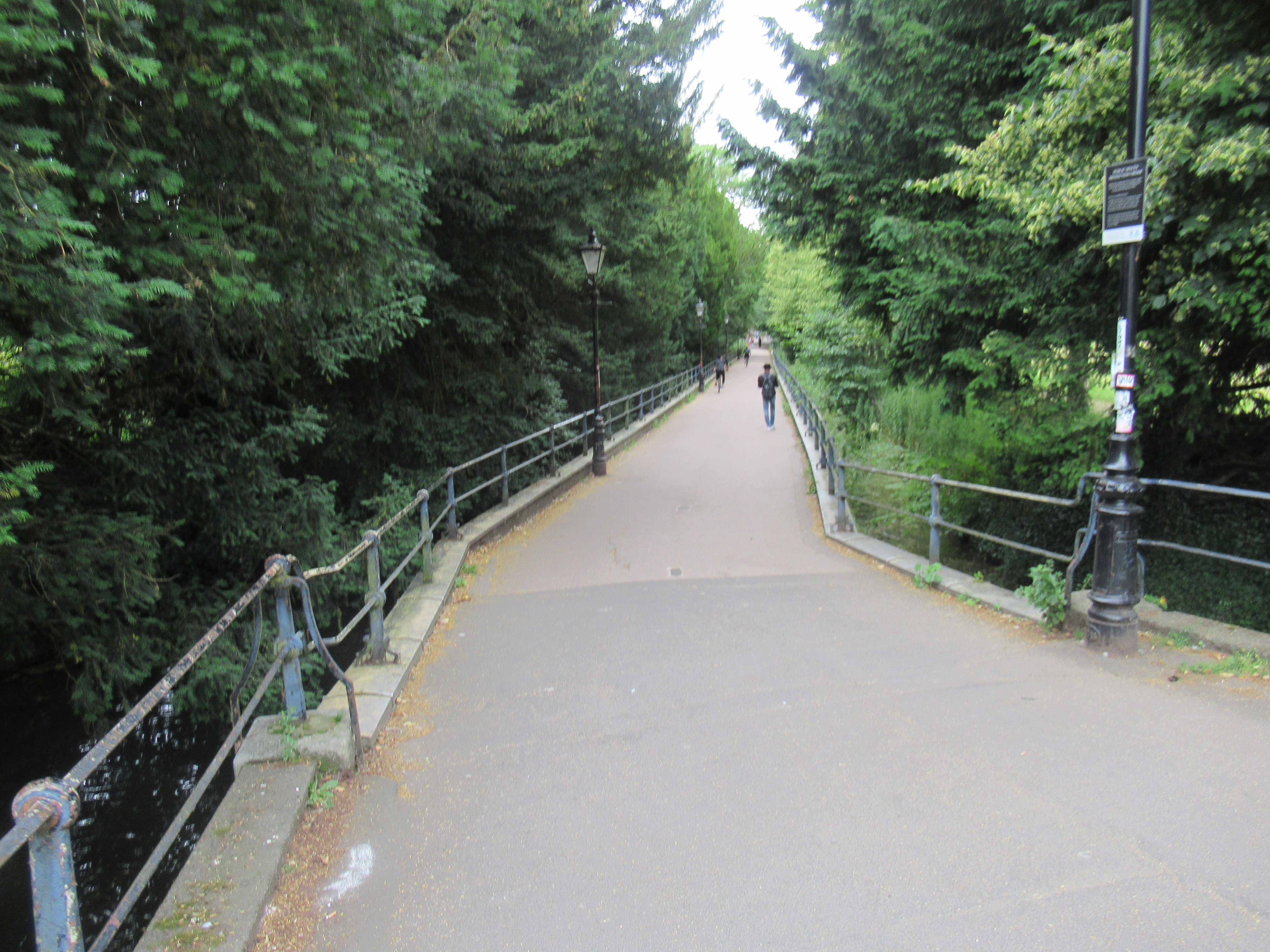
The bridge heralded a change the walk was no longer flanked by buildings but after the bridge the lane was tree lined.
Garret Hostel Lane after the bridge
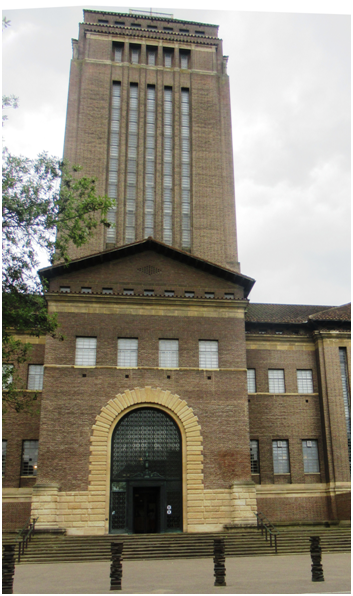
At the end of Garret Hostel Lane, the route took me across Queen’s Road into Burrell’s Walk. Before long I was at the gateway gazing at the imposing University Library Building and facing it to my left was Clare College.
It is difficult to show the size of the library building, if I remember correctly this tower houses the crime fiction collection. If that is the case, somewhere within lurks Arnold Lane, Marvin and of course Sylvia.
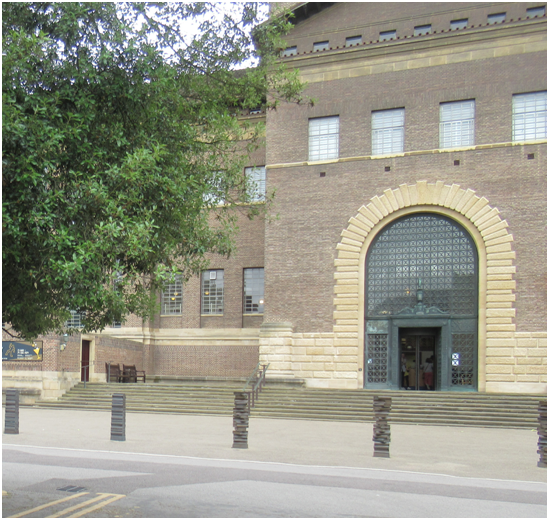
The entrance to the library
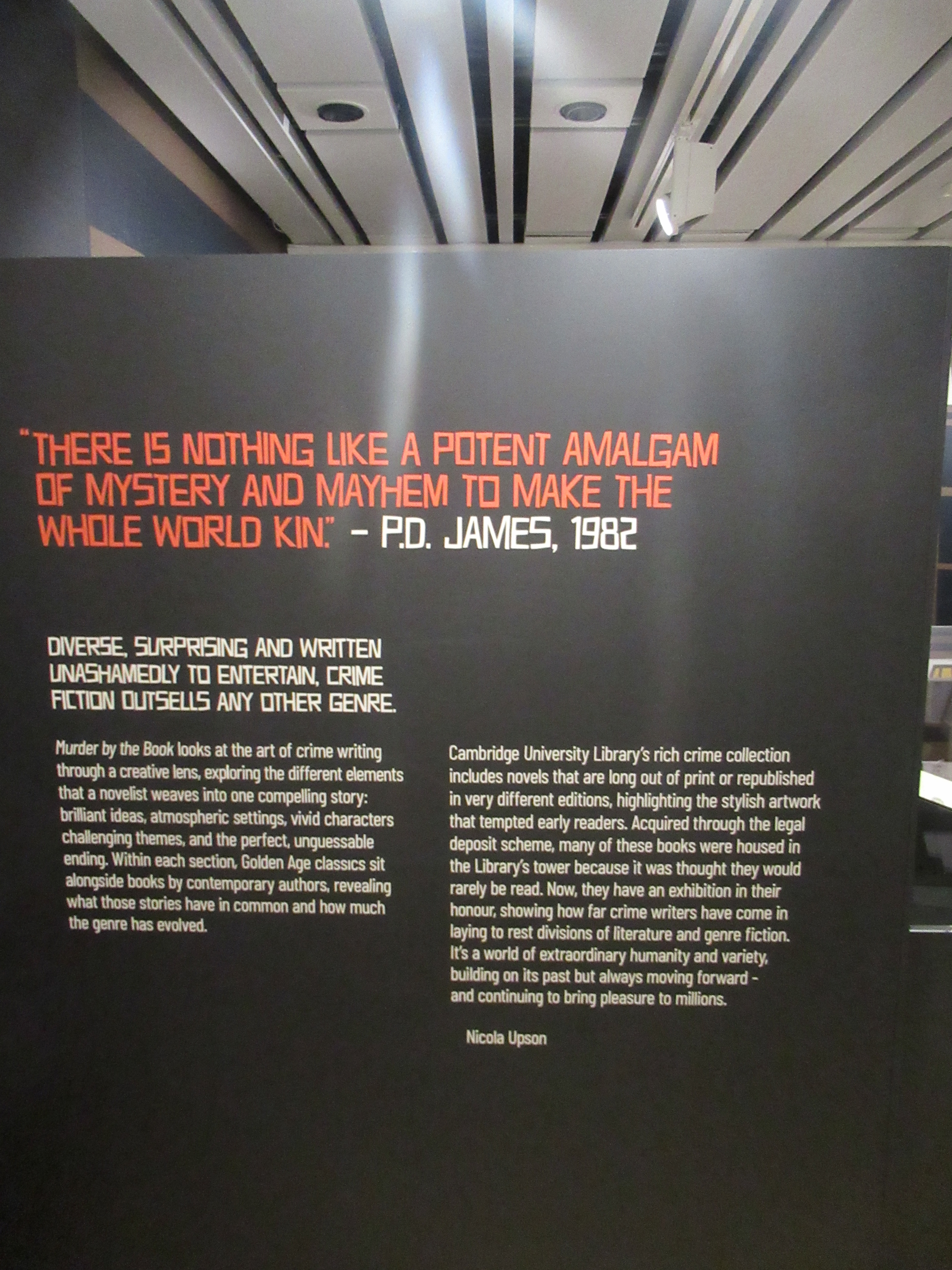
Once I was through the imposing entrance I made my way to the exhibition. The first thing I noted was a quote by PD James, one of many of hers within the collection.
P.D. James telling it like it is
The exhibition started with a chronological history of crime fiction with copies of some of the very earliest works Wilkie Collins The Lady in White and an even earlier work whose title I didn’t note.
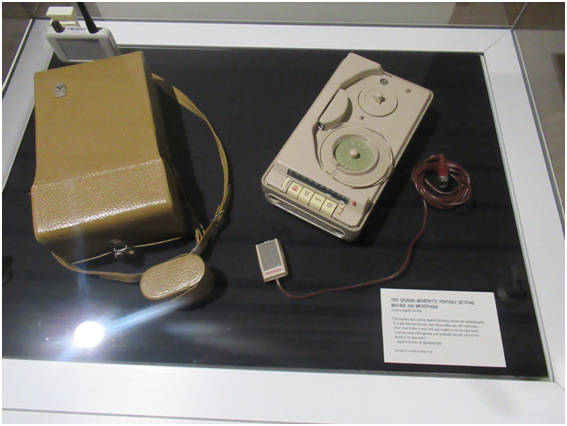
Unsurprisingly Conan Doyle’s Sherlock Holmes books featured prominently in early British crime writing. Slightly later came Dorothy L Sayers and of course Agatha Christie. On display were several exhibits relating to Agatha Christie, her Dictaphone which came into use when she broke her arm and her portable typewriter. However, the items relating to Agatha Christie which held most interest for me were her notebooks, a separate one for each book it seemed. That is one idea I might borrow.
Agatha Christie’s dictaphone.
I took a leisurely stroll around part 1 of the exhibition, many of the authors were familiar to me PD James, Dorothy L Sayers, Sir Athur Conan Doyle and of course, Agatha Christie but there were others unknown to me including, Martin Blake, Ellen Wilkinson, Cyril Hare, Nicholas Blake and Celia Fremlin.
Another P.D. James quote and totally accurate.
Further along were some more contemporary authors H R Keating, Ian Rankin, Ruth Rendell, Lynda La Plante and Marjory Allingham. I looked for books by Raymond Chandler but didn’t see any of his displayed, although he was based, as was his writing in America, he was an Englishman.
More contemporary crime fiction.
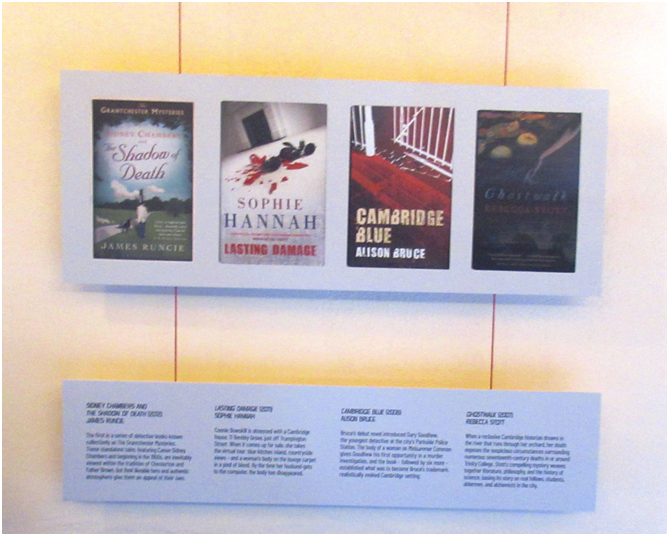
Having completed the circuit of part 1, I stowed my bag in the locker room and made my way upstairs to the gallery and the other parts of the exhibition to find books by authors I had met. For me, Alison Bruce’s D C Gary Goodhew, could well fit the bill as Cambridge’s iconic detective, a possible answer to Oxford’s Morse but he wasn’t elevated to this position by the powers that be. However Cambridge Blue had a well deserved prominent position as did books by Sophie Hannah and Ellie Griffiths two other authors I have had the pleasure of meeting.
On the first floor part 2 of the exhibition.
When I had seen all the exhibits I sought refreshment in the café situated on the first floor at the end of the gallery. The mistake I made was not bringing my tablet computer in with me in a clear bag I like the quiet of libraries to write in and with generous-sized desks or even in the café, this quiet place would have been ideal. However, on this occasion as I hadn’t used the clear bag for my laptop it would have to be the Central Library.
An ideal place to write.
This picture of just one of many corridors leading off in different directions and on several floors gives a glimpse of the size of the building.
I retraced my steps to Trinity Street and then made my way through the city to the Central Library, on my way along Kings Parade I came across students, well graduates now, in white trimmed black gowns together with their families emerging from a graduation ceremony. It was I am sure a proud moment for all those concerned.
A graduation, one of many in Cambridge during the summer a moment of pride for all concerned.
All in all, after a short stint of writing at the Central Library and the return trip on the guided bus, it was a great day out.







 Fenlandphil's Blog