I’ve had an interesting week and a half. On the 27th of August, a Wednesday, I was admitted to Hinchingbrooke Hospital for a scheduled hernia repair. It was keyhole surgery, and I was discharged the same day. I spent a reasonable night at home, a little uncomfortable but nothing too worrying. The next morning, I was up early and getting one or two administrative chores out of the way and feeling quite good. However, by the evening, I wasn’t too well and brought up what appeared to be dark blood. My wife and I concluded that, as a tube had been put down my throat to help with breathing during the operation, perhaps it had caused some bleeding.
By Saturday evening, things had become worse, so I contacted the hospital, “No, it isn’t normal, dial 999.” The ambulance could only deliver me to Peterborough. Aware of the possibility of miscommunication between the two hospitals, my brother took me to Hinchingbrooke and delivered me into the welcoming arms of A&E during the early hours of Sunday morning; they were expecting me.
After a while I was wheeled into the same ward I had been admitted to the previous Wednesday. It is always difficult to get answers it seems, I was connected up to drips and given blood transfusions but apart from a doctor telling me it wasn’t a surgical problem and that I would be moved to a medical ward that was about it. The hernia repair gave me no trouble and seems to be a well executed piece of surgery. Eventually I was given an endoscopy and a diagnosis of a Hiatus Hernia. When I was able to talk to a consultant I asked him if what they had found could have accounted for such a large loss of blood, (about one and a half pints or to use the Tony Hancock scale one and a half armfuls). He assured me this was the likely cause.
While lying in bed on my back, I started to examine the ceiling of the ward I was in. Hinchingbrooke Hospital is suffering from the problems of RAAC (dodgy concrete), and they are desperately trying to rebuild it while keeping it open. The ward’s ceiling and presumably the roof above it are now supported by a grid of 203 x 203mm Universal Columns; the minimum weight of this size of column is 47kg per metre (close to a hundred weight per yard). Nearly forty years ago, when I started my metalworking business, the supply price of manufactured structural steelwork was £1000 a tonne; prices haven’t gone down in that time. It wouldn’t surprise me if the cost of the steelwork alone, supporting the roof in that ward, exceeded £20,000, not including all the installation costs. Meanwhile, within half a mile as the crow flies is the original Huntingdon County Hospital building is still there intact and over one hundred years old.
Some of the steelwork.
The ward staff were brilliant, compassionate, patient and caring. When I was asked if I would mind vacating my bed early while waiting to be collected I had no hesitation in agreeing. The chap they wheeled in looked very poorly. It was heartening to see the love of mainly, wives, daughters and granddaughters for their, husbands, dads and granddads.
Above all else the experience has given me a renewed hope for us all.
A little while back I attended an event at Niche Comics Bookshop in Huntingdon, (yes I do visit it often, they are nice people and as I lived in Huntingdon until I got married I know the area). At the event in question, a book launch, Rosie Andrews’s, Puzzle Wood, I bought The Twyford Code by Janice Hallett, however, a mystery shelf with books gift wrapped and a brief description attached attracted my attention, (Blind Date with a Book.)
What was inside.
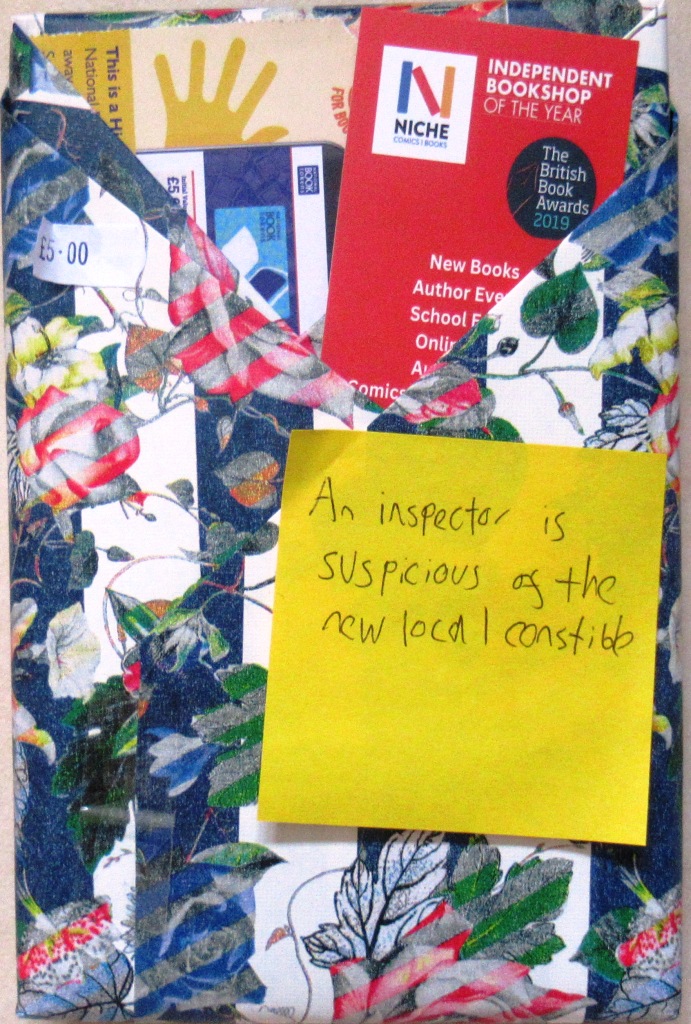
Tenpted I parted with my five pounds, it was an absolute bargain, because there was a five pound book token wrapped in the packaging, in effect, to celebrate Independent Book Shop Week, it was a book for free.
I waited until the next morning before unwrapping my purchase. The book inside was A Shot in the Dark by Lynne Truss. I have now finished reading the book and loved it.
A Shot in the Dark by Lynne Truss
The book is written about and set in 1950s Brighton, at around and following the time of Graham Green’s Brighton Rock, of which it alludes. Newly graduated, Constable Twitten finds himself at Brighton Police Station. Twitten has been moved from police force to police force on an almost daily basis since qualifying. It soon becomes apparent that Twitten’s keen, insightful approach to policing and crime solving is an irritant to his superior officers which has seen him quickly moved on elsewhere.
Having arrived at Brighton police station then left unsupervised, Twitten leafs through recent crime reports and quickly discovers a pattern in a spate of local burglaries. When he is imprudent enough to share his thoughts with his boss, Inspector Steine, it upsets the inspector creating the possibility that Twitten will be moved on yet again. Since Steine’s famous triumph in the case of the Middle Street Massacre, he holds the opinion that there is no crime in Brighton and isn’t keen to have this view challenged, particularly by Twitten.
A Shot in the Dark, although violent, set as it is in the era of Teddy Boys and serious criminality; its approach is completely off the wall. The activities of a criminal mastermind are well hidden as is the mastermind’s identity. However, when Twitten thinks he has put all the pieces of the jigsaw together his problems are not over. Lynne Truss has assembled a colourful cast of characters including a clever charwoman, a bricklaying strong woman, a Phrenologist and other interesting characters; the story is entertaining and engaging. I’m glad I tried this blind date..
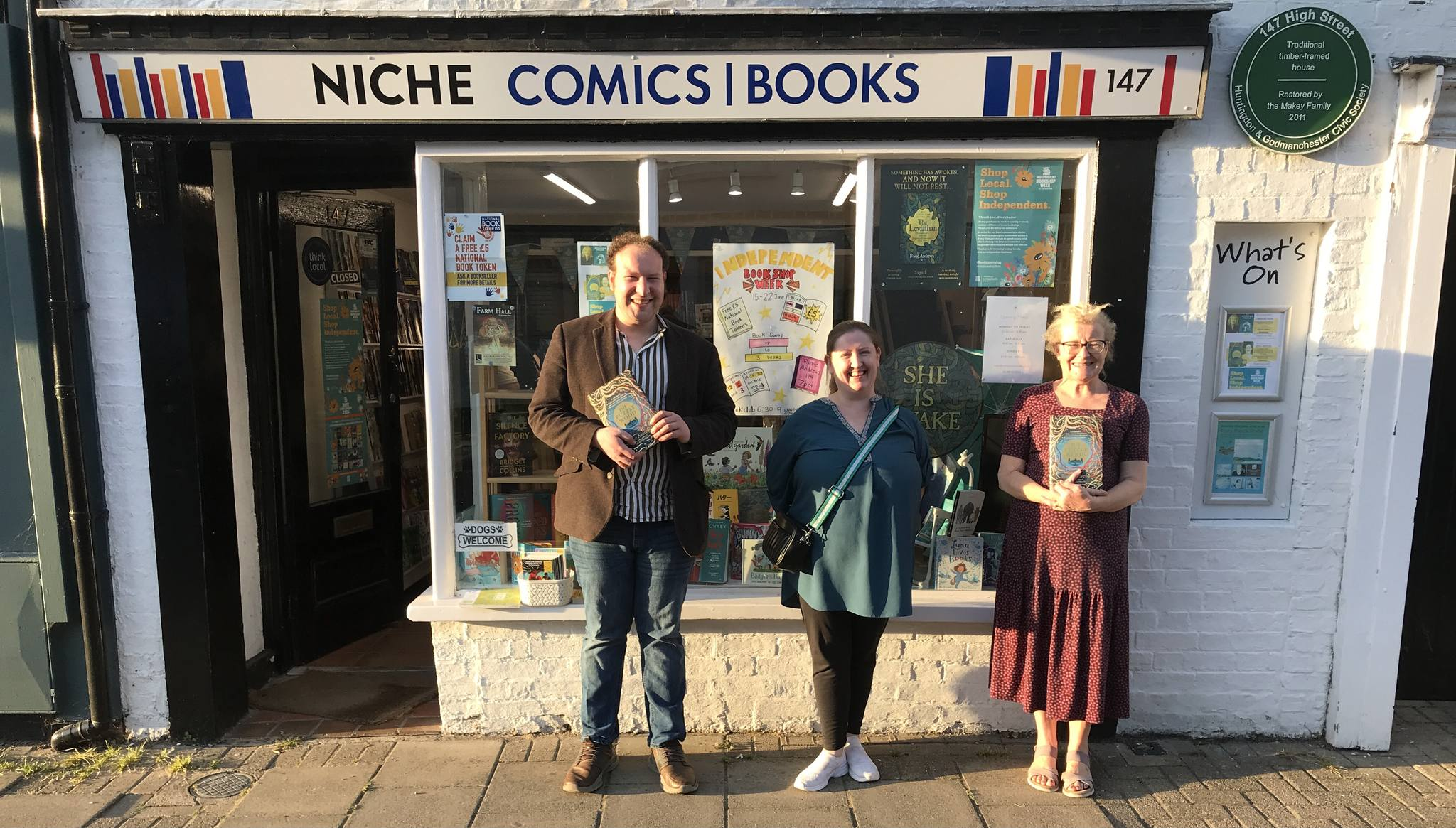
From left to right Guy Makey, Rosie Andrews and Angela Makey (photo credit Niche Comics)
Cathy Cade and I recently attended an event at Huntingdon’s, Niche Comics Bookshop as part of the celebrations for Independent Bookshop week. I wasn’t intending to buy any books so of course I came away with two.
The Bookshop is a seventeenth building with all the quirkiness and eccentricities of something that old, the low height of the doorway into the garden is a particular problem for unwary people taller than about four foot eight.
It was in the garden that we were introduced to Rosie Andrews launching her new book The Puzzle Wood. Rosie had started life in Liverpool a child in a very large family, the third of twelve children. After she graduated from Cambridge University with a history degree, Rosie became an English teacher. Her first book The Leviathan was a best seller.
Rosie Andrews signing books in the garden.(photo credit Niche Comics)
During the question and answer session Rosie mentioned that she had been a member of a writing group near St Ives, it was there she met local author Alison Bruce, a smashing lady not only connected to Niche Comics but also someone I have met on several occasions.
My first purchase of the evening
The mystery £5 package
And this is what was inside
With wine, tea and homemade cakes on offer, not to mention cracking deals on books it was a really wonderful evening. Thank you Angela, Adam and Guy.
I didn’t find out about this event organised by indiebookfair.com until it was too late to hire a stand for our Whittlesey Wordsmith’s writing group. However I thought it would be a good plan to visit and see what the event had to offer. I had no intention at all to buy books, I have according to my lovely wife, more than enough as it is.
Indie authors are those that often self publish their own books either individually or cooperatively with other authors. It is a great community and they, like all the authors I have met are encouraging and supportive.
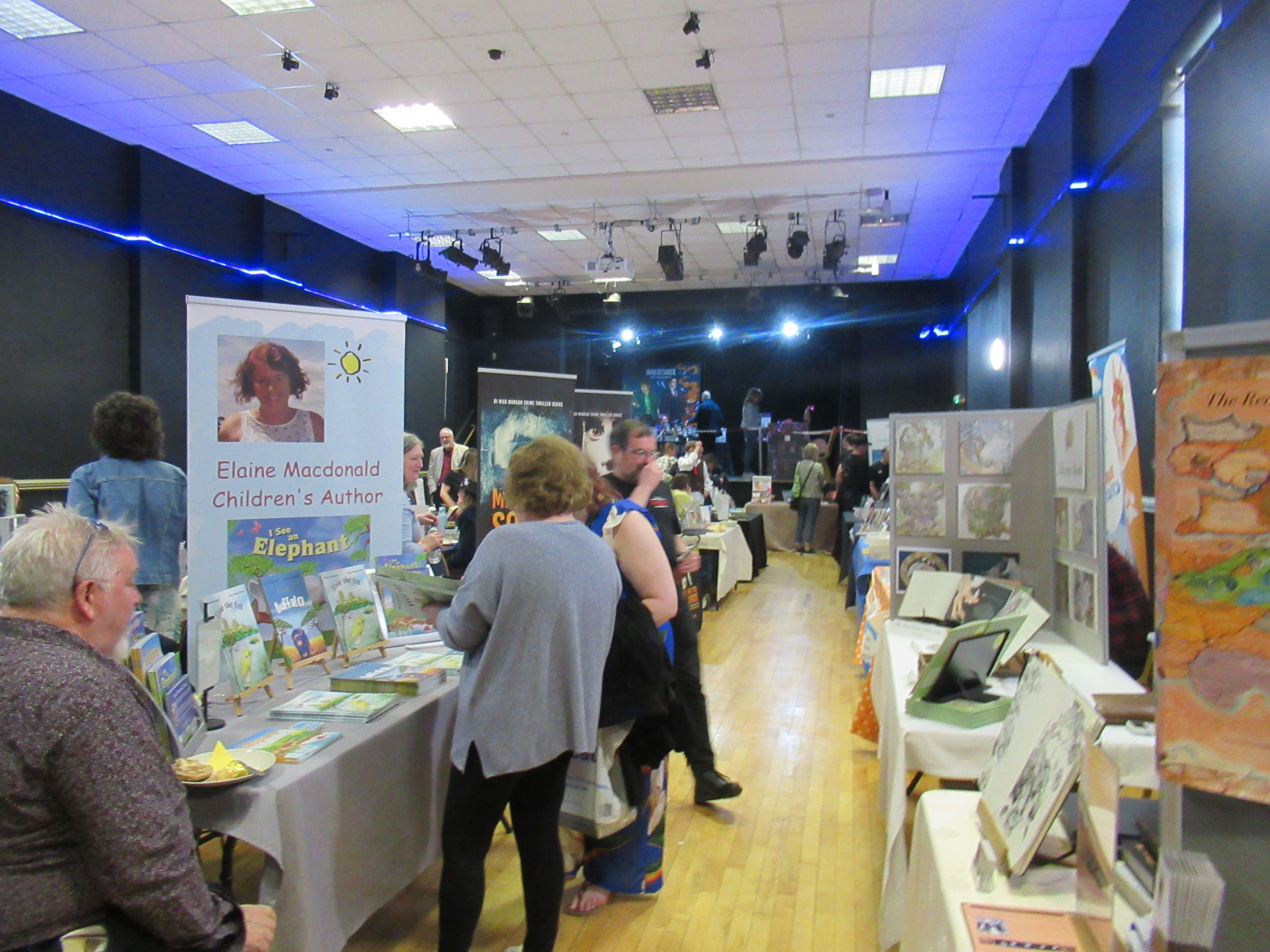
A bit of a lull so I could get a photo
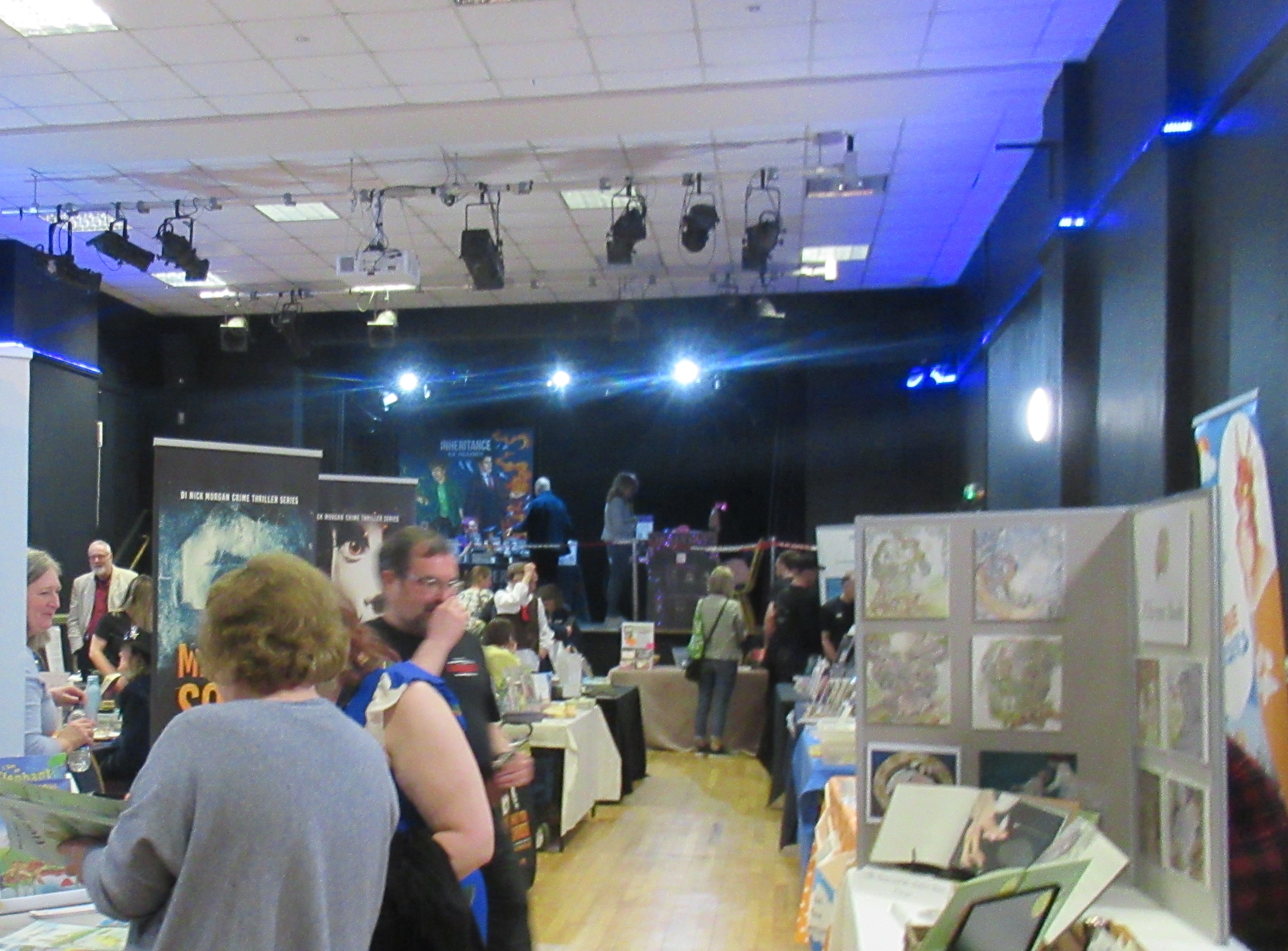
The hall was nicely laid out and there certainly wasn’t any space for more stalls, it was fully booked. The public seemed to like it too it was getting quite crowded as I walked around. It was a really interesting event and a chance to amble round and meet other local authors. The exhibitors catered for just about every genre, from children’s stories, to puzzle books for elderly dementia sufferers and just about any subject in between.
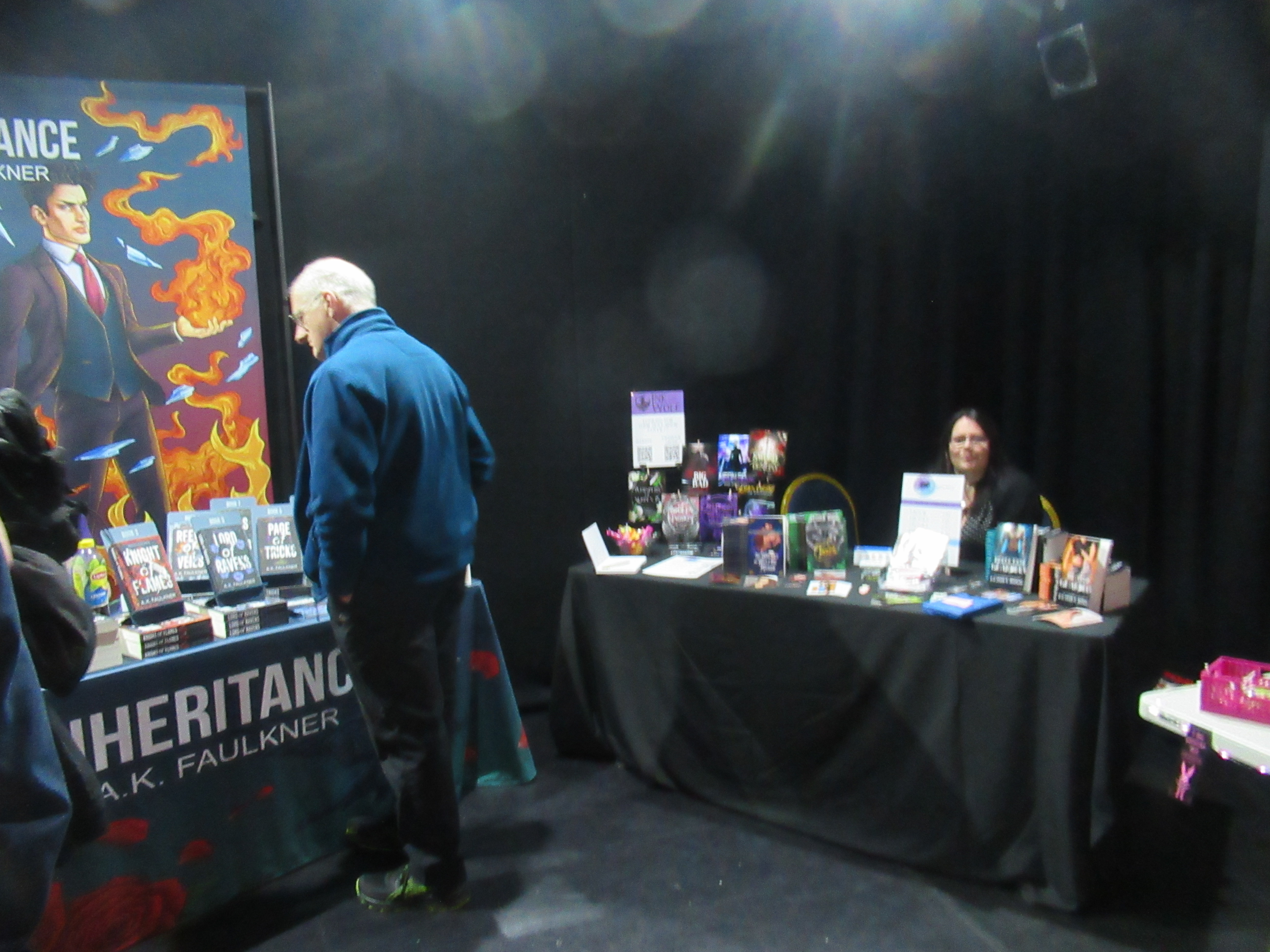
Even the stage was used
Browsing
A particular highlight for me was meeting Carol Carman; Carol had been the sound engineer for Dennis of Grunty Fen’s, broadcast on Radio Cambridgeshire, working with the late Pete Sayers, (Dennis) and Christopher South. The programmes, were broadcast on Radio Cambridgeshire every Sunday morning, they were what the wireless was made for. Christopher South would interview Dennis learning more about the wild world and community that is Grunty Fen. Christopher South has written four books about this intriguing community. I bought number 3 in the series from Carol.
Carol Carman with her books and those from Grunty Fen.
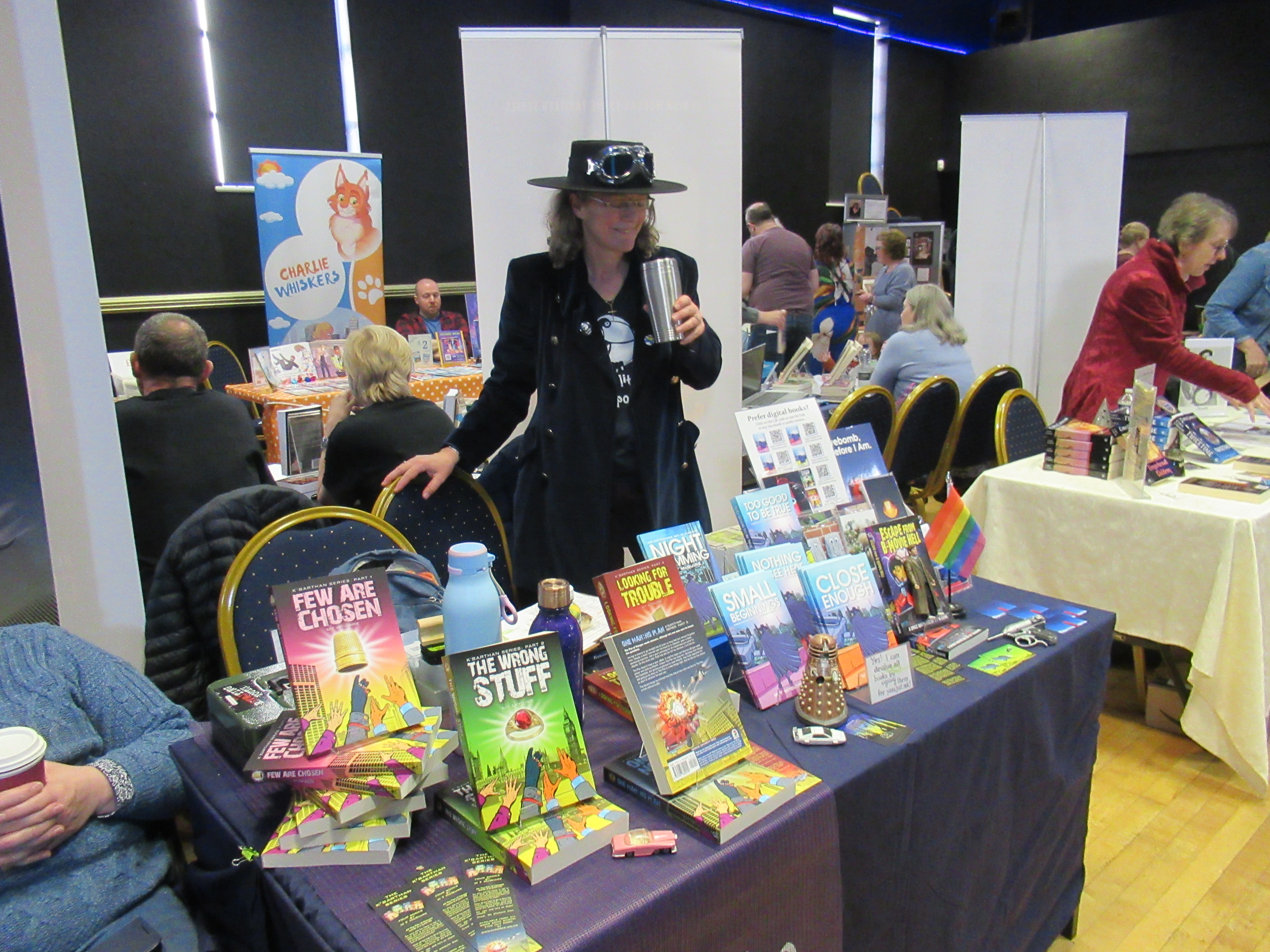
Close to Carol’s stall was a remarkably dressed lady M T McGuire a science fiction author, one of the panellists on the author panels I attended later in the day I didn’t catch her forename, which I know isn’t M..
M T McGuire
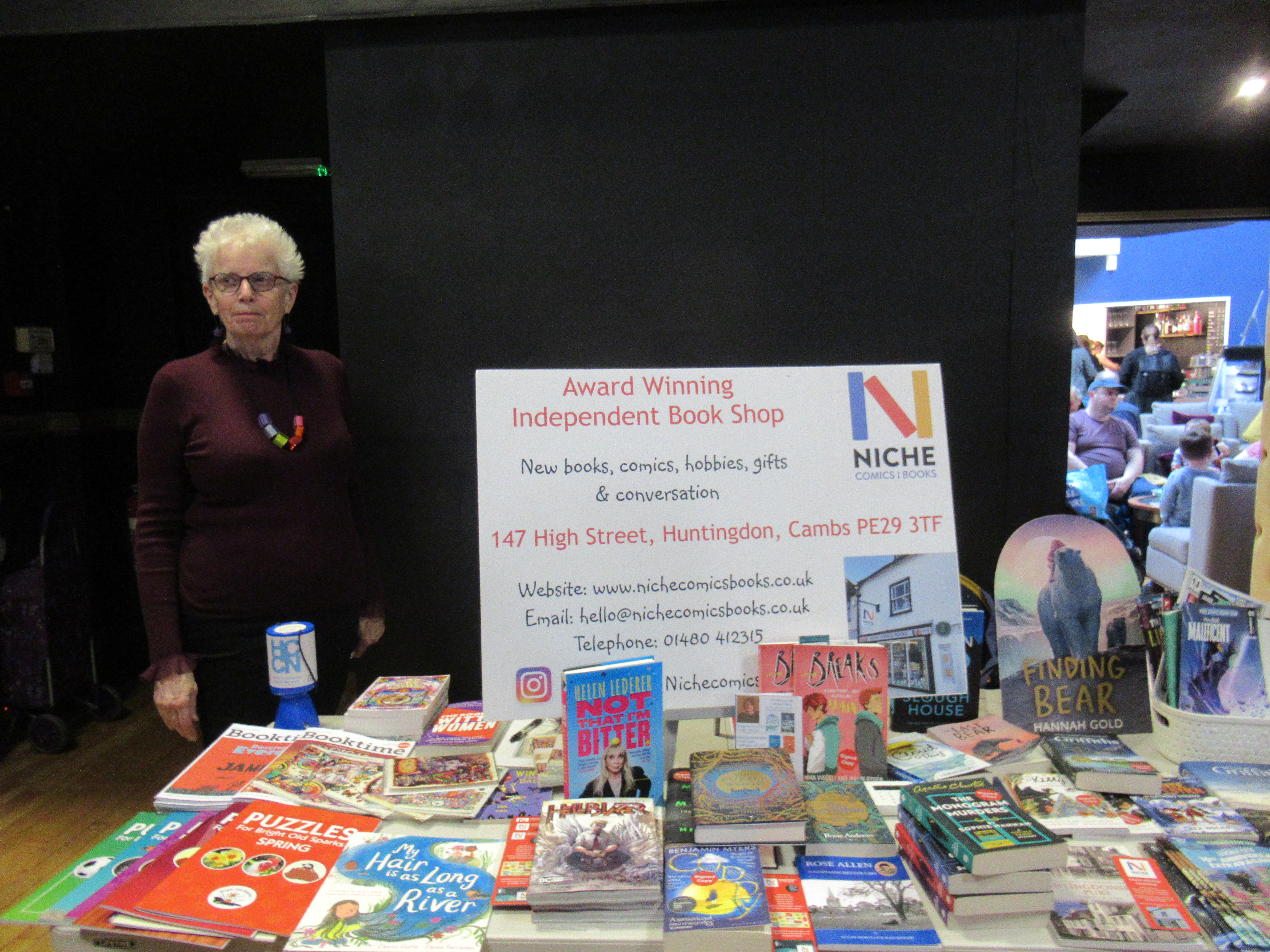
Niche Comics Bookshop had a stall in one corner with Angela presiding and Gill Ashby, author of the Bright Old Sparks Books in attendance.
Gill Ashby, author of Bright Old Sparks on the Niche Comics Book Shop stand.
It was great wandering around chatting to the authors and despite my resolve not to buy any books I came away with 3 in total.
I usually get to see my brother most weekends, one Sunday he suggested we visit the SOE Barn at Tempsford.
I had been aware of the Special Operations Executive (S. O. E.) for a long while, initially from memory, by reading about the British secret services during World War Two. Until I attended a lecture as part of a Huntingdonshire History Festival in 2019 from memory, I was unaware of the very local connection to my home town Huntingdon.
The SOE had a base in Godmanchester, Farm Hall, where SOE agents were trained and housed until they were taken to Tempsford Aerodrome near Saint Neots. From Tempsford they were flown to Europe at night either to be dropped by parachute or landed in Lysander aircraft covertly. Once in Europe behind enemy lines they would undertake sabotage missions to destroy infrastructure or carry out espionage.
It was dangerous work and casualty rates were high not just among the SOE personnel but also among the airman delivering and collecting them.
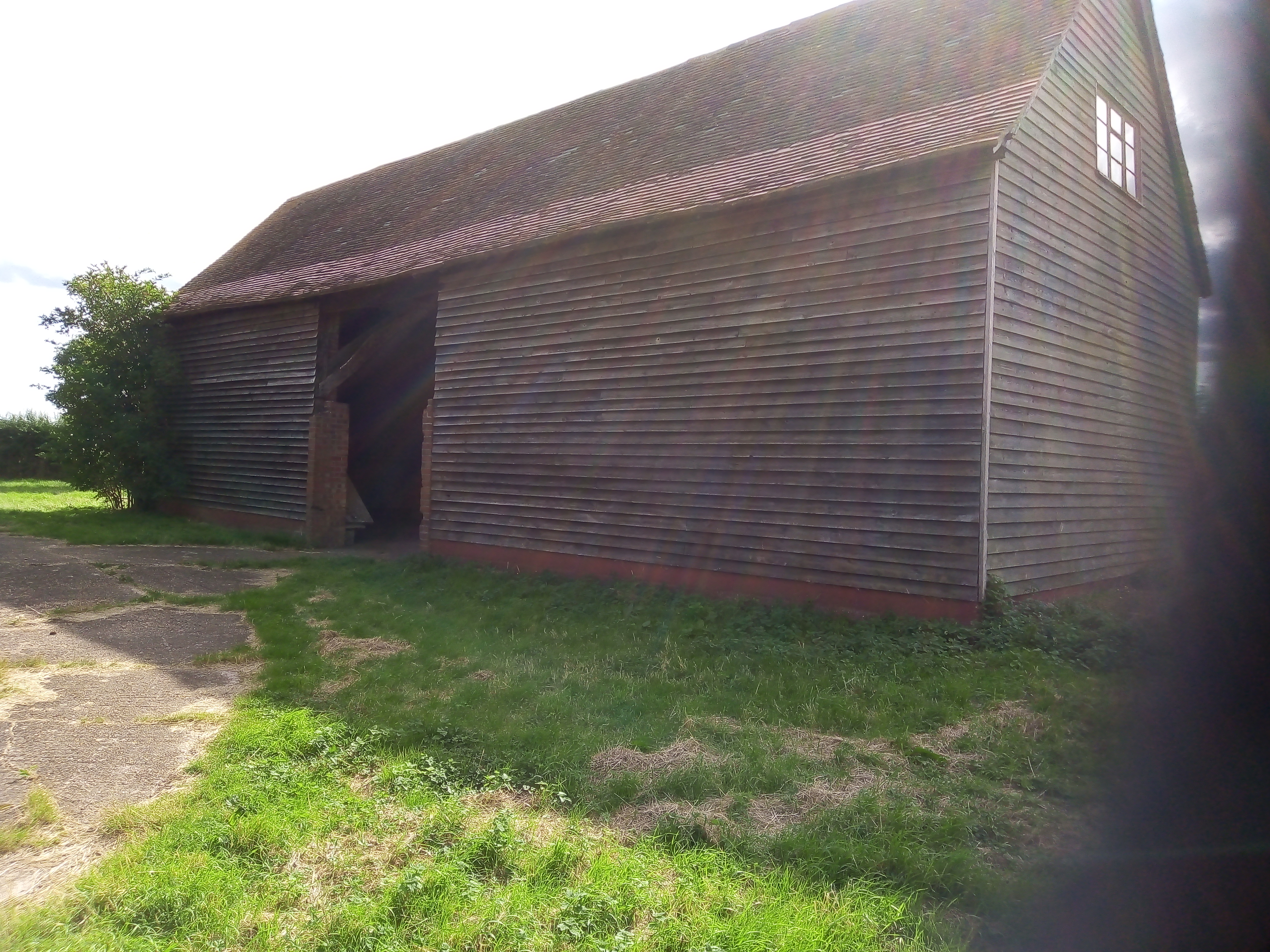
I suppose that as the work of the SOE was clandestine and shrouded in secrecy it should have come as no surprise that the SOE Barn would be less than easy to find. My brother typed the Post Code into his sat nav and we started the journey from his home nearby. There were no helpful signs giving any clue as to its position before we fetched up in the village of Tempsford. A look around the village revealed no helpful signs either. The first people we asked were not local luckily a man walking his dog knew of the barn and gave us instructions on how to find it back the way we came, a pull in off the road before the railway crossing a sort of semi layby.
We passed through a metal gate and walked along a concrete path that could have been part of the perimeter track of the old aerodrome, after walking for some time with no sight of the barn it seemed that this wasn’t the way after all. We were on the point of turning back to retrace our steps when a young couple approached from behind we waited for them and asked if they knew where the barn was and for directions. They told us the path was the correct one and offered to show us where the barn was, an offer eagerly accepted.
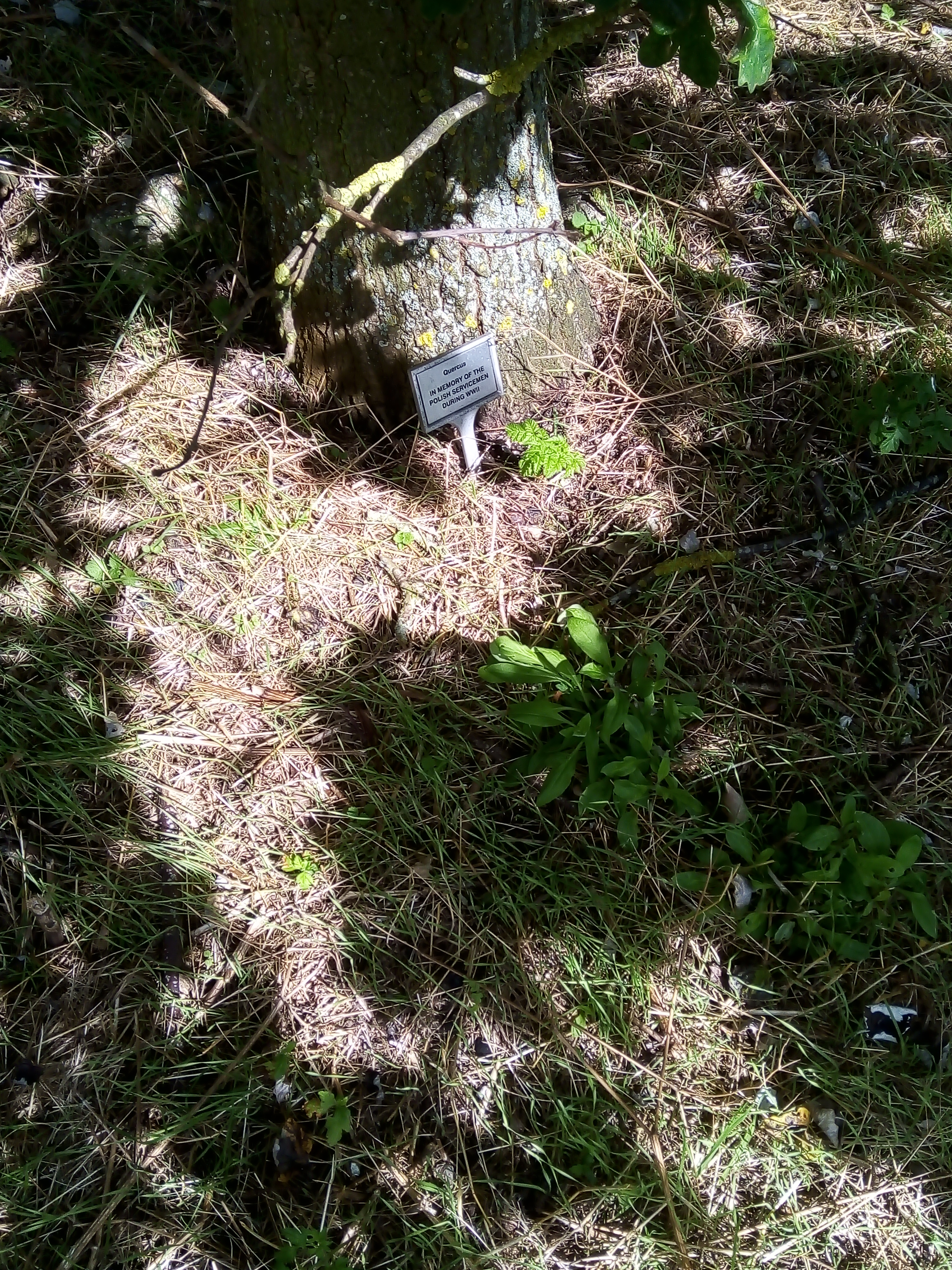
A simple memorial outside the barn. Planted next to an Oak tree it reads in memory of the Polish Servicemen in WW2
Inside the Barn
In remembrance
The Barn was a surprise with nothing on it to mark it out there was no door and you could walk straight in. There were a few trees in the grounds with memorial plaques. Inside much of the wall space at a lower level housed wreaths and photos commemorating some of those passing through here, many of them didn’t return. After spending some time reading the material on show and looking at the photos, we left walking the half mile back to the car.
A remembrance
A quiet, sobering place, a memorial of sorts, perhaps it could be better but possibly for the people who really matter, the relatives of those who passed through Tempsford, it is enough.
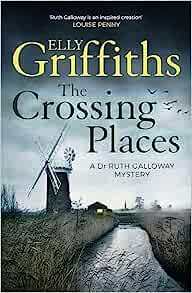
I was sorry to have missed an author event with Elly Griffiths in Huntingdon organised by Niche Comics Bookshop but it did put Elly’s name on my radar. With the name Elly Griffiths lodged firmly in what passes these days as my memory, I looked in the local library. Picking up a copy there of The Crossing Places, Elly Griffith’s first novel in the Dr. Ruth Calloway series.
Elly Griffith’s, Dr Ruth Calloway is a Forensic Archaeologist, and lecturer at the North Norfolk University. she is called in to help the police when bones of a young child are discovered buried in a salt marsh, close to Ruth’s home. The man requesting her assistance is Detective Chief Inspector Harry Nelson, a man trying to solve the mystery of a child who disappeared ten years earlier. The book is well written in as much as the characters are finely drawn and believable. The landscape and the locations are described with great skill.
However, the plot could be better. This is I understand Elly Griffiths first crime novel, I will try some of her others, to see if she has addressed, what was in my opinion a serious shortcoming.
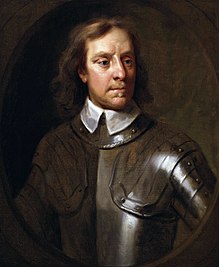
Oliver Cromwell, ‘warts and all’ painted by Samuel Cooper painted in 1656(public domain)
Oliver Cromwell is Huntingdon’s most famous son and has been voted England’s greatest man. However it is not until very recently that Huntingdon acknowledged him as a worthy citizen of the town.
It is said that it is the victors that write the history books and although Cromwell and the Puritans won the Civil War, establishing a republic for the first time in these islands, the restoration of the monarchy was ultimately a defeat. The Monarchists were the ultimate victors and until the nineteenth century Cromwell had been painted in various shades of black. It was only when historians took a more balanced view of the Civil War and Cromwell that; the acknowledgement of Cromwell’s achievements and his contribution to our parliamentary democracy became appreciated.
The restored monarchy in a very short space of time became the model offered to and rejected by Charles the first. Had he been less arrogant and accepted what was offered by Parliament, it would have saved many lives, his own included.
Back to Cromwell, he grew up and was educated in Huntingdon, he was for a time its Member of Parliament. He fell out with the town, when it became what was known as a Rotten Borough and moved to St Ives. From the time of the restoration until recently, Huntingdon wanted little to do with his memory.
All Saints Church
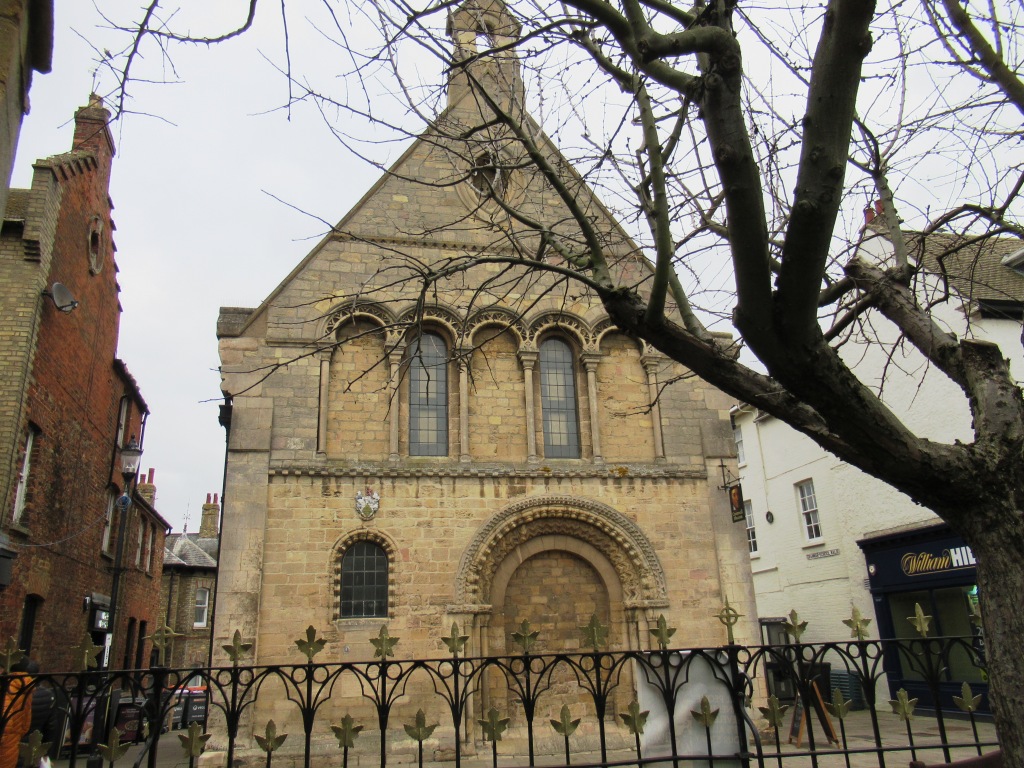
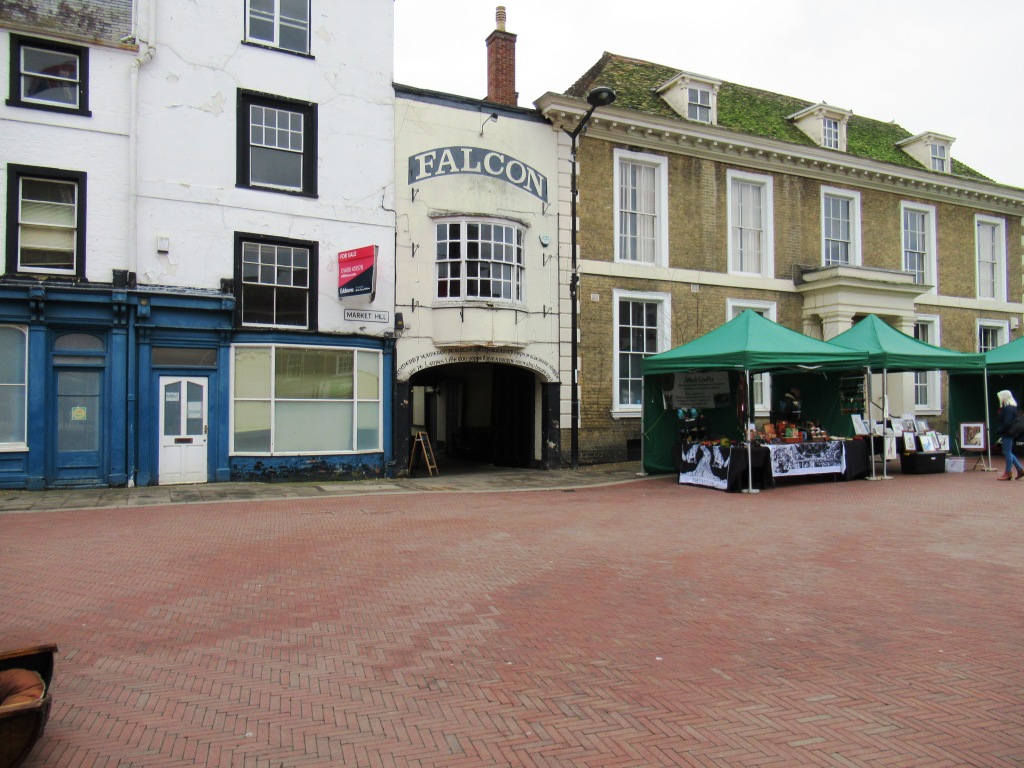
Huntingdon was in Cromwell’s time a much smaller place but then as now The Market Square is flanked on one side by All Saints Church; to the right of the church facing it from across the High Street is what was the Old Grammar School, now the Cromwell Museum. The building itself was rebuilt in the nineteenth century but where it stands is where Cromwell was educated. Opposite the museum is the Falcon Inn, the headquarters of the Parliamentary forces. Standing to the left of the Falcon and directly opposite All Saints Church is the Town Hall, in Cromwell’s time an earlier building stood on the same site.
The Old Grammar School now The Cromwell Museum
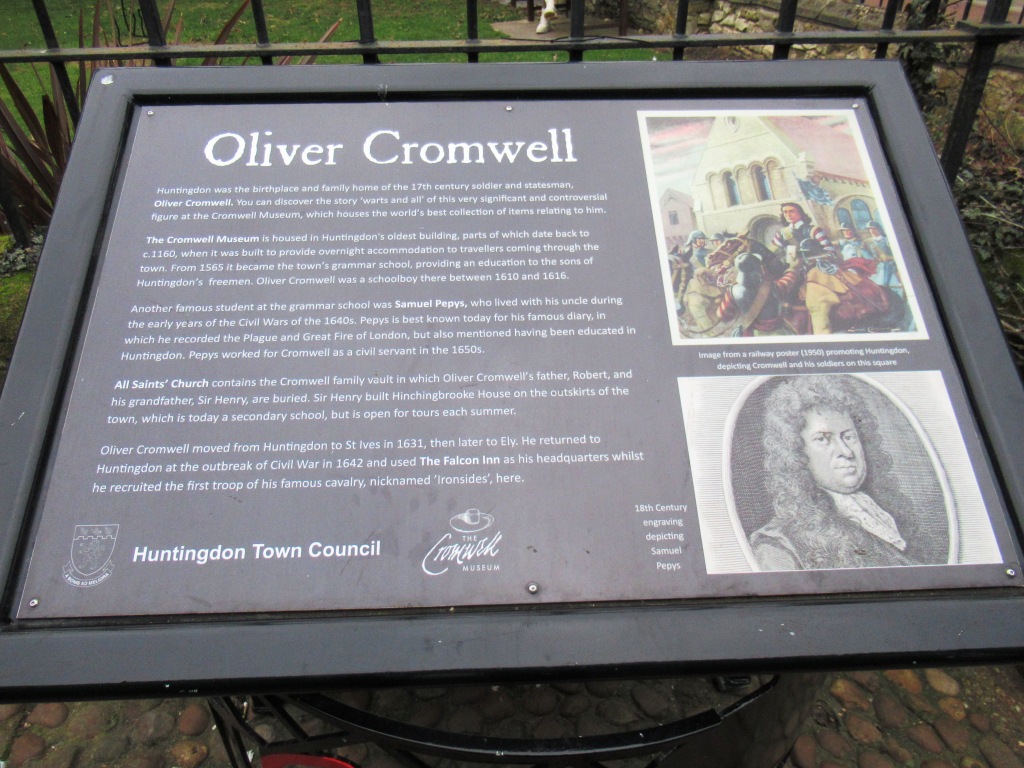
One of the signs
Such was the town’s antipathy to its favourite son that it dithered and delayed about erecting a statue of statue of the man, instead Cromwell’s statue was accepted by St Ives where it still stands.
Over the years various centenary celebrations of Cromwell were shunned by Huntingdon’s town council despite their popularity with the townsfolk and visitors but things have changed.
The Falcon
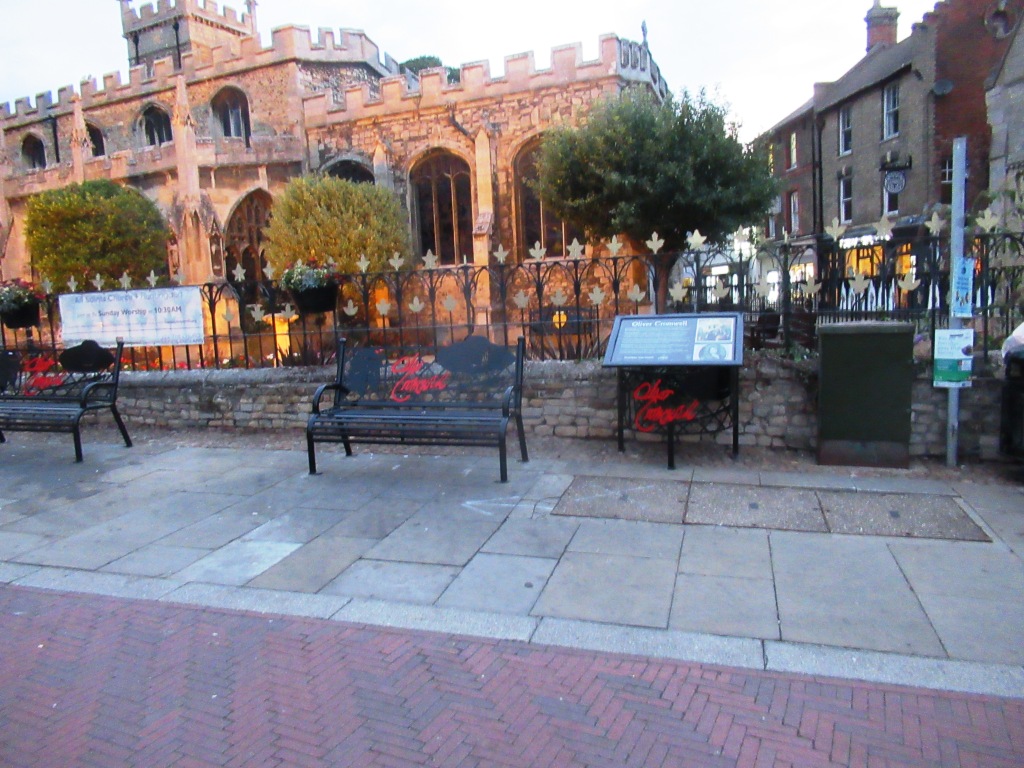
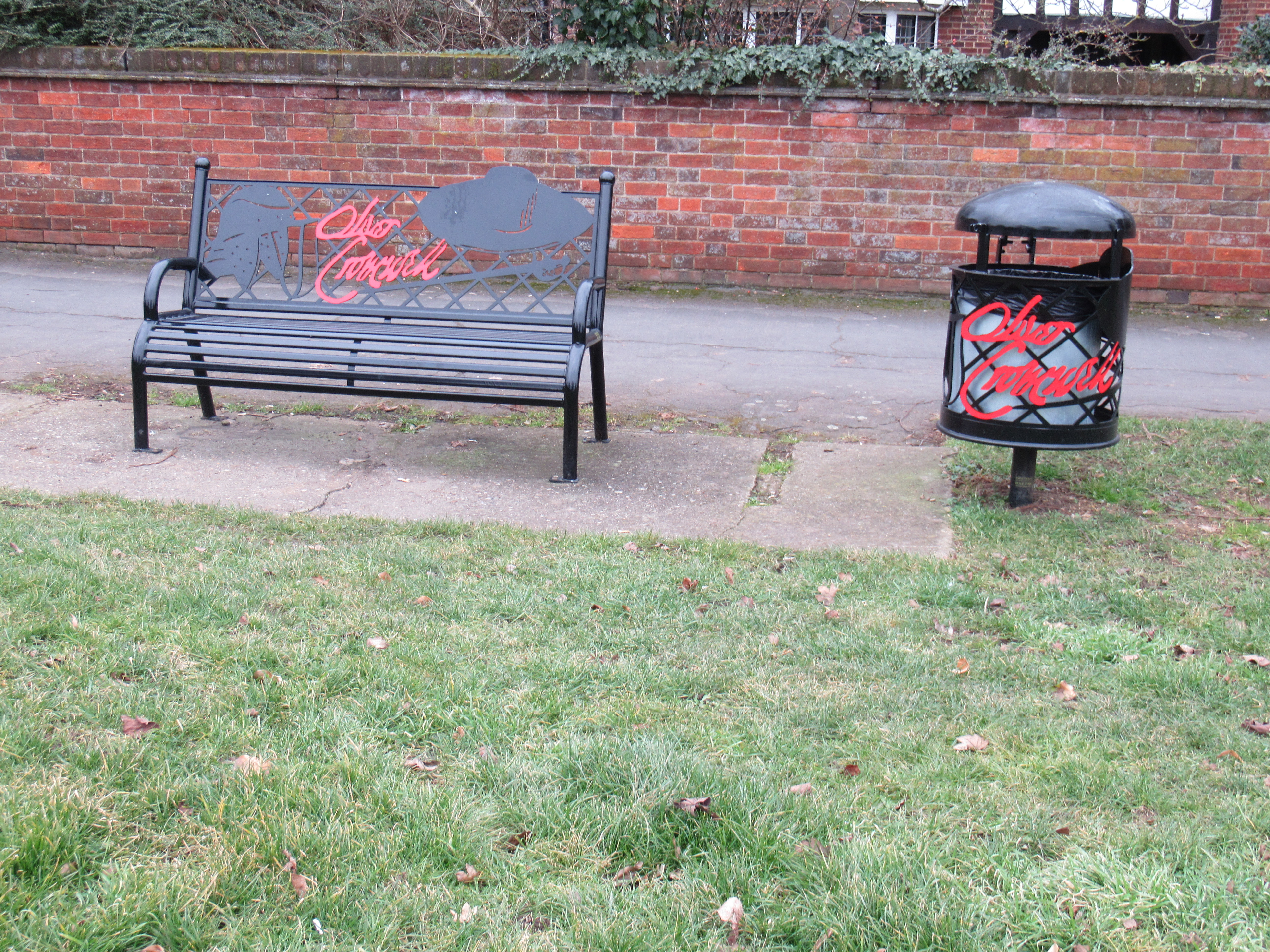
Bench and litter bin
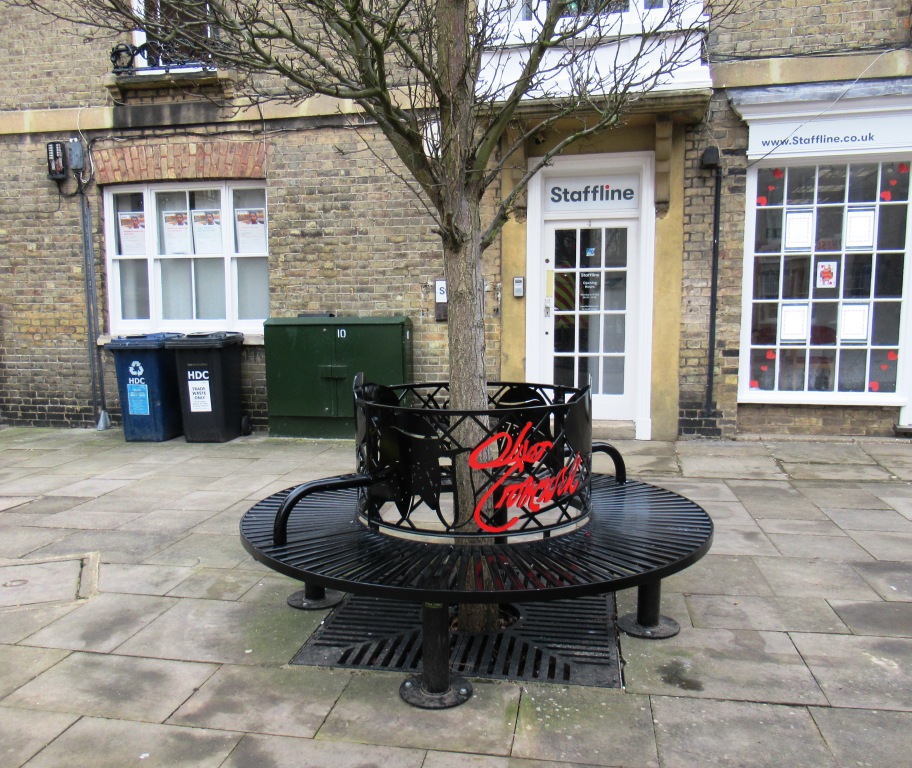
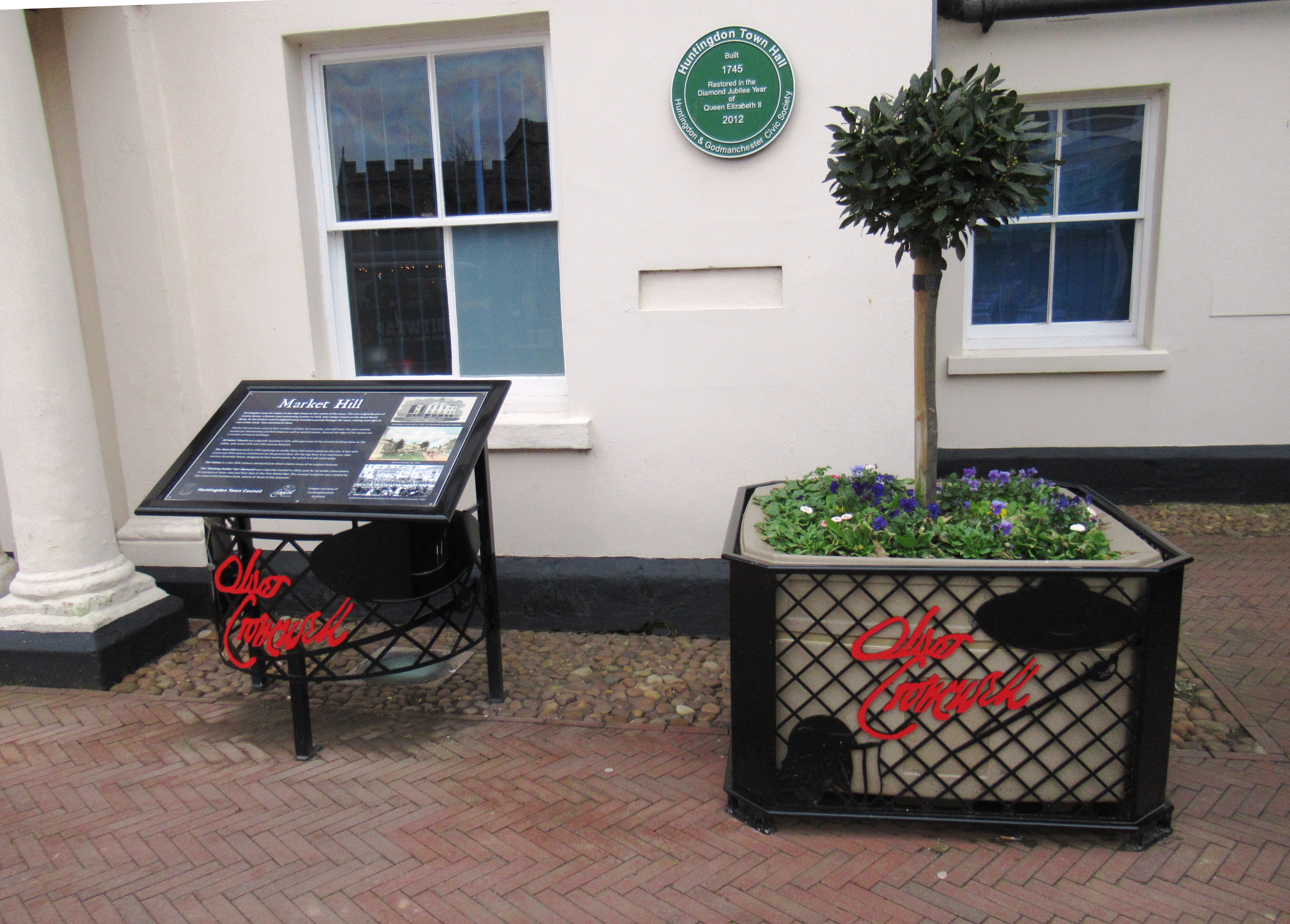
Street furniture bearing a motif of his hat, a Roundhead helmet and his signature together with commemorative information signs are in place within the market place and the surrounding streets.
Tree seat
Outside the Town Hall
Oliver, as far as Huntingdon is concerned, it seems, has come in from the cold, at last.
I can’t think of a single occasion when I have visited a book event at Huntingdon’s Commemoration Hall and left empty handed.
The Book Bank and similar book related events are hosted by Niche Comics and Books of Huntingdon, it was at a recent event that I came away with “Missing, Presumed”, written by Susie Steiner.
Angela Mackey, of said Niche Comics told me that the book was set in Huntingdon.
I bore my purchase home and have now finally got around to reading it.
I think knowing the area identifying the streets and places adds a little more to the story, it does for me and I have had similar comments from those readers familiar with Cambridge about my book.
Susie Steiner’s story is of a young woman, whose disappearance, is discovered by her boyfriend. An open door a trail of blood, her clothing and mobile phone left behind in their house, prompts fears for her safety. DS Mannon Bradshaw, DI Harriet Harper and their team struggle to make headway in the search for famous surgeon Sir. Ian Hinds’, daughter Edith.
This is a fascinating story, the plot moves in different directions as new threads are woven into its fabric.
All the time the team are coping with their own problems, within their relationships and families.
A tale of secrets, fragile lives, deception and families under stress, the end is unexpected and satisfying.
Susie Steiner
I learned from Angela that Susie Steiner was no longer with us having died of brain cancer in July 2022 at the tragically young age of 51.
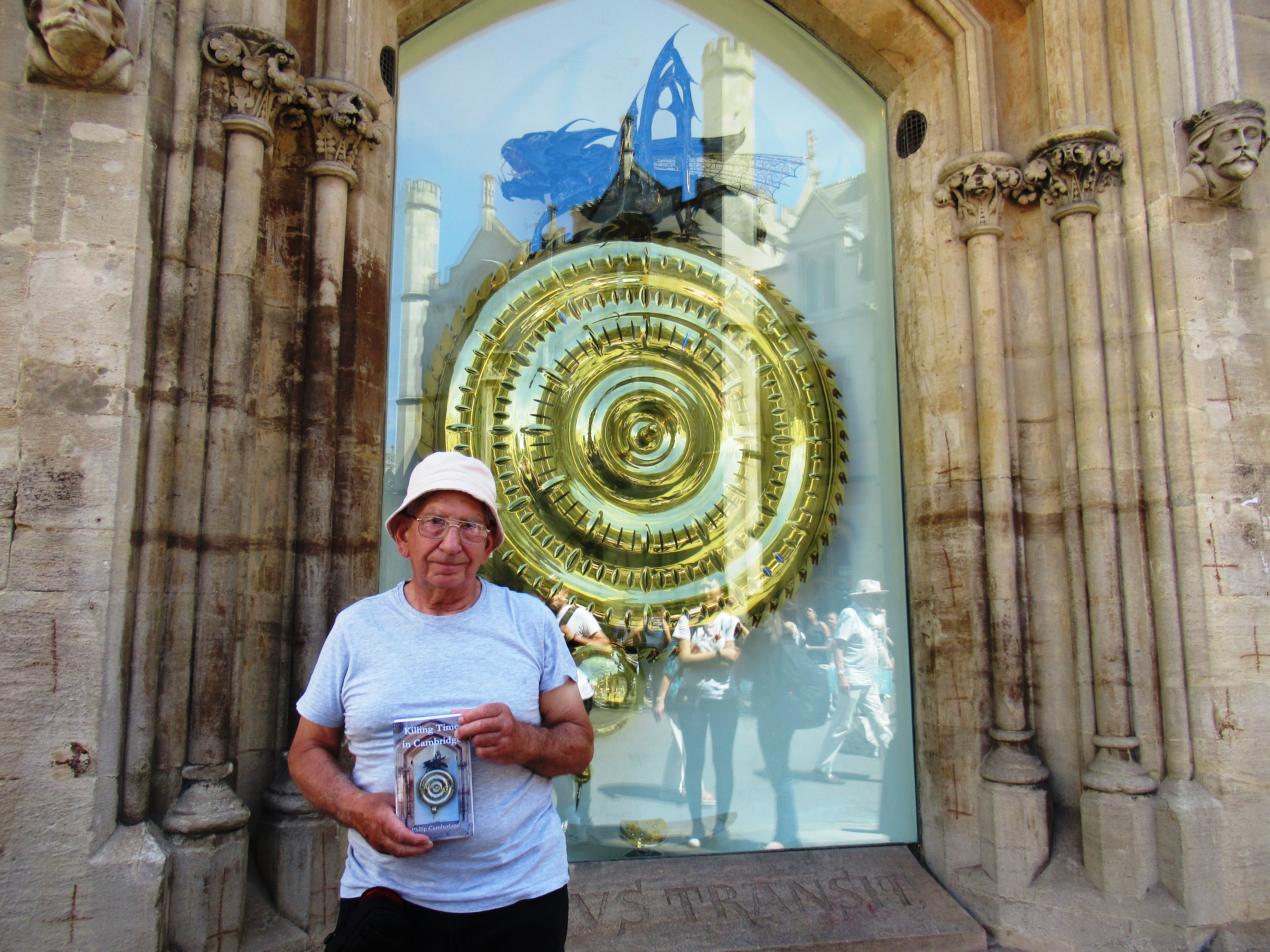
Me with my book, Killing Time in Cambridge with the Grasshopper Chronophage at Corpus Christi College Cambridge
I was given the opportunity to talk about writing and my novel twice during this last week. On Tuesday I was invited to speak at a local Women’s Institute meeting and on Thursday at The August Book Bank event at Huntingdon’s Commemoration Hall.
I haven’t spoken in public for a very long time and then it was only once. I can’t even remember what the talk was about.
It was very kind of both the Whittlesey Women’s Institute (W I) and Niche Comics and Books in Huntingdon to invite me.
I was able to tell the attentive W I audience about the tremendous help and collaborative effort of the u3a Whittlesey Wordsmiths, to which I belong. The group encourages its members to write, help hone their skills and see their work in print and published. It is the mutual support and collaboration that has helped all of us within the group to succeed, including me.
The W I audience was engaging and their questions were interesting.
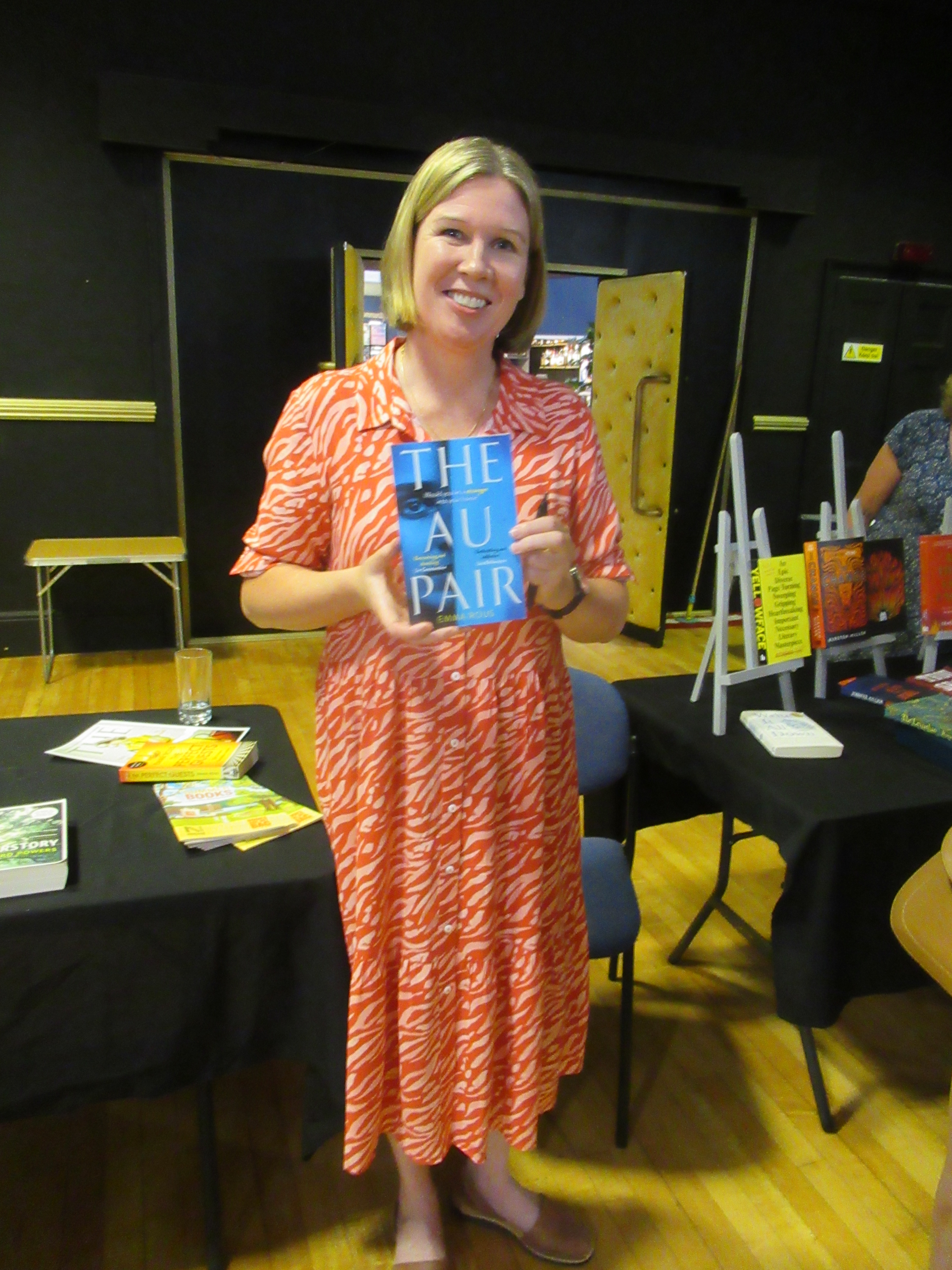
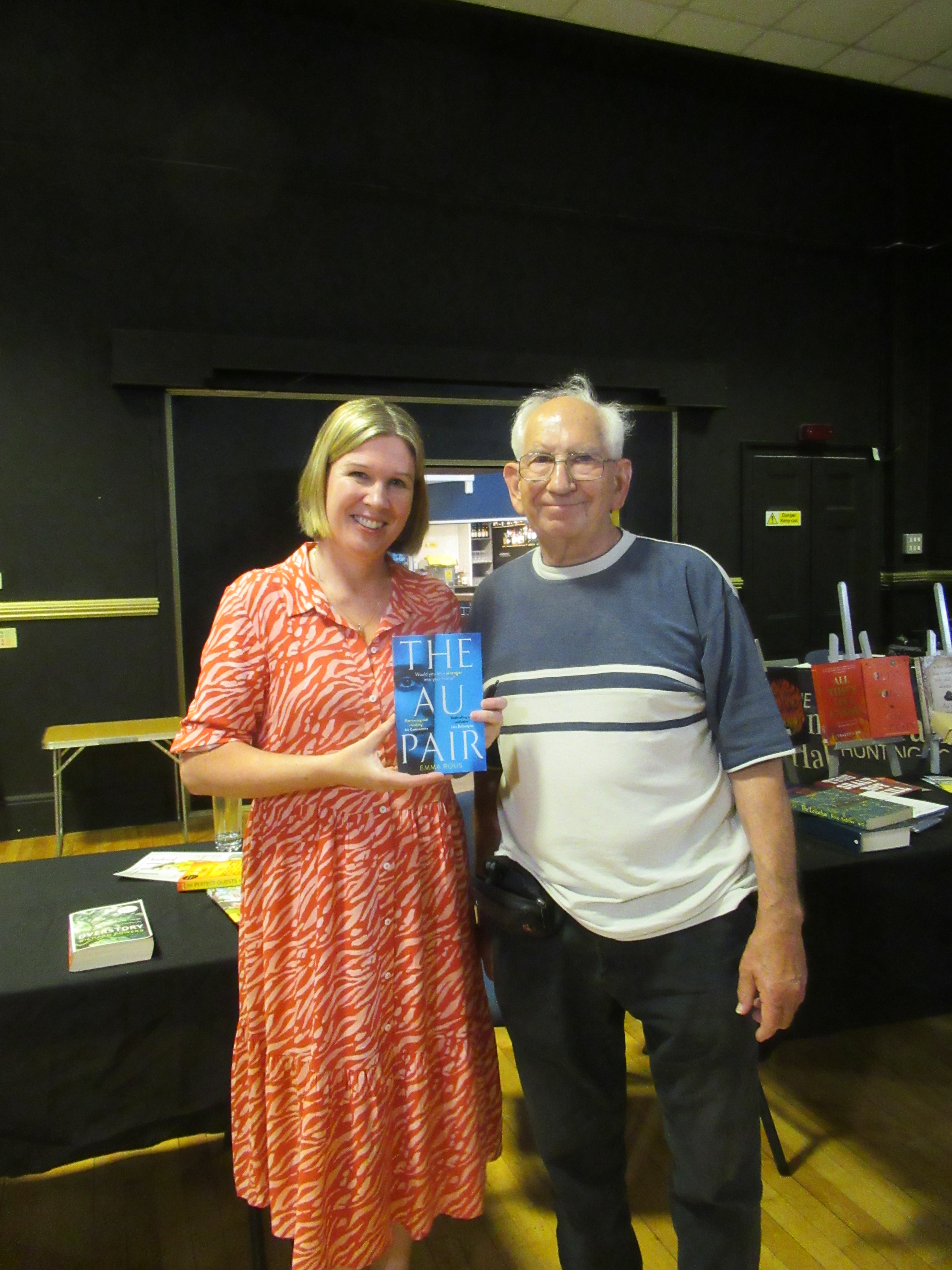
Best-selling author Emma Rous with her first novel The Au Pair
At, Huntingdon I was invited to give a short talk to an audience which included the best-selling author Emma Rous, about my book Killing Time in Cambridge. I was invited to read a well-received short extract. After other members of the audience shared experiences of their recent reading the local best-selling author, Emma Rous spoke to us about her writing. She spoke about the decision to give up her profession as a vet to pursue her writing career. By coincidence we both worked at Ramsey, Emma leaving her job as a vet and me retiring in the same year.
It was an interesting talk, Emma gave us insights into the world of professional publishing, explaining the methods and processes of a major publishing house. The changes in titles and cover designs to suit different markets and countries were an eye-opener. The examples on display were remarkable both in variety and concept. The thinking behind the different designs was prompted by serious market research and knowledge of different markets. She also mentioned the willingness of other authors to help and support one another, something even with my limited experience I have found to be the case.
When I spoke to Emma afterwards she told me she enjoyed the piece from my book that I had read aloud to the audience.
We share a love of the Fen country, in particular the skies.
I enjoyed both meetings, particularly the supportive interaction from both audiences.
Thank you Whittlesey Women’s Institute and Niche Books and Comics for the opportunity to share my story.
My wife lived in Warboys before we married and her brother still continues to live there in the family home. Fairly early on in our courtship and possibly before that as a resident of Huntingdon I was aware of the phrase the Witches of Warboys, I knew nothing of them other than that.
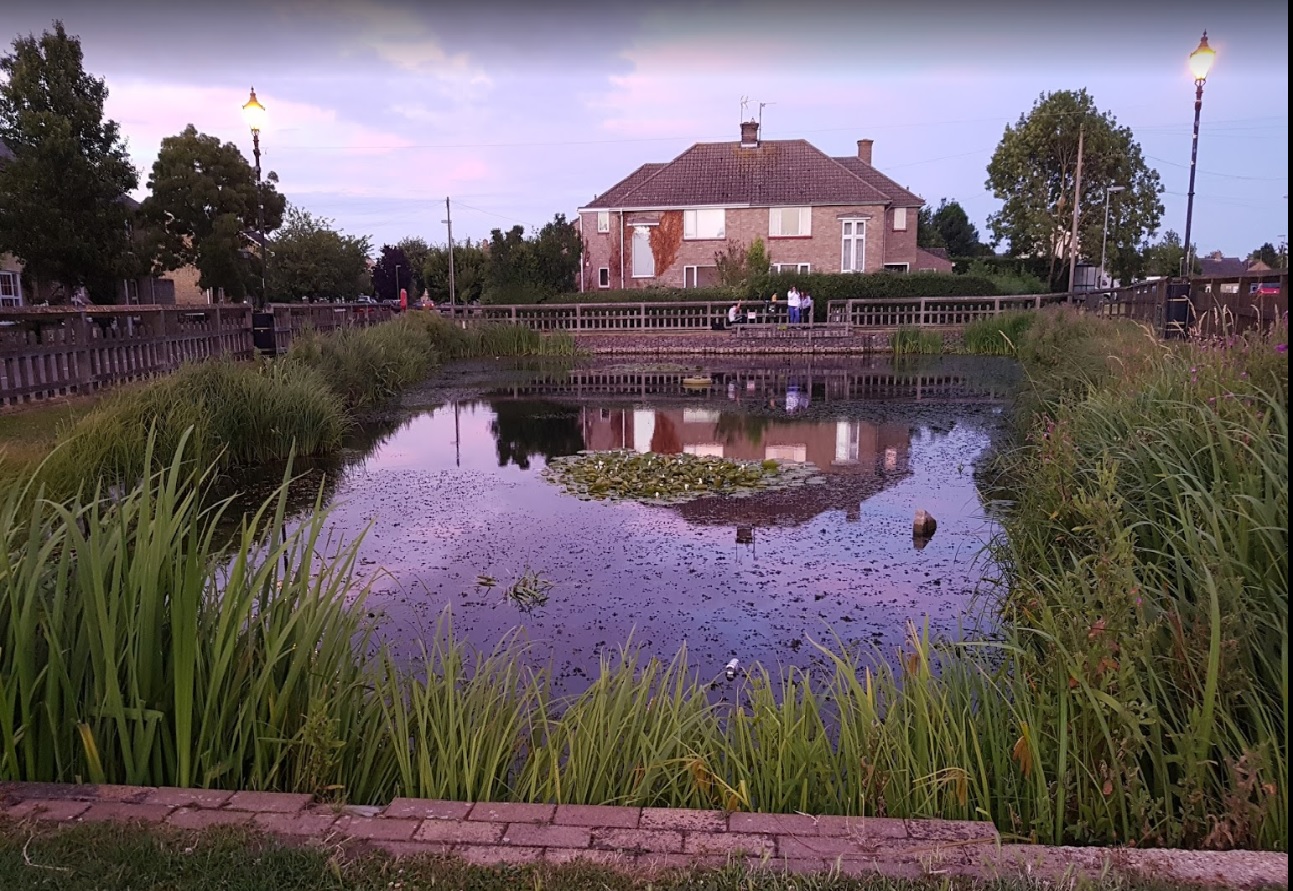
There was and is a pond in the centre of the village at the fork of the roads High Street and Mill Green it is called the Weir (pronounced ware). Popular legend suggests this is where the witches were tried for witchcraft and then drowned. The early method of determining guilt for witchcraft:
*It was a popular belief that a witch could not sink if submersed in water. Suspected witches were put through a process called “swimming” or “floating.” The victim’s left hand was tied to her right foot, and her right hand was secured to her left foot before she was thrown into a body of water. It was believed that the innocent would sink while the guilty remained afloat. Sometimes a rope was fastened around the suspect’s middle in case she proved her innocence by sinking beneath the water. Both the Church and the courts of law disapproved this method of proving guilt, but it was still practiced throughout England (Holmes 137).
The Weir at Warboys as it is now (photo credit Robert Hogg)
This wasn’t the case with the trial of 76 year old Alice Samuel, her husband John and her daughter Agnes.
Alice’s accuser was initially Jane (possibly Joan by some accounts) Throckmorton the 9 year old daughter of the Squire Robert Throckmorton. In November 1589 Jane accused Alice of causing her to suffer fits, Jane’s four sisters and some of the family’s servants began exhibiting similar symptoms. When Alice Samuel was brought to see the children their illness became worse and they had the urge to scratch her.
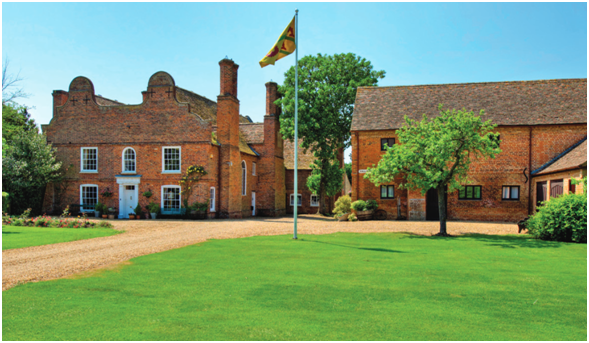
Robert Throckmorton was a close friend of Sir Henry Cromwell one of the wealthiest men in the country at that time and grandfather of Oliver Cromwell. Lady Cromwell visited the Throckmorton household in March 1590, whilst there she interviewed Alice Samuel at the family home the Manor House in Warboys. The interview served to confirm as far as Lady Cromwell was concerned the suspicions the Throckmortons had of Alice Samuel. During the interview, Lady Cromwell cut a lock of Alice’s hair and gave it to Mrs Throckmorton to burn, (a folk remedy believed to weaken the power of a witch).
Lady Cromwell was tormented by Alice Samuel in her dreams and later was taken ill and died (she was buried in 1592). This death and the events in Warboys were enough apperent proof to put Alice and her family on trial for Witchcraft
The Manor House at Warboys (Estate Agents photo Fine and Country)
From Wikipedia:
The Throckmorton family
“The first allegations declaring Alice as a practitioner of witchcraft were made in November 1589. Following this, there were a total of twelve maid-servants of the Throckmorton household (in addition to the five daughters) who experienced fits and the torment of Alice Samuell’s witchcraft. Jane’s fits were described as such: “Sometimes she would neese [sneeze] very loud and thick for the space of half an hour together; and evidently as one in a great trance and sound lay quietly as long, soon after would begin to swell and heave up her belly so as none was able to bend her or keep her down, sometime thee would shake one leg and no other part of her, as if the palsie had been in it, sometimes the other, presently she would shake one of her arms and then the other, and soon after her head as if she had with the running palsie”.
Jane’s mother and grandmother were by the child’s side while other neighbors came to see her. When Alice Samuel came in, the child proclaimed: “Grandmother look where the old witch sitteth (pointing to Samuell) did you ever see one more like a witch than she is: Take off her black thrumbed [shaggy or fringed] cap, for I cannot abide to look on her”. Jane’s mother thought nothing of this at first, thinking her child was sleep deprived and sick. However, because Jane continued to get worse, her parents sent her urine to Doctor Barrow of Cambridge, who sent medicine to Jane three separate times thinking it would heal her. It did not. After the third time, the Doctor inquired whether there were any signs of sorcery or witchcraft involved that the parents could see. Jane’s urine was then sent to a family acquaintance, Master Butler, for examination and he sent back the same remedies that Doctor Barrow had sent. Exactly a month later, on the same day almost to the hour, two more of Master Throckmorton’s daughters fell sick to the same illness that was afflicting Jane
These daughters, two to three years older than Jane, cried out: “Take her away, look where she standeth here before us in a black thrumbed cap it is she that hath bewitched us and she will kill us if you do not take her away”.
The parents were then worried, but could not understand why any such harm would come to them, for they had only moved into the town the “Michaelmas before” (September 29, 1588). Their youngest daughter, nine years old, fell sick less than a month later. Soon after this, the oldest daughter, fifteen years old, fell sick. She was sickest out of the five. Both cried out against Alice Samuell. Their eldest sister, had been the strongest, strived with the spirit, and was grievously tortured not being able to overcome it. This caused her to “(neefe), screech and groan very fearfully, sometimes it would heave up her belly and bounce up her body with such violence that she was not kept upon her bed”. When sitting in a chair, her fits often caused her to break that chair.
The daughters could not see, hear or feel while in these fits. They accused Mother Samuel, asking for her to be taken away. These fits would sometimes last for half a day and happened up to six or seven times a day. They believed that God freed them of this sorcery and afterwards, the sisters remembered nothing of what they had been saying. “
Following the death of Lady Cromwell in 1592 Alice Samuel was interviewed by a local clergyman she confessed to being a witch but withdrew her confession the next day, later she was interviewed by the Bishop of Lincoln and she confessed to him. She was imprisoned in Huntingdon together with her daughter and husband. The family were tried in April 1593 for the murder of Lady Cromwell by witchcraft. Alice’swords to Lady Cromwell,
“Madam, why do you use me thus? I never did you any harm as yet”, were used against her at the trial. All three were found guilty and hanged.
Following her execution, the hangman and his wife examined Alice’s body and found a witches mark, the so called third nipple, a teat like growth on the pendula. This was taken as proof of guilt.
There seems to be no apparent motive behind the actions attributed to Alice Samuel’s actions in relationship to the Throckmortons. Lady Cromwells’s assault on Alice could be said to be a motive but without the Throckmorton incidents Lady Cromwell wouldn’t have been involved.
Agnes during the trial ended Jane’s (Joan’s)fits by commanding the devil to leave her. She (Agnes) also adimitted she was a witch and was complicit in the murder of Lady Cromwell.
The fens at that time were a strange place, getting around was either by boat, horse or on foot. The watery landscape was a place of mists will o’ the wisps, strange lights and suddden unexplained disappearances, the threat of disease too was never far away. Herbal remedies were for most people the only medicines available, opium poppies were grown widely, the opium produced was used for treating the symptoms of amongst other things the Ague. There is a fine line between those making and supplying medicines and those thought to be involved in witchraft, particularly in a time of ignorance and superstition.











 Fenlandphil's Blog